NOW THAT ITS namesake year has come and gone, the movie 2001: A Space Odyssey provides an opportunity to measure imagination against reality. Arthur C. Clarke’s 1968 sci-fi classic traced out the destiny of our species from ape-men on the savanna to a transcendence of time, space, and bodies that we can only dimly comprehend. Clarke and the director, Stanley Kubrick, contrived a radical vision of life in the third millennium, and in some ways it has come to pass. A permanent space station is being built, and voice mail and the Internet are a routine part of our lives. In other regards Clarke and Kubrick were overoptimistic about the march of progress. We still don’t have suspended animation, missions to Jupiter, or computers that read lips and plot mutinies. And in still other regards they missed the boat completely. In their vision of the year 2001, people recorded their words on typewriters; Clarke and Kubrick did not anticipate word processors or laptop computers. And in their depiction of the new millennium, the American women were “girl assistants”: secretaries, receptionists, and flight attendants.
That these visionaries did not anticipate the revolution in women’s status of the 1970s is a pointed reminder of how quickly social arrangements can change. It was not so long ago that women were seen as fit only to be housewives, mothers, and sexual partners, were discouraged from entering the professions because they would be taking the place of a man, and were routinely subjected to discrimination, condescension, and sexual extortion. The ongoing liberation of women after millennia of oppression is one of the great moral achievements of our species, and I consider myself fortunate to have lived through some of its major victories.
The change in the status of women has several causes. One is the inexorable logic of the expanding moral circle, which led also to the abolition of despotism, slavery, feudalism, and racial segregation. 1 In the midst of the Enlightenment, the early feminist Mary Astell (1688–1731) wrote:
If absolute Sovereignty be not necessary in a State how comes it to be so in a Family? or if in a Family why not in a State? since no reason can be alleg’d for the one that will not hold more strongly for the other.
If all Men are born free, how is it that all Women are born slaves? As they must be if the being subjected to the inconstant, uncertain, unknown, arbitrary Will of Men, be the perfect Condition of Slavery? 2
Another cause is the technological and economic progress that made it possible for couples to have sex and raise children without a pitiless division of labor in which a mother had to devote every waking moment to keeping the children alive. Clean water, sanitation, and modern medicine lowered infant mortality and reduced the desire for large broods of children. Baby bottles and pasteurized cow’s milk, and then breast pumps and freezers, made it possible to feed babies without their mothers being chained to them around the clock. Mass production made it cheaper to buy things than to make them by hand, and plumbing, electricity, and appliances reduced the domestic workload even more. The increased value of brains over brawn in the economy, the extension of the human lifespan (with the prospect of decades of life after childrearing), and the affordability of extended education changed the values of women’s options in life. Contraception, amniocentesis, ultrasound, and reproductive technologies made it possible for women to defer childbearing to the optimal points in their lives.
And of course the other major cause of women’s progress is feminism: the political, literary, and academic movements that channeled these advances into tangible changes in policies and attitudes. The first wave of feminism, bookended in the United States by the Seneca Falls convention of 1848 and the ratification of the Nineteenth Amendment to the Constitution in 1920, gave women the right to vote, to serve as jurors, to hold property in marriage, to divorce, and to receive an education. The second wave, flowering in the 1970s, brought women into the professions, changed the division of labor in the home, exposed sexist biases in business, government, and other institutions, and threw a spotlight on women’s interests in all walks of life. The recent progress in women’s rights has not drained feminism of its raison d’ětre. In much of the Third World, women’s position has not improved since the Middle Ages, and in our own society women are still subjected to discrimination, harassment, and violence.
Feminism is widely seen as being opposed to the sciences of human nature. Many of those scientists believe that the minds of the two sexes differ at birth, and feminists have pointed out that such beliefs have long been used to justify the unequal treatment of women. Women were thought to be designed for childrearing and home life and to be incapable of the reason necessary for politics and the professions. Men were believed to harbor irresistible urges that made them harass and rape women, and that belief served to excuse the perpetrators and to license fathers and husbands to control women in the guise of protecting them. Therefore, it might seem, the theories that are most friendly to women are the Blank Slate—if nothing is innate, differences between the sexes cannot be innate—and the Noble Savage—if we harbor no ignoble urges, sexual exploitation can be eliminated by changing our institutions.
The belief that feminism requires a blank slate and a noble savage has become a powerful impetus for spreading disinformation. A 1994 headline in the New York Times science section, for example, proclaimed, “Sexes Equal on South Sea Isle.” 3 It was based on the work of the anthropologist Maria Lepowsky, who (perhaps channeling the ghost of Margaret Mead) said that gender relations on the island of Vanatinai prove that “the subjugation of women by men is not a human universal, and it is not inevitable.” Only late in the story do we learn what this supposed “equality” amounts to: that men must do bride service to pay for wives, that warfare had been waged exclusively by men (who raided neighboring islands for brides), that women spend more time caring for children and sweeping up pig excrement, and that men spend more time building their reputations and hunting wild boar (which is accorded more prestige by both sexes). A similar disconnect between headline and fact appeared in a 1998 Boston Globe story entitled “Girls Appear to Be Closing Aggression Gap with Boys.” How much have they “closed this gap”? According to the story, they now commit murder at one-tenth the rate of boys. 4 And in a 1998 op-ed, the co-producer of Ms. magazine’s “Take Our Daughters to Work Day” explained recent high school shootings with the remarkable assertion that boys in America “are being trained by their parents, other adults, and our culture and media to harass, assault, rape, and murder girls.” 5
On the other side, some conservatives are confirming feminists’ worst fears by invoking dubious sex differences to condemn the choices of women. In a Wall Street Journal editorial, the political scientist Harvey Mansfield wrote that “the protective element of manliness is endangered by women having equal access to jobs outside the home.” 6 A book by F. Carolyn Graglia called Domestic Tranquility: A Brief Against Feminism theorized that women’s maternal and sexual instincts are being distorted by the assertiveness and analytical mind demanded by a career. The journalists Wendy Shalit and Danielle Crittenden recently advised women to marry young, postpone their careers, and care for children in traditional marriages, even though they could not have written their books if they had followed their own advice. 7 Leon Kass has taken it upon himself to inform young women what they want: “For the first time in human history, mature women by the tens of thousands live the entire decade of their twenties—their most fertile years—neither in the homes of their fathers nor in the homes of their husbands; unprotected, lonely, and out of sync with their inborn nature. Some women positively welcome this state of affairs, but most do not.” 8
There is, in fact, no incompatibility between the principles of feminism and the possibility that men and women are not psychologically identical. To repeat: equality is not the empirical claim that all groups of humans are interchangeable; it is the moral principle that individuals should not be judged or constrained by the average properties of their group. In the case of gender, the barely defeated Equal Rights Amendment put it succinctly: “Equality of Rights under the law shall not be denied or abridged by the United States or any state on account of sex.” If we recognize this principle, no one has to spin myths about the indistinguishability of the sexes to justify equality. Nor should anyone invoke sex differences to justify discriminatory policies or to hector women into doing what they don’t want to do.
In any case, what we do know about the sexes does not call for any action that would penalize or constrain one sex or the other. Many psychological traits relevant to the public sphere, such as general intelligence, are the same on average for men and women, and virtually all psychological traits may be found in varying degrees among the members of each sex. No sex difference yet discovered applies to every last man compared with every last woman, so generalizations about a sex will always be untrue of many individuals. And notions like “proper role” and “natural place” are scientifically meaningless and give no grounds for restricting freedom.
Despite these principles, many feminists vehemently attack research on sexuality and sex differences. The politics of gender is a major reason that the application of evolution, genetics, and neuroscience to the human mind is bitterly resisted in modern intellectual life. But unlike other human divisions such as race and ethnicity, where any biological differences are minor at most and scientifically uninteresting, gender cannot possibly be ignored in the science of human beings. The sexes are as old as complex life and are a fundamental topic in evolutionary biology, genetics, and behavioral ecology. To disregard them in the case of our own species would be to make a hash of our understanding of our place in the cosmos. And of course differences between men and women affect every aspect of our lives. We all have a mother and a father, are attracted to members of the opposite sex (or notice our contrast with the people who are), and are never unaware of the sex of our siblings, children, and friends. To ignore gender would be to ignore a major part of the human condition.
The goal of this chapter is to clarify the relation between the biology of human nature and current controversies on the sexes, including the two most incendiary, the gender gap and sexual assault. With both of these hot buttons, I will argue against the conventional wisdom associated with certain people who claim to speak on behalf of feminism. That may create an illusion that the arguments go against feminism in general, or even against the interests of women. They don’t in the least, and I must begin by showing why.
FEMINISM IS OFTEN derided because of the arguments of its lunatic fringe—for example, that all intercourse is rape, that all women should be lesbians, or that only 10 percent of the population should be allowed to be male. 9 Feminists reply that proponents of women’s rights do not speak with one voice, and that feminist thought comprises many positions, which have to be evaluated independently. 10 That is completely legitimate, but it cuts both ways. To criticize a particular feminist proposal is not to attack feminism in general.
Anyone familiar with academia knows that it breeds ideological cults that are prone to dogma and resistant to criticism. Many women believe that this has now happened to feminism. In her book Who Stole Feminism? the philosopher Christina Hoff Sommers draws a useful distinction between two schools of thought. 11 Equity feminism opposes sex discrimination and other forms of unfairness to women. It is part of the classical liberal and humanistic tradition that grew out of the Enlightenment, and it guided the first wave of feminism and launched the second wave. Gender feminism holds that women continue to be enslaved by a pervasive system of male dominance, the gender system, in which “bi-sexual infants are transformed into male and female gender personalities, the one destined to command, the other to obey.” 12 It is opposed to the classical liberal tradition and allied instead with Marxism, postmodernism, social constructionism, and radical science. It has became the credo of some women’s studies programs, feminist organizations, and spokespeople for the women’s movement.
Equity feminism is a moral doctrine about equal treatment that makes no commitments regarding open empirical issues in psychology or biology. Gender feminism is an empirical doctrine committed to three claims about human nature. The first is that the differences between men and women have nothing to do with biology but are socially constructed in their entirety. The second is that humans possess a single social motive—power—and that social life can be understood only in terms of how it is exercised. The third is that human interactions arise not from the motives of people dealing with each other as individuals but from the motives of groups dealing with other groups—in this case, the male gender dominating the female gender.
In embracing these doctrines, the genderists are handcuffing feminism to railroad tracks on which a train is bearing down. As we shall see, neuroscience, genetics, psychology, and ethnography are documenting sex differences that almost certainly originate in human biology. And evolutionary psychology is documenting a web of motives other than group-against-group dominance (such as love, sex, family, and beauty) that entangle us in many conflicts and confluences of interest with members of the same sex and of the opposite sex. Gender feminists want either to derail the train or to have other women join them in martyrdom, but the other women are not cooperating. Despite their visibility, gender feminists do not speak for all feminists, let alone for all women.
To begin with, research on the biological basis of sex differences has been led by women. Because it is so often said that this research is a plot to keep women down, I will have to name names. Researchers on the biology of sex differences include the neuroscientists Raquel Gur, Melissa Hines, Doreen Kimura, Jerre Levy, Martha McClintock, Sally Shaywitz, and Sandra Witelson and the psychologists Camilla Benbow, Linda Gottfredson, Diane Halpern, Judith Kleinfeld, and Diane McGuinness. Sociobiology and evolutionary psychology, sometimes stereotyped as a “sexist discipline,” is perhaps the most bi-gendered academic field I am familiar with. Its major figures include Laura Betzig, Elizabeth Cashdan, Leda Cosmides, Helena Cronin, Mildred Dickeman, Helen Fisher, Patricia Gowaty, Kristen Hawkes, Sarah Blaffer Hrdy, Magdalena Hurtado, Bobbie Low, Linda Mealey, Felicia Pratto, Marnie Rice, Catherine Salmon, Joan Silk, Meredith Small, Barbara Smuts, Nancy Wilmsen Thornhill, and Margo Wilson.
It is not just gender feminism’s collision with science that repels many feminists. Like other inbred ideologies, it has produced strange excrescences, like the offshoot known as difference feminism. Carol Gilligan has become a gender-feminist icon because of her claim that men and women guide their moral reasoning by different principles: men think about rights and justice; women have feelings of compassion, nurturing, and peaceful accommodation. 13 If true, it would disqualify women from becoming constitutional lawyers, Supreme Court justices, and moral philosophers, who make their living by reasoning about rights and justice. But it is not true. Many studies have tested Gilligan’s hypothesis and found that men and women differ little or not at all in their moral reasoning. 14 So difference feminism offers women the worst of both worlds: invidious claims without scientific support. Similarly, the gender-feminist classic called Women’s Ways of Knowing claims that the sexes differ in their styles of reasoning. Men value excellence and mastery in intellectual matters and skeptically evaluate arguments in terms of logic and evidence; women are spiritual, relational, inclusive, and credulous. 15 With sisters like these, who needs male chauvinists?
Gender feminism’s disdain for analytical rigor and classical liberal principles has recently been excoriated by equity feminists, among them Jean Bethke Elshtain, Elizabeth Fox-Genovese, Wendy Kaminer, Noretta Koertge, Donna Laframboise, Mary Lefkowitz, Wendy McElroy, Camille Paglia, Daphne Patai, Virginia Postrel, Alice Rossi, Sally Satel, Christina Hoff Sommers, Nadine Strossen, Joan Kennedy Taylor, and Cathy Young. 16 Well before them, prominent women writers demurred from gender-feminist ideology, including Joan Didion, Doris Lessing, Iris Murdoch, Cynthia Ozick, and Susan Sontag. 17 And ominously for the movement, a younger generation has rejected the gender feminists’ claims that love, beauty, flirtation, erotica, art, and heterosexuality are pernicious social constructs. The title of the book The New Victorians: A Young Woman’s Challenge to the Old Feminist Order captures the revolt of such writers as Rene Denfeld, Karen Lehrman, Katie Roiphe, and Rebecca Walker, and of the movements called Third Wave, Riot Grrrl Movement, Pro-Sex Feminism, Lipstick Lesbians, Girl Power, and Feminists for Free Expression. 18
The difference between gender feminism and equity feminism accounts for the oft-reported paradox that most women do not consider themselves feminists (about 70 percent in 1997, up from about 60 percent a decade before), yet they agree with every major feminist position. 19 The explanation is simple: the word “feminist” is often associated with gender feminism, but the positions in the polls are those of equity feminism. Faced with these signs of slipping support, gender feminists have tried to stipulate that only they can be considered the true advocates of women’s rights. For example, in 1992 Gloria Steinem said of Paglia, “Her calling herself a feminist is sort of like a Nazi saying they’re not anti-Semitic.” 20 And they have invented a lexicon of epithets for what in any other area would be called disagreement: “backlash,” “not getting it,” “silencing women,” “intellectual harassment.” 21
All this is an essential background to the discussions to come. To say that women and men do not have interchangeable minds, that people have desires other than power, and that motives belong to individual people and not just to entire genders is not to attack feminism or to compromise the interests of women, despite the misconception that gender feminism speaks in their name. All the arguments in the remainder of this chapter have been advanced most forcefully by women.
WHY ARE PEOPLE so afraid of the idea that the minds of men and women are not identical in every respect? Would we really be better off if everyone were like Pat, the androgynous nerd from Saturday Night Live? The fear, of course, is that different implies unequal—that if the sexes differed in any way, then men would have to be better, or more dominant, or have all the fun.
Nothing could be farther from biological thinking. Trivers alluded to a “symmetry in human relationships,” which embraced a “genetic equality of the sexes.” 22 From a gene’s point of view, being in the body of a male and being in the body of a female are equally good strategies, at least on average (circumstances can nudge the advantage somewhat in either direction). 23 Natural selection thus tends toward an equal investment in the two sexes: equal numbers, an equal complexity of bodies and brains, and equally effective designs for survival. Is it better to be the size of a male baboon and have six-inch canine teeth or to be the size of a female baboon and not have them? Merely to ask the question is to reveal its pointlessness. A biologist would say that it’s better to have the male adaptations to deal with male problems and the female adaptations to deal with female problems.
So men are not from Mars, nor are women from Venus. Men and women are from Africa, the cradle of our evolution, where they evolved together as a single species. Men and women have all the same genes except for a handful on the Y chromosome, and their brains are so similar that it takes an eagle-eyed neuroanatomist to find the small differences between them. Their average levels of general intelligence are the same, according to the best psychometric estimates, 24 and they use language and think about the physical and living world in the same general way. They feel the same basic emotions, and both enjoy sex, seek intelligent and kind marriage partners, get jealous, make sacrifices for their children, compete for status and mates, and sometimes commit aggression in pursuit of their interests.
But of course the minds of men and women are not identical, and recent reviews of sex differences have converged on some reliable differences. 25 Sometimes the differences are large, with only slight overlap in the bell curves. Men have a much stronger taste for no-strings sex with multiple or anonymous partners, as we see in the almost all-male consumer base for prostitution and visual pornography. 26 Men are far more likely to compete violently, sometimes lethally, with one another over stakes great and small (as in the recent case of a surgeon and an anesthesiologist who came to blows in the operating room while a patient lay on the table waiting to have her gall bladder removed). 27 Among children, boys spend far more time practicing for violent conflict in the form of what psychologists genteelly call “rough-and-tumble play.” 28 The ability to manipulate three-dimensional objects and space in the mind also shows a large difference in favor of men. 29
With some other traits the differences are small on average but can be large at the extremes. That happens for two reasons. When two bell curves partly overlap, the farther out along the tail you go, the larger the discrepancies between the groups. For example, men on average are taller than women, and the discrepancy is greater for more extreme values. At a height of five foot ten, men outnumber women by a ratio of thirty to one; at a height of six feet, men outnumber women by a ratio of two thousand to one. Also, confirming an expectation from evolutionary psychology, for many traits the bell curve for males is flatter and wider than the curve for females. That is, there are proportionally more males at the extremes. Along the left tail of the curve, one finds that boys are far more likely to be dyslexic, learning disabled, attention deficient, emotionally disturbed, and mentally retarded (at least for some types of retardation). 30 At the right tail, one finds that in a sample of talented students who score above 700 (out of 800) on the mathematics section of the Scholastic Assessment Test, boys outnumber girls by thirteen to one, even though the scores of boys and girls are similar within the bulk of the curve. 31
With still other traits, the average values for the two sexes differ by smaller amounts and in different directions for different traits. 32 Though men, on average, are better at mentally rotating objects and maps, women are better at remembering landmarks and the positions of objects. Men are better throwers; women are more dexterous. Men are better at solving mathematical word problems, women at mathematical calculation. Women are more sensitive to sounds and smells, have better depth perception, match shapes faster, and are much better at reading facial expressions and body language. Women are better spellers, retrieve words more fluently, and have a better memory for verbal material.
Women experience basic emotions more intensely, except perhaps anger. 33 Women have more intimate social relationships, are more concerned about them, and feel more empathy toward their friends, though not toward strangers. (The common view that women are more empathic toward everyone is both evolutionarily unlikely and untrue.) They maintain more eye contact, and smile and laugh far more often. 34 Men are more likely to compete with one another for status using violence or occupational achievement, women more likely to use derogation and other forms of verbal aggression.
Men have a higher tolerance for pain and a greater willingness to risk life and limb for status, attention, and other dubious rewards. The Darwin Awards, given annually to “the individuals who ensure the long-term survival of our species by removing themselves from the gene pool in a sublimely idiotic fashion,” almost always go to men. Recent honorees include the man who squashed himself under a Coke machine after tipping it forward to get a free can, three men who competed over who could stomp the hardest on an antitank mine, and the would-be pilot who tied weather balloons to his lawn chair, shot two miles into the air, and drifted out to sea (earning just an Honorable Mention because he was rescued by helicopter).
Women are more attentive to their infants’ everyday cries (though both sexes respond equally to cries of extreme distress) and are more solicitous toward their children in general. 35 Girls play more at parenting and trying on social roles, boys more at fighting, chasing, and manipulating objects. And men and women differ in their patterns of sexual jealousy, their mate preferences, and their incentives to philander.
Many sex differences, of course, have nothing to do with biology. Hair styles and dress vary capriciously across centuries and cultures, and in recent decades participation in universities, professions, and sports has switched from mostly male to fifty-fifty or mostly female. For all we know, some of the current sex differences may be just as ephemeral. But gender feminists argue that all sex differences, other than the anatomical ones, come from the expectations of parents, playmates, and society. The radical scientist Anne Fausto-Sterling wrote:
The key biological fact is that boys and girls have different genitalia, and it is this biological difference that leads adults to interact differently with different babies whom we conveniently color-code in pink or blue to make it unnecessary to go peering into their diapers for information about gender. 36
But the pink-and-blue theory is becoming less and less credible. Here are a dozen kinds of evidence that suggest that the difference between men and women is more than genitalia-deep.
- Sex differences are not an arbitrary feature of Western culture, like the decision to drive on the left or on the right. In all human cultures, men and women are seen as having different natures. All cultures divide their labor by sex, with more responsibility for childrearing by women and more control of the public and political realms by men. (The division of labor emerged even in a culture where everyone had been committed to stamping it out, the Israeli kibbutz.) In all cultures men are more aggressive, more prone to stealing, more prone to lethal violence (including war), and more likely to woo, seduce, and trade favors for sex. And in all cultures one finds rape, as well as proscriptions against rape. 37
- Many of the psychological differences between the sexes are exactly what an evolutionary biologist who knew only their physical differences would predict. 38 Throughout the animal kingdom, when the female has to invest more calories and risk in each offspring (in the case of mammals, through pregnancy and nursing), she also invests more in nurturing the offspring after birth, since it is more costly for a female to replace a child than for a male to replace one. The difference in investment is accompanied by a greater competition among males over opportunities to mate, since mating with many partners is more likely to multiply the number of offspring of a male than the number of offspring of a female. When the average male is larger than the average female (as is true of men and women), it bespeaks an evolutionary history of greater violent competition by males over mating opportunities. Other physical traits of men, such as later puberty, greater adult strength, and shorter lives, also indicate a history of selection for high-stakes competition.
- Many of the sex differences are found widely in other primates, indeed, throughout the mammalian class. 39 The males tend to compete more aggressively and to be more polygamous; the females tend to invest more in parenting. In many mammals a greater territorial range is accompanied by an enhanced ability to navigate using the geometry of the spatial layout (as opposed to remembering individual landmarks). More often it is the male who has the greater range, and that is true of human hunter-gatherers. Men’s advantage in using mental maps and performing 3-D mental rotation may not be a coincidence. 40
- Geneticists have found that the diversity of the DNA in the mitochondria of different people (which men and women inherit from their mothers) is far greater than the diversity of the DNA in Y chromosomes (which men inherit from their fathers). This suggests that for tens of millennia men had greater variation in their reproductive success than women. Some men had many descendants and others had none (leaving us with a small number of distinct Y chromosomes), whereas a larger number of women had a more evenly distributed number of descendants (leaving us with a larger number of distinct mitochondrial genomes). These are precisely the conditions that cause sexual selection, in which males compete for opportunities to mate and females choose the best-quality males. 41
- The human body contains a mechanism that causes the brains of boys and the brains of girls to diverge during development. 42 The Y chromosome triggers the growth of testes in a male fetus, which secrete androgens, the characteristically male hormones (including testosterone). Androgens have lasting effects on the brain during fetal development, in the months after birth, and during puberty, and they have transient effects at other times. Estrogens, the characteristically female sex hormones, also affect the brain throughout life. Receptors for the sex hormones are found in the hypothalamus, the hippocampus, and the amygdala in the limbic system of the brain, as well as in the cerebral cortex.
- The brains of men differ visibly from the brains of women in several ways. 43 Men have larger brains with more neurons (even correcting for body size), though women have a higher percentage of gray matter. (Since men and women are equally intelligent overall, the significance of these differences is unknown.) The interstitial nuclei in the anterior hypothalamus, and a nucleus of the stria terminalis, also in the hypothalamus, are larger in men; they have been implicated in sexual behavior and aggression. Portions of the cerebral commissures, which link the left and right hemispheres, appear to be larger in women, and their brains may function in a less lopsided manner than men’s. Learning and socialization can affect the microstructure and functioning of the human brain, of course, but probably not the size of its visible anatomical structures.
- Variation in the level of testosterone among different men, and in the same man in different seasons or at different times of day, correlates with libido, self-confidence, and the drive for dominance. 44 Violent criminals have higher levels than nonviolent criminals; trial lawyers have higher levels than those who push paper. The relations are complicated for a number of reasons. Over a broad range of values, the concentration of testosterone in the bloodstream doesn’t matter. Some traits, such as spatial abilities, peak at moderate rather than high levels. The effects of testosterone depend on the number and distribution of receptors for the molecule, not just on its concentration. And one’s psychological state can affect testosterone levels as well as the other way around. But there is a causal relation, albeit a complicated one. When women preparing for a sex-change operation are given androgens, they improve on tests of mental rotation and get worse on tests of verbal fluency. The journalist Andrew Sullivan, whose medical condition had lowered his testosterone levels, describes the effects of injecting it: “The rush of a T shot is not unlike the rush of going on a first date or speaking before an audience. I feel braced. After one injection, I almost got in a public brawl for the first time in my life. There is always a lust peak—every time it takes me unaware.” 45 Though testosterone levels in men and women do not overlap, variations in level have similar kinds of effects in the two sexes. High-testosterone women smile less often and have more extramarital affairs, a stronger social presence, and even a stronger handshake.
- Women’s cognitive strengths and weaknesses vary with the phase of their menstrual cycle. 46 When estrogen levels are high, women get even better at tasks on which they typically do better than men, such as verbal fluency. When the levels are low, women get better at tasks on which men typically do better, such as mental rotation. A variety of sexual motives, including their taste in men, vary with the menstrual cycle as well. 47
- Androgens have permanent effects on the developing brain, not just transient effects on the adult brain. 48 Girls with congenital adrenal hyperplasia overproduce androstenedione, the androgen hormone made famous by the baseball slugger Mark McGwire. Though their hormone levels are brought to normal soon after birth, the girls grow into tomboys, with more rough-and-tumble play, a greater interest in trucks than dolls, better spatial abilities, and, when they get older, more sexual fantasies and attractions involving other girls. Those who are treated with hormones only later in childhood show male patterns of sexuality when they become young adults, including quick arousal by pornographic images, an autonomous sex drive centered on genital stimulation, and the equivalent of wet dreams. 49
- The ultimate fantasy experiment to separate biology from socialization would be to take a baby boy, give him a sex-change operation, and have his parents raise him as a girl and other people treat him as one. If gender is socially constructed, the child should have the mind of a normal girl; if it depends on prenatal hormones, the child should feel like a boy trapped in a girl’s body. Remarkably, the experiment has been done in real life—not out of scientific curiosity, of course, but as a result of disease and accidents. One study looked at twenty-five boys who were born without a penis (a birth defect known as cloacal exstrophy) and who were then castrated and raised as girls. All of them showed male patterns of rough-and-tumble play and had typically male attitudes and interests. More than half of them spontaneously declared they were boys, one when he was just five years old.
50
In a famous case study, an eight-month-old boy lost his penis in a botched circumcision (not by a mohel, I was relieved to learn, but by a bungling doctor). His parents consulted the famous sex researcher John Money, who had maintained that “Nature is a political strategy of those committed to maintaining the status quo of sex differences.” He advised them to let the doctors castrate the baby and build him an artificial vagina, and they raised him as a girl without telling him what had happened. 51 I learned about the case as an undergraduate in the 1970s, when it was offered as proof that babies are born neuter and acquire a gender from the way they are raised. A New York Times article from the era reported that Brenda (née Bruce) “has been sailing contentedly through childhood as a genuine girl.” 52 The facts were suppressed until 1997, when it was revealed that from a young age Brenda felt she was a boy trapped in a girl’s body and gender role. 53 She ripped off frilly dresses, rejected dolls in favor of guns, preferred to play with boys, and even insisted on urinating standing up. At fourteen she was so miserable that she decided either to live her life as a male or to end it, and her father finally told her the truth. She underwent a new set of operations, assumed a male identity, and today is happily married to a woman.
- Children with Turner’s syndrome are genetically neuter. They have a single X chromosome, inherited from either their mother or their father, instead of the usual two X chromosomes of a girl (one from her mother, the other from her father) or the X and Y of a boy (the X from his mother, the Y from his father). Since a female body plan is the default among mammals, they look and act like girls. Geneticists have discovered that parents’ bodies can molecularly imprint genes on the X chromosome so they become more or less active in the developing bodies and brains of their children. A Turner’s syndrome girl who gets her X chromosome from her father may have genes that are evolutionarily optimized for girls (since a paternal X always ends up in a daughter). A Turner’s girl who gets her X from her mother may have genes that are evolutionarily optimized for boys (since a maternal X, though it can end up in either sex, will act unopposed only in a son, who has no counterpart to the X genes on his puny Y chromosome). And in fact Turner’s girls do differ psychologically depending on which parent gave them their X. The ones with an X from their father (which is destined for a girl) were better at interpreting body language, reading emotions, recognizing faces, handling words, and getting along with other people compared to the ones with an X from their mother (which is fully active only in a boy). 54
- Contrary to popular belief, parents in contemporary America do not treat their sons and daughters very differently. 55 A recent assessment of 172 studies involving 28,000 children found that boys and girls are given similar amounts of encouragement, warmth, nurturance, restrictiveness, discipline, and clarity of communication. The only substantial difference was that about two-thirds of the boys were discouraged from playing with dolls, especially by their fathers, out of a fear that they would become gay. (Boys who prefer girls’ toys often do turn out gay, but forbidding them the toys does not change the outcome.) Nor do differences between boys and girls depend on their observing masculine behavior in their fathers and feminine behavior in their mothers. When Hunter has two mommies, he acts just as much like a boy as if he had a mommy and a daddy.
Things are not looking good for the theory that boys and girls are born identical except for their genitalia, with all other differences coming from the way society treats them. If that were true, it would be an amazing coincidence that in every society the coin flip that assigns each sex to one set of roles would land the same way (or that one fateful flip at the dawn of the species should have been maintained without interruption across all the upheavals of the past hundred thousand years). It would be just as amazing that, time and again, society’s arbitrary assignments matched the predictions that a Martian biologist would make for our species based on our anatomy and the distribution of our genes. It would seem odd that the hormones that make us male and female in the first place also modulate the characteristically male and female mental traits, both decisively in early brain development and in smaller degrees throughout our lives. It would be all the more odd that a second genetic mechanism differentiating the sexes (genomic imprinting) also installs characteristic male and female talents. Finally, two key predictions of the social construction theory—that boys treated as girls will grow up with girls’ minds, and that differences between boys and girls can be traced to differences in how their parents treat them—have gone down in flames.
Of course, just because many sex differences are rooted in biology does not mean that one sex is superior, that the differences will emerge for all people in all circumstances, that discrimination against a person based on sex is justified, or that people should be coerced into doing things typical of their sex. But neither are the differences without consequences.
BY NOW MANY people are happy to say what was unsayable in polite company a few years ago: that males and females do not have interchangeable minds. Even the comic pages have commented on the shift in the debate, as we see in this dialogue between the free-associating, junkfood-loving Zippy and the cartoonist’s alter ego Griffy:
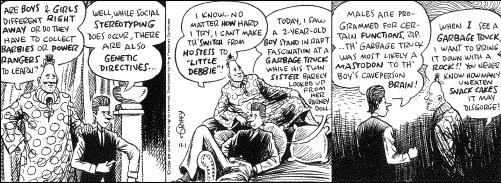
© Bill Griffith. Reprinted with special permission of King Features Syndicate.
But among many professional women the existence of sex differences is still a source of discomfort. As one colleague said to me, “Look, I know that males and females are not identical. I see it in my kids, I see it in myself, I know about the research. I can’t explain it, but when I read claims about sex differences, steam comes out of my ears.” The most likely cause of her disquiet is captured in a recent editorial by Betty Friedan, the cofounder of the National Organization for Women and the author of the 1963 book The Feminine Mystique:
Though the women’s movement has begun to achieve equality for women on many economic and political measures, the victory remains incomplete. To take two of the simplest and most obvious indicators: women still earn no more than 72 cents for every dollar that men earn, and we are nowhere near equality in numbers at the very top of decision making in business, government, or the professions. 56
Like Friedan, many people believe that the gender gap in wages and a “glass ceiling” that keeps women from rising to the uppermost levels of power are the two main injustices facing women in the West today. In his 1999 State of the Union address, Bill Clinton said, “We can be proud of this progress, but 75 cents on the dollar is still only three-quarters of the way there, and Americans can’t be satisfied until we’re all the way there.” The gender gap and the glass ceiling have inspired lawsuits against companies that have too few women in the top positions, pressure on the government to regulate all salaries so men and women are paid according to the “comparable worth” of their jobs, and aggressive measures to change girls’ attitudes to the professions, such as the annual Take Our Daughters to Work Day.
Scientists and engineers face the issue in the form of the “leaky pipeline.” Though women make up almost 60 percent of university students and about half of the students majoring in many fields of science, the proportion advancing to the next career stage diminishes as they go from being undergraduates to graduate students to postdoctoral fellows to junior professors to tenured professors. Women make up less than 20 percent of the workforce in science, engineering, and technology development, and only 9 percent of the workforce in engineering. 57 Readers of the flagship journals Science and Nature have seen two decades of headlines such as “Diversity: Easier Said Than Done” and “Efforts to Boost Diversity Face Persistent Problems.” 58 A typical story, commenting on the many national commissions set up to investigate the problem, said, “These activities are meant to continue chipping away at a problem that, experts say, begins with negative messages in elementary school, continues through undergraduate and graduate programs that erect barriers—financial, academic, and cultural—to all but the best candidates, and persists into the workplace.” 59 A meeting in 2001 of the presidents of nine elite American universities called for “significant changes,” such as setting aside grants and fellowships for women faculty, giving them the best parking spaces on campus, and ensuring that the percentage of women faculty equals the percentage of women students. 60
But there is something odd in these stories about negative messages, hidden barriers, and gender prejudices. The way of science is to lay out every hypothesis that could account for a phenomenon and to eliminate all but the correct one. Scientists prize the ability to think up alternative explanations, and proponents of a hypothesis are expected to refute even the unlikely ones. Nonetheless, discussions of the leaky pipeline in science rarely even mention an alternative to the theory of barriers and bias. One of the rare exceptions was a sidebar to a 2000 story in Science, which quoted from a presentation at the National Academy of Engineering by the social scientist Patti Hausman:
The question of why more women don’t choose careers in engineering has a rather obvious answer: Because they don’t want to. Wherever you go, you will find females far less likely than males to see what is so fascinating about ohms, carburetors, or quarks. Reinventing the curriculum will not make me more interested in learning how my dishwasher works. 61
An eminent woman engineer in the audience immediately denounced her analysis as “pseudoscience.” But Linda Gottfredson, an expert in the literature on vocational preferences, pointed out that Hausman had the data on her side: “On average, women are more interested in dealing with people and men with things.” Vocational tests also show that boys are more interested in “realistic,” “theoretical,” and “investigative” pursuits, and girls more interested in “artistic” and “social” pursuits.
Hausman and Gottfredson are lonely voices, because the gender gap is almost always analyzed in the following way. Any imbalance between men and women in their occupations or earnings is direct proof of gender bias—if not in the form of overt discrimination, then in the form of discouraging messages and hidden barriers. The possibility that men and women might differ from each other in ways that affect what jobs they hold or how much they get paid may never be mentioned in public, because it will set back the cause of equity in the workplace and harm the interests of women. It is this conviction that led Friedan and Clinton, for example, to say that we will not have attained gender equity until earnings and representation in the professions are identical for men and women. In a 1998 television interview, Gloria Steinem and the congresswoman Bella Abzug called the very idea of sex differences “poppycock” and “anti-American crazy thinking,” and when Abzug was asked whether gender equality meant equal numbers in every field, she replied, “Fifty-fifty—absolutely.” 62 This analysis of the gender gap has also become the official position of universities. That the presidents of the nation’s elite universities are happy to accuse their colleagues of shameful prejudice without even considering alternative explanations (whether or not they would end up accepting them) shows how deeply rooted the taboo is.
The problem with this analysis is that inequality of outcome cannot be used as proof of inequality of opportunity unless the groups being compared are identical in all of their psychological traits, which is likely to be true only if we are blank slates. But the suggestion that the gender gap may arise, even in part, from differences between the sexes can be fightin’ words. Anyone bringing it up is certain to be accused of “wanting to keep women in their place” or “justifying the status quo.” This makes about as much sense as saying that a scientist who studies why women live longer than men “wants old men to die.” And far from being a ploy by self-serving men, analyses exposing the flaws of the glass-ceiling theory have largely come from women, including Hausman, Gottfredson, Judith Kleinfeld, Karen Lehrman, Cathy Young, and Camilla Benbow, the economists Jennifer Roback, Felice Schwartz, Diana Furchtgott-Roth, and Christine Stolba, the legal scholar Jennifer Braceras, and, more guardedly, the economist Claudia Goldin and the legal scholar Susan Estrich. 63
I believe these writers have given us a better understanding of the gender gap than the standard one, for a number of reasons. Their analysis is not afraid of the possibility that the sexes might differ, and therefore does not force us to choose between scientific findings on human nature and the fair treatment of women. It offers a more sophisticated understanding of the causes of the gender gap, one that is consistent with our best social science. It takes a more respectful view of women and their choices. And ultimately it promises more humane and effective remedies for gender inequities in the workplace.
Before presenting the new analysis of the gender gap from equity feminists, let me reiterate three points that are not in dispute. First, discouraging women from pursuing their ambitions, and discriminating against them on the basis of their sex, are injustices that should be stopped wherever they are discovered.
Second, there is no doubt that women faced widespread discrimination in the past and continue to face it in some sectors today. This cannot be proven by showing that men earn more than women or that the sex ratio departs from fifty-fifty, but it can be proven in other ways. Experimenters can send out fake résumés or grant proposals that are identical in all ways except the sex of the applicant and see whether they are treated differently. Economists can do a regression analysis that takes measures of people’s qualifications and interests and determines whether the men and the women earn different amounts, or are promoted at different rates, when their qualifications and interests are statistically held constant. The point that differences in outcome don’t show discrimination unless one has equated for other relevant traits is elementary social science (not to mention common sense), and is accepted by all economists when they analyze data sets looking for evidence of wage discrimination. 64
Third, there is no question of whether women are “qualified” to be scientists, CEOs, leaders of nations, or elite professionals of any other kind. That was decisively answered years ago: some are and some aren’t, just as some men are qualified and some aren’t. The only question is whether the proportions of qualified men and women must be identical.
As in many other topics related to human nature, people’s unwillingness to think in statistical terms has led to pointless false dichotomies. Here is how to think about gender distributions in the professions without having to choose between the extremes of “women are unqualified” and “fifty-fifty absolutely,” or between “there is no discrimination” and “there is nothing but discrimination.”
In a free and unprejudiced labor market, people will be hired and paid according to the match between their traits and the demands of the job. A given job requires some mixture of cognitive talents (such as mathematical or linguistic skill), personality traits (such as risk taking or cooperation), and tolerance of lifestyle demands (rigid schedules, relocations, updating job skills). And it offers some mixture of personal rewards: people, gadgets, ideas, the outdoors, pride in workmanship. The salary is influenced, among other things, by supply and demand: how many people want the job, how many can do it, and how many the employer can pay to do it. Readily filled jobs may pay less; difficult-to-fill jobs may pay more.
People vary in the traits relevant to employment. Most people can think logically, work with people, tolerate conflict or unpleasant surroundings, and so on, but not to an identical extent; everyone has a unique profile of strengths and tastes. Given all the evidence for sex differences (some biological, some cultural, some both), the statistical distributions for men and women in these strengths and tastes are unlikely to be identical. If one now matches the distribution of traits for men and for women with the distribution of the demands of the jobs in the economy, the chance that the proportion of men and of women in each profession will be identical, or that the mean salary of men and of women will be identical, is very close to zero—even if there were no barriers or discrimination.
None of this implies that women will end up with the short end of the stick. It depends on the menu of opportunities that a given society makes available. If there are more high-paying jobs that call for typical male strengths (say, willingness to put oneself in physical danger, or an interest in machines), men may do better on average; if there are more that call for typical female strengths (say, a proficiency with language, or an interest in people), women may do better on average. In either case, members of both sexes will be found in both kinds of jobs, just in different numbers. That is why some relatively prestigious professions are dominated by women. An example is my own field, the study of language development in children, in which women outnumber men by a large margin. 65 In her book The First Sex: The Natural Talents of Women and How They Are Changing the World, the anthropologist Helen Fisher speculates that the culture of business in our knowledge-driven, globalized economy will soon favor women. Women are more articulate and cooperative, are not as obsessed with rank, and are better able to negotiate win-win outcomes. The workplaces of the new century, she predicts, will increasingly demand these talents, and women may surpass men in status and earnings.
In today’s world, of course, the gap favors men. Some of the gap is caused by discrimination. Employers may underestimate the skills of women, or assume that an all-male workplace is more efficient, or worry that their male employees will resent female supervisors, or fear resistance from prejudiced customers and clients. But the evidence suggests that not all sex differences in the professions are caused by these barriers. 66 It is unlikely, for example, that among academics the mathematicians are unusually biased against women, the developmental psycholinguists are unusually biased against men, and the evolutionary psychologists are unusually free of bias.
In a few professions, differences in ability may play some role. The fact that more men than women have exceptional abilities in mathematical reasoning and in mentally manipulating 3-D objects is enough to explain a departure from a fifty-fifty sex ratio among engineers, physicists, organic chemists, and professors in some branches of mathematics (though of course it does not mean that the proportion of women should be anywhere near zero).
In most professions, average differences in ability are irrelevant, but average differences in preferences may set the sexes on different paths. The most dramatic example comes from an analysis by David Lubinski and Camilla Benbow of a sample of mathematically precocious seventh-graders selected in a nationwide talent search. 67 The teenagers were born during the second wave of feminism, were encouraged by their parents to develop their talents (all were sent to summer programs in math and science), and were fully aware of their ability to achieve. But the gifted girls told the researchers that they were more interested in people, “social values,” and humanitarian and altruistic goals, whereas the gifted boys said they were more interested in things, “theoretical values,” and abstract intellectual inquiry. In college, the young women chose a broad range of courses in the humanities, arts, and sciences, whereas the boys were geeks who stuck to math and science. And sure enough, fewer than 1 percent of the young women pursued doctorates in math, physical sciences, or engineering, whereas 8 percent of the young men did. The women went into medicine, law, the humanities, and biology instead.
This asymmetry is writ large in massive surveys of job-related values and career choices, another kind of study in which men and women actually say what they want rather than having activists speak for them. 68 On average, men’s self-esteem is more highly tied to their status, salary, and wealth, and so is their attractiveness as a sexual partner and marriage partner, as revealed in studies of what people look for in the opposite sex. 69 Not surprisingly, men say they are more keen to work longer hours and to sacrifice other parts of their lives—to live in a less attractive city, or to leave friends and family when they relocate—in order to climb the corporate ladder or achieve notoriety in their fields. Men, on average, are also more willing to undergo physical discomfort and danger, and thus are more likely to be found in grungy but relatively lucrative jobs such as repairing factory equipment, working on oil rigs, and jack-hammering sludge from the inside of oil tanks. Women, on average, are more likely to choose administrative support jobs that offer lower pay in air-conditioned offices. Men are greater risk takers, and that is reflected in their career paths even when qualifications are held constant. Men prefer to work for corporations, women for government agencies and nonprofit organizations. Male doctors are more likely to specialize and to open up private practices; female doctors are more likely to be general practitioners on salary in hospitals and clinics. Men are more likely to be managers in factories, women more likely to be managers in human resources or corporate communications.
Mothers are more attached to their children, on average, than are fathers. That is true in societies all over the world and probably has been true of our lineage since the first mammals evolved some two hundred million years ago. As Susan Estrich puts it, “Waiting for the connection between gender and parenting to be broken is waiting for Godot.” This does not mean that women in any society have ever been uninterested in work; among hunter-gatherers, women do most of the gathering and some of the hunting, especially when it involves nets rather than rocks and spears. 70 Nor does it mean that men in any society are indifferent to their children; male parental investment is a conspicuous and zoologically unusual feature of Homo sapiens. But it does mean that the biologically ubiquitous tradeoff between investing in a child and working to stay healthy (ultimately to beget or invest in other children) may be balanced at different points by males and females. Not only are women the sex who nurse, but women are more attentive to their babies’ well-being and, in surveys, place a higher value on spending time with their children. 71
So even if both sexes value work and both sexes value children, the different weightings may lead women, more often than men, to make career choices that allow them to spend more time with their children—shorter or more flexible hours, fewer relocations, skills that don’t become obsolete as quickly—in exchange for lower wages or prestige. As the economist Jennifer Roback points out, “Once we observe that people sacrifice money income for other pleasurable things we can infer next to nothing by comparing the income of one person with another’s.” 72 The economist Gary Becker has shown that marriage can magnify the effects of sex differences, even if they are small to begin with, because of what economists call the law of comparative advantage. In couples where the husband can earn a bit more than the wife, but the wife is a somewhat better parent than the husband, they might rationally decide they are both better off if she works less than he does. 73
To repeat: none of this means that sex discrimination has vanished, or that it is justified when it occurs. The point is only that gender gaps by themselves say nothing about discrimination unless the slates of men and women are blank, which they are not. The only way to establish discrimination is to compare their jobs or wages when choices and qualifications are equalized. And in fact a recent study of data from the National Longitudinal Survey of Youth found that childless women between the ages of twenty-seven and thirty-three earn 98 cents to men’s dollar. 74 Even to people who are cynical about the motivations of American employers, this should come as no shock. In a cutthroat market, any company stupid enough to overlook qualified women or to overpay unqualified men would be driven out of business by a more meritocratic competitor.
Now, there is nothing in science or social science that would rule out policies implementing a fifty-fifty distribution of wages and jobs between the sexes, if a democracy decided that this was an inherently worthy goal. What the findings do say is that such policies will come with costs as well as benefits. The obvious benefit of equality-of-outcome policies is that they might neutralize the remaining discrimination against women. But if men and women are not interchangeable, the costs have to be considered as well.
Some costs would be borne by men or by both sexes. The two most obvious are the possibility of reverse discrimination against men and of a false presumption of sexism among the men and women who make decisions about hiring and salary today. Another cost borne by both sexes is the inefficiency that could result if employment decisions were based on factors other than the best match between the demands of a job and the traits of the person.
But many of the costs of equality-of-outcome policies would be borne by women. Many women scientists are opposed to hard gender preferences in science, such as designated faculty positions for women, or the policy (advocated by one activist) in which federal research grants would be awarded in exact proportion to the number of men and women who apply for them. The problem with these well-meaning policies is that they can plant seeds of doubt in people’s minds about the excellence of the beneficiaries. As the astronomer Lynne Hillenbrand said, “If you’re given an opportunity for the reason of being female, it doesn’t do anyone any favors; it makes people question why you’re there.” 75
Certainly there are institutional barriers to the advancement of women. People are mammals, and we should think through the ethical implications of the fact that it is women who bear, nurse, and disproportionately raise children. One ought not to assume that the default human being is a man and that children are an indulgence or an accident that strikes a deviant subset. Sex differences therefore can be used to justify, rather than endanger, woman-friendly policies such as parental leave, subsidized childcare, flexible hours, and stoppages of the tenure clock or the elimination of tenure altogether (a possibility recently broached by the biologist and Princeton University president Shirley Tilghman).
Of course, there is no such thing as a free lunch, and these policies are also decisions—perhaps justifiable ones—to penalize men and women who are childless, have grown children, or choose to stay at home with their children. But even when it comes to weighing these tradeoffs, thinking about human nature can raise deep new questions that could ultimately improve the lot of working women. Which of the onerous job demands that deter women really contribute to economic efficiency, and which are obstacle courses in which men compete for alpha status? In reasoning about fairness in the workplace, should we consider people as isolated individuals, or should we consider them as members of families who probably will have children at some point in their lives and who probably will care for aging parents at some point in their lives? If we trade off some economic efficiency for more pleasant working conditions in all jobs, might there be a net increase in happiness? I don’t have answers, but the questions are well worth asking.
There is one more reason that acknowledging sex differences can be more humane than denying them. It is men and women, not the male gender and the female gender, who prosper or suffer, and those men and women are endowed with brains—perhaps not identical brains—that give them values and an ability to make choices. Those choices should be respected. A regular feature of the lifestyle pages is the story about women who are made to feel ashamed about staying at home with their children. As they always say, “I thought feminism was supposed to be about choices.” The same should apply to women who do choose to work but also to trade off some income in order to “have a life” (and, of course, to men who make that choice). It is not obviously progressive to insist that equal numbers of men and women work eighty-hour weeks in a corporate law firm or leave their families for months at a time to dodge steel pipes on a frigid oil platform. And it is grotesque to demand (as advocates of gender parity did in the pages of Science) that more young women “be conditioned to choose engineering,” as if they were rats in a Skinner box. 76
Gottfredson points out, “If you insist on using gender parity as your measure of social justice, it means you will have to keep many men and women out of the work they like best and push them into work they don’t like.” 77 She is echoed by Kleinfeld on the leaky pipeline in science: “We should not be sending [gifted] women the messages that they are less worthy human beings, less valuable to our civilization, lazy or low in status, if they choose to be teachers rather than mathematicians, journalists rather than physicists, lawyers rather than engineers.” 78 These are not hypothetical worries: a recent survey by the National Science Foundation found that many more women than men say they majored in science, mathematics, or engineering under pressure from teachers or family members rather than to pursue their own aspirations—and that many eventually switched out for that reason. 79 I will give the final word to Margaret Mead, who, despite being wrong in her early career about the malleability of gender, was surely right when she said, “If we are to achieve a richer culture, rich in contrasting values, we must recognize the whole gamut of human potentialities, and so weave a less arbitrary social fabric, one in which each diverse human gift will find a fitting place.”
OTHER THAN THE gender gap, the most combustible recent issue surrounding the sexes has been the nature and causes of rape. When the biologist Randy Thornhill and the anthropologist Craig Palmer published A Natural History of Rape in 2000, they threatened a consensus that had held firm in intellectual life for a quarter of a century, and they brought down more condemnation on evolutionary psychology than any issue had in years. 80 Rape is a painful issue to write about, but also an unavoidable one. Nowhere else in modern intellectual life is the denial of human nature more passionately insisted upon, and nowhere else is the alternative more deeply misunderstood. Clarifying these issues, I believe, would go a long way toward reconciling three ideals that have needlessly been put into conflict: women’s rights, a biologically informed understanding of human nature, and common sense.
The horror of rape gives it a special gravity in our understanding of the psychology of men and women. There is an overriding moral imperative in the study of rape: to reduce its occurrence. Any scientist who illuminates the causes of rape deserves our admiration, like a medical researcher who illuminates the cause of a disease, because understanding an affliction is the first step toward eliminating it. And since no one acquires the truth by divine revelation, we must also respect those who explore theories that may turn out to be incorrect. Moral criticism would seem to be in order only for those who would enforce dogmas, ignore evidence, or shut down research, because they would be protecting their reputations at the expense of victims of rapes that might not have occurred if we understood the phenomenon better.
Current sensibilities, unfortunately, are very different. In modern intellectual life the overriding moral imperative in analyzing rape is to proclaim that rape has nothing to do with sex. The mantra must be repeated whenever the subject comes up. “Rape is an abuse of power and control in which the rapist seeks to humiliate, shame, embarrass, degrade, and terrify the victim,” the United Nations declared in 1993. “The primary objective is to exercise power and control over another person.” 81 This was echoed in a 2001 Boston Globe op-ed piece that said, “Rape is not about sex; it is about violence and the use of sex to exert power and control. . . . Domestic violence and sexual assault are manifestations of the same powerful social forces: sexism and the glorification of violence.” 82 When an iconoclastic columnist wrote a dissenting article on rape and battering, a reader responded:
As a man who has been actively engaged for more than a decade as an educator and a counselor to help men to stop their violence against women, I find Cathy Young’s Oct. 15 column disturbing and discouraging. She confuses issues by failing to acknowledge that men are socialized in a patriarchal culture that still supports their violence against women if they choose it. 83
So steeped in the prevailing ideology was this counselor that he didn’t notice that Young was arguing against the dogma he took as self-evidently true, not “failing to acknowledge” it. And his wording—“men are socialized in a patriarchal culture”—reproduces a numbingly familiar slogan.
The official theory of rape originated in an important 1975 book, Against Our Will, by the gender feminist Susan Brownmiller. The book became an emblem of a revolution in our handling of rape that is one of second-wave feminism’s greatest accomplishments. Until the 1970s, rape was often treated by the legal system and popular culture with scant attention to the interests of women. Victims had to prove they resisted their attackers to within an inch of their lives or else they were seen as having consented. Their style of dress was seen as a mitigating factor, as if men couldn’t control themselves when an attractive woman walked by. Also mitigating was the woman’s sexual history, as if choosing to have sex with one man on one occasion were the same as agreeing to have sex with any man on any occasion. Standards of proof that were not required for other violent crimes, such as eyewitness corroboration, were imposed on charges of rape. Women’s consent was often treated lightly in the popular media. It was not uncommon in movies for a reluctant woman to be handled roughly by a man and then melt into his arms. The suffering of rape victims was treated lightly as well; I remember teenage girls, in the wake of the sexual revolution in the early 1970s, joking to one another, “If a rape is inevitable, you might as well lie back and enjoy it.” Marital rape was not a crime, date rape was not a concept, and rape during wartime was left out of the history books. These affronts to humanity are gone or on the wane in Western democracies, and feminism deserves credit for this moral advance.
But Brownmiller’s theory went well beyond the moral principle that women have a right not to be sexually assaulted. It said that rape had nothing to do with an individual man’s desire for sex but was a tactic by which the entire male gender oppressed the entire female gender. In her famous words:
Man’s discovery that his genitalia could serve as a weapon to generate fear must rank as one of the most important discoveries of prehistoric times, along with the use of fire and the first crude stone axe. From prehistoric times to the present, I believe, rape has played a critical function . . . it is nothing more or less than a conscious process of intimidation by which all men keep all women in a state of fear. 84
This grew into the modern catechism: rape is not about sex, our culture socializes men to rape, it glorifies violence against women. The analysis comes right out of the gender-feminist theory of human nature: people are blank slates (who must be trained or socialized to want things); the only significant human motive is power (so sexual desire is irrelevant); and all motives and interests must be located in groups (such as the male sex and the female sex) rather than in individual people.
The Brownmiller theory is appealing even to people who are not gender feminists because of the doctrine of the Noble Savage. Since the 1960s most educated people have come to believe that sex should be thought of as natural, not shameful or dirty. Sex is good because sex is natural and natural things are good. But rape is bad; therefore, rape is not about sex. The motive to rape must come from social institutions, not from anything in human nature.
The violence-not-sex slogan is right about two things. Both parts are absolutely true for the victim: a woman who is raped experiences it as a violent assault, not as a sexual act. And the part about violence is true for the perpetrator by definition: if there is no violence or coercion, we do not call it rape. But the fact that rape has something to do with violence does not mean it has nothing to do with sex, any more than the fact that armed robbery has something to do with violence means it has nothing to do with greed. Evil men may use violence to get sex, just as they use violence to get other things they want.
I believe that the rape-is-not-about-sex doctrine will go down in history as an example of extraordinary popular delusions and the madness of crowds. It is preposterous on the face of it, does not deserve its sanctity, is contradicted by a mass of evidence, and is getting in the way of the only morally relevant goal surrounding rape, the effort to stamp it out.
Think about it. First obvious fact: Men often want to have sex with women who don’t want to have sex with them. They use every tactic that one human being uses to affect the behavior of another: wooing, seducing, flattering, deceiving, sulking, and paying. Second obvious fact: Some men use violence to get what they want, indifferent to the suffering they cause. Men have been known to kidnap children for ransom (sometimes sending their parents an ear or finger to show they mean business), blind the victim of a mugging so the victim can’t identify them in court, shoot out the kneecaps of an associate as punishment for ratting to the police or invading their territory, and kill a stranger for his brand-name athletic footwear. It would be an extraordinary fact, contradicting everything else we know about people, if some men didn’t use violence to get sex.
Let’s also apply common sense to the doctrine that men rape to further the interests of their gender. A rapist always risks injury at the hands of the woman defending herself. In a traditional society, he risks torture, mutilation, and death at the hands of her relatives. In a modern society, he risks a long prison term. Are rapists really assuming these risks as an altruistic sacrifice to benefit the billions of strangers that make up the male gender? The idea becomes even less credible when we remember that rapists tend to be losers and nobodies, while presumably the main beneficiaries of the patriarchy are the rich and powerful. Men do sacrifice themselves for the greater good in wartime, of course, but they are either conscripted against their will or promised public adulation when their exploits are made public. But rapists usually commit their acts in private and try to keep them secret. And in most times and places, a man who rapes a woman in his community is treated as scum. The idea that all men are engaged in brutal warfare against all women clashes with the elementary fact that men have mothers, daughters, sisters, and wives, whom they care for more than they care for most other men. To put the same point in biological terms, every person’s genes are carried in the bodies of other people, half of whom are of the opposite sex.
Yes, we must deplore the sometimes casual treatment of women’s autonomy in popular culture. But can anyone believe that our culture literally “teaches men to rape” or “glorifies the rapist”? Even the callous treatment of rape victims in the judicial system of yesteryear has a simpler explanation than that all men benefit by rape. Until recently jurors in rape cases were given a warning from the seventeenth-century jurist Lord Matthew Hale that they should evaluate a woman’s testimony with caution, because a rape charge is “easily made and difficult to defend against, even if the accused is innocent.” 85 The principle is consistent with the presumption of innocence built into our judicial system and with its preference to let ten guilty people go free rather than jail one innocent. Even so, let’s suppose that the men who applied this policy to rape did tilt it toward their own collective interests. Let’s suppose that they leaned on the scales of justice to minimize their own chances of ever being falsely accused of rape (or accused under ambiguous circumstances) and that they placed insufficient value on the injustice endured by women who would not see their assailants put behind bars. That would indeed be unjust, but it is still not the same thing as encouraging rape as a conscious tactic to keep women down. If that were men’s tactic, why would they have made rape a crime in the first place?
As for the morality of believing the not-sex theory, there is none. If we have to acknowledge that sexuality can be a source of conflict and not just wholesome mutual pleasure, we will have rediscovered a truth that observers of the human condition have noted throughout history. And if a man rapes for sex, that does not mean that he “just can’t help it” or that we have to excuse him, any more than we have to excuse the man who shoots the owner of a liquor store to raid the cash register or who bashes a driver over the head to steal his BMW. The great contribution of feminism to the morality of rape is to put issues of consent and coercion at center stage. The ultimate motives of the rapist are irrelevant.
Finally, think about the humanity of the picture that the gender-feminist theory has painted. As the equity feminist Wendy McElroy points out, the theory holds that “even the most loving and gentle husband, father, and son is a beneficiary of the rape of women they love. No ideology that makes such vicious accusations against men as a class can heal any wounds. It can only provoke hostility in return.” 86
BROWNMILLER ASKED A revealing rhetorical question:
Does one need scientific methodology in order to conclude that the anti-female propaganda that permeates our nation’s cultural output promotes a climate in which acts of sexual hostility directed against women are not only tolerated but ideologically encouraged?
McElroy responded: “The answer is a clear and simple ‘yes.’ One needs scientific methodology to verify any empirical claim.” And she called attention to the consequences of Brownmiller’s attitude: “One of the casualties of the new dogma on rape has been research. It is no longer ‘sexually correct’ to conduct studies on the causes of rape, because—as any right-thinking person knows—there is only one cause: patriarchy. Decades ago, during the heyday of liberal feminism and sexual curiosity, the approach to research was more sophisticated.” 87 McElroy’s suspicions are borne out by a survey of published “studies” of rape that found that fewer than one in ten tested hypotheses or used scientific methods. 88
Scientific research on rape and its connections to human nature was thrown into the spotlight in 2000 with the publication of A Natural History of Rape. Thornhill and Palmer began with a basic observation: a rape can result in a conception, which could propagate the genes of the rapist, including any genes that had made him likely to rape. Therefore, a male psychology that included a capacity to rape would not have been selected against, and could have been selected for. Thornhill and Palmer argued that rape is unlikely to be a typical mating strategy because of the risk of injury at the hands of the victim and her relatives and the risk of ostracism from the community. But it could be an opportunistic tactic, becoming more likely when the man is unable to win the consent of women, alienated from a community (and thus undeterred by ostracism), and safe from detection and punishment (such as in wartime or pogroms). Thornhill and Palmer then outlined two theories. Opportunistic rape could be a Darwinian adaptation that was specifically selected for, as in certain insects that have an appendage with no function other than restraining a female during forced copulation. Or rape could be a by-product of two other features of the male mind: a desire for sex and a capacity to engage in opportunistic violence in pursuit of a goal. The two authors disagreed on which hypothesis was better supported by the data, and they left that issue unresolved.
No honest reader could conclude that the authors think rape is “natural” in the vernacular sense of being welcome or unavoidable. The first words of the book are, “As scientists who would like to see rape eradicated from human life . . .,” which are certainly not the words of people who think it is inevitable. Thornhill and Palmer discuss the environmental circumstances that affect the likelihood of rape, and they offer suggestions on how to reduce it. The idea that most men have the capacity to rape works, if anything, in the interests of women, because it calls for vigilance against acquaintance rape, marital rape, and rape during societal breakdowns. Indeed, the analysis jibes with Brownmiller’s own data that ordinary men, including “nice” American boys in Vietnam, may rape in wartime. For that matter, Thornhill and Palmer’s hypothesis that rape is on a continuum with the rest of male sexuality makes them strange allies with the most radical gender feminists, such as Catharine MacKinnon and Andrea Dworkin, who said that “seduction is often difficult to distinguish from rape. In seduction, the rapist often bothers to buy a bottle of wine.” 89
Most important, the book focuses in equal part on the pain of the victims. (Its draft title was Why Men Rape, Why Women Suffer.) Thornhill and Palmer explain in Darwinian terms why females throughout the animal kingdom resist being forced into sex, and argue that the agony that rape victims feel is deeply rooted in women’s nature. Rape subverts female choice, the core of the ubiquitous mechanism of sexual selection. By choosing the male and the circumstances for sex, a female can maximize the chances that her offspring will be fathered by a male with good genes, a willingness and ability to share the responsibility of rearing the offspring, or both. As John Tooby and Leda Cosmides have put it, this ultimate (evolutionary) calculus explains why women evolved “to exert control over their own sexuality, over the terms of their relationships, and over the choice of which men are to be the fathers of their children.” They resist being raped, and they suffer when their resistance fails, because “control over their sexual choices and relationships was wrested from them.” 90
Thornhill and Palmer’s theory reinforces many points of an equity-feminist analysis. It predicts that from the woman’s point of view, rape and consensual sex are completely different. It affirms that women’s repugnance toward rape is not a symptom of neurotic repression, nor is it a social construct that could easily be the reverse in a different culture. It predicts that the suffering caused by rape is deeper than the suffering caused by other physical traumas or body violations. That justifies our working harder to prevent rape, and punishing the perpetrators more severely, than we do for other kinds of assault. Compare this analysis with the dubious claim by two gender feminists that an aversion to rape has to be pounded into women by every social influence they can think of:
Female fear . . . [results] not only from women’s personal backgrounds but from what women as a group have imbibed from history, religion, culture, social institutions, and everyday social interactions. Learned early in life, female fear is continually reinforced by such social institutions as the school, the church, the law, and the press. Much is also learned from parents, siblings, teachers, and friends. 91
But despite the congeniality of their analysis to women’s interests, Thornhill and Palmer had broken a taboo, and the response was familiar: there were demonstrations, disruptions of lectures, and invective that would curdle your hair, as the popular malaprop has it. “Latest nauseating scientific theory” was a typical reaction, and radical scientists applied their usual standards of accuracy to denounce it. Hilary Rose, discussing a presentation of the theory by another biologist, wrote, “The sociobiologist David Barash’s appeal in defense of his misogynist claims that men are naturally predisposed to rape, ‘If Nature is sexist don’t blame her sons,’ can no longer plug into the old deference to science as the view from nowhere.” 92 Barash, of course, had said no such thing; he had referred to rapists as criminals who should be punished. The science writer Margaret Wertheim began her review of Thornhill and Palmer’s book by calling attention to a recent epidemic of rape in South Africa. 93 Pitting the theory that rape is “a byproduct of social conditioning and chaos” against the theory that rape has evolutionary and genetic origins, she sarcastically wrote that if the latter were true, “South Africa must be a hothouse for such genes.” Two slurs for the price of one: the statement puts Thornhill and Palmer on the simplistic side of a false dichotomy (in fact, they devote many pages to the social conditions fostering rape) and slips in the innuendo that their theory is racist, too. The psychologist Geoffrey Miller, in his own mixed review of the book, diagnosed the popular reaction:
The Natural History of Rape has already suffered the worst possible fate for a popular science book. Like The Descent of Man and The Bell Curve, it has become an ideological touchstone. People who wish to demonstrate their sympathy for rape victims and women in general have already learned that they must dismiss this book as sexist, reactionary pseudo-science. News stories that treat the book as a symptom of chauvinist cultural decay have greatly outnumbered reviews that assess it as science. Viewed sociologically, turning books into ideological touchstones can be useful. People can efficiently sort themselves out into like-minded cliques without bothering to read or think. However, there can be more to human discourse than ideological self-advertisement. 94
It’s unfortunate that Thornhill and Palmer themselves set up a dichotomy between the theory that rape is an adaptation (a specifically selected sexual strategy) and the theory that it is a by-product (a consequence of using violence in general), because it diverted attention from the more basic claim that rape has something to do with sex. I think their dichotomy is drawn too sharply. Male sexuality may have evolved in a world in which women were more discriminating than men about partners and occasions for sex. That would have led men to treat female reluctance as an obstacle to be overcome. (Another way to put it is that one can imagine a species in which the male could become sexually interested only if he detected reciprocal signs of interest on the part of the female, but that humans do not appear to be such a species.) How the woman’s reluctance is overcome depends on the rest of the man’s psychology and on his assessment of the circumstances. His usual tactics may include being kind, persuading the woman of his good intentions, and offering the proverbial bottle of wine, but may become increasingly coercive as certain risk factors are multiplied in: the man is a psychopath (hence insensitive to the suffering of others), an outcast (hence immune to ostracism), a loser (with no other means to get sex), or a soldier or ethnic rioter who considers an enemy subhuman and thinks he can get away with it. Certainly most men in ordinary circumstances do not harbor a desire to rape. According to surveys, violent rape is unusual in pornography and sexual fantasies, and according to laboratory studies of men’s sexual arousal, depictions of actual violence toward a woman or signs of her pain and humiliation are a turnoff. 95
What about the more basic question of whether the motives of rapists include sex? The gender-feminist argument that they do not points to the rapists who target older, infertile women, those who suffer from sexual dysfunction during the rape, those who coerce nonreproductive sexual acts, and those who use a condom. The argument is unconvincing for two reasons. First, these examples make up a minority of rapes, so the argument could be turned around to show that most rapes do have a sexual motive. And all these phenomena occur with consensual sex, too, so the argument leads to the absurdity that sex itself has nothing to do with sex. And date rape is a particularly problematic case for the not-sex theory. Most people agree that women have the right to say no at any point during sexual activity, and that if the man persists he is a rapist—but should we also believe that his motive has instantaneously changed from wanting sex to oppressing women?
On the other side there is an impressive body of evidence (reviewed more thoroughly by the legal scholar Owen Jones than by Thornhill and Palmer) that the motives for rape overlap with the motives for sex: 96
- Coerced copulation is widespread among species in the animal kingdom, suggesting that it is not selected against and may sometimes be selected for. It is found in many species of insects, birds, and mammals, including our relatives the orangutans, gorillas, and chimpanzees.
- Rape is found in all human societies.
- Rapists generally apply as much force as is needed to coerce the victim into sex. They rarely inflict a serious or fatal injury, which would preclude conception and birth. Only 4 percent of rape victims sustain serious injuries, and fewer than one in five hundred is murdered.
- Victims of rape are mostly in the peak reproductive years for women, between thirteen and thirty-five, with a mean in most data sets of twenty-four. Though many rape victims are classified as children (under the age of sixteen), most of these are adolescents, with a median age of fourteen. The age distribution is very different from that of victims of other violent crimes, and is the opposite of what would happen if rape victims were picked for their physical vulnerability or by their likelihood of holding positions of power.
- Victims of rape are more traumatized when the rape can result in a conception. It is most psychologically painful for women in their fertile years, and for victims of forced intercourse as opposed to other forms of rape.
- Rapists are not demographically representative of the male gender. They are overwhelmingly young men, the age of the most intense sexual competitiveness. The young males who allegedly have been “socialized” to rape mysteriously lose that socialization as they get older.
- Though most rapes do not result in conception, many do. About 5 percent of rape victims of reproductive age become pregnant, resulting in more than 32,000 rape-related pregnancies in the United States each year. (That is why abortion in the case of rape is a significant issue.) The proportion would have been even higher in prehistory, when women did not use long-term contraception. 97 Brownmiller wrote that biological theories of rape are “fanciful” because “in terms of reproductive strategy, the hit or miss ejaculations of a single-strike rapist are a form of Russian roulette compared to ongoing consensual mating.” 98 But ongoing consensual mating is not an option for every male, and dispositions that resulted in hit-or-miss sex could be evolutionarily more successful than dispositions that resulted in no sex at all. Natural selection can operate effectively with small reproductive advantages, as little as 1 percent.
THE PAYOFF FOR a reality-based understanding of rape is the hope of reducing or eliminating it. Given the theories on the table, the possible sites for levers of influence include violence, sexist attitudes, and sexual desire.
Everyone agrees that rape is a crime of violence. Probably the biggest amplifier of rape is lawlessness. The rape and abduction of women is often a goal of raiding in non-state societies, and rape is common in wars between states and riots between ethnic groups. In peacetime, the rates of rape tend to track rates of other violent crime. In the United States, for example, the rate of forcible rape went up in the 1960s and down in the 1990s, together with the rates of other violent crimes. 99 Gender feminists blame violence against women on civilization and social institutions, but this is exactly backwards. Violence against women flourishes in societies that are outside the reach of civilization, and erupts whenever civilization breaks down.
Though I know of no quantitative studies, the targeting of sexist attitudes does not seem to be a particularly promising avenue for reducing rape, though of course it is desirable for other reasons. Countries with far more rigid gender roles than the United States, such as Japan, have far lower rates of rape, and within the United States the sexist 1950s were far safer for women than the more liberated 1970s and 1980s. If anything, the correlation might go in the opposite direction. As women gain greater freedom of movement because they are independent of men, they will more often find themselves in dangerous situations.
What about measures that focus on the sexual components of rape? Thornhill and Palmer suggested that teenage boys be forced to take a rape-prevention course as a condition for obtaining a driver’s license, and that women should be reminded that dressing in a sexually attractive way may increase their risk of being raped. These untested prescriptions are an excellent illustration of why scientists should stay out of the policy business, but they don’t deserve the outrage that followed. Mary Koss, described as an authority on rape, said, “The thinking is absolutely unacceptable in a democratic society.” (Note the psychology of taboo—not only is their suggestion wrong, but merely thinking it is “absolutely unacceptable.”) Koss continues, “Because rape is a gendered crime, such recommendations harm equality. They infringe more on women’s liberties than men’s.” 100
One can understand the repugnance at any suggestion that an attractively dressed woman excites an irresistible impulse to rape, or that culpability in any crime should be shifted from the perpetrator to the victim. But Thornhill and Palmer said neither of those things. They were offering a recommendation based on prudence, not an assignment of blame based on justice. Of course women have a right to dress in any way they please, but the issue is not what women have the right to do in a perfect world but how they can maximize their safety in this world. The suggestion that women in dangerous situations be mindful of reactions they may be eliciting or signals they may inadvertently be sending is just common sense, and it’s hard to believe any grownup would think otherwise—unless she has been indoctrinated by the standard rape-prevention programs that tell women that “sexual assault is not an act of sexual gratification” and that “appearance and attractiveness are not relevant.” 101 Equity feminists have called attention to the irresponsibility of such advice, in terms far harsher than anything by Thornhill and Palmer. Paglia, for example, wrote:
For a decade, feminists have drilled their disciples to say, “Rape is a crime of violence but not sex.” This sugar-coated Shirley Temple nonsense has exposed young women to disaster. Misled by feminism, they do not expect rape from the nice boys from good homes who sit next to them in class. . . .
These girls say, “Well, I should be able to get drunk at a fraternity party and go upstairs to a guy’s room without anything happening.” And I say, “Oh, really? And when you drive your car to New York City, do you leave your keys on the hood?” My point is that if your car is stolen after you do something like that, yes, the police should pursue the thief and he should be punished. But at the same time, the police—and I—have the right to say to you, “You stupid idiot, what the hell were you thinking?” 102
Similarly, McElroy points out the illogic of arguments like Koss’s that women should not be given practical advice that “infringes more on women’s liberties than men’s”:
The fact that women are vulnerable to attack means we cannot have it all. We cannot walk at night across an unlit campus or down a back alley, without incurring real danger. These are things every woman should be able to do, but “shoulds” belong in a utopian world. They belong in a world where you drop your wallet in a crowd and have it returned, complete with credit cards and cash. A world in which unlocked Porsches are parked in the inner city. And children can be left unattended in the park. This is not the reality that confronts and confines us. 103
The flight from reality of the rape-is-not-sex doctrine warps not just advice to women but policies for deterring rapists. Some prison systems put sex offenders in group therapy and psychodrama sessions designed to uproot experiences of childhood abuse. The goal is to convince the offenders that aggression against women is a way of acting out anger at their mothers, fathers, and society. (A sympathetic story in the Boston Globe concedes that “there is no way to know what the success rate of [the] therapy is.”) 104 Another program reeducates batterers and rapists with “pro-feminist therapy” consisting of lectures on patriarchy, heterosexism, and the connections between domestic violence and racial oppression. In an article entitled “The Patriarchy Made Me Do It,” the psychiatrist Sally Satel comments, “While it’s tempting to conclude that perhaps pro-feminist ‘therapy’ is just what a violent man deserves, the tragic fact is that truly victimized women are put in even more danger when their husbands undergo a worthless treatment.” 105 Savvy offenders who learn to mouth the right psychobabble or feminist slogans can be seen as successfully treated, which can win them earlier release and the opportunity to prey on women anew.
In his thoughtful review, Jones explores how the legal issues surrounding rape can be clarified by a more sophisticated understanding that does not rule the sexual component out of bounds. One example is “chemical castration,” voluntary injections of the drug Depo-Provera, which inhibits the release of androgens and reduces the offender’s sex drive. It is sometimes given to offenders who are morbidly obsessed with sex and compulsively commit crimes such as rape, indecent exposure, and child abuse. Chemical castration can cut recidivism rates dramatically—in one study, from 46 percent to 3 percent. Use of the drug certainly raises serious constitutional issues about privacy and punishment, which biology alone cannot decide. But the issues become cloudier, not clearer, when commentators declare a priori that “castration will not work because rape is not a crime about sex, but rather a crime about power and violence.”
Jones is not advocating chemical castration (and neither am I). He is asking people to look at all the options for reducing rape and to evaluate them carefully and with an open mind. Anyone who is incensed by the very idea of mentioning rape and sex in the same breath should read the numbers again. If a policy is rejected out of hand that can reduce rape by a factor of fifteen, then many women will be raped who otherwise might not have been. People may have to decide which they value more, an ideology that claims to advance the interests of the female gender or what actually happens in the world to real women.
DESPITE ALL THE steam coming out of people’s ears in the modern debate on the sexes, there are wide expanses of common ground. No one wants to accept sex discrimination or rape. No one wants to turn back the clock and empty the universities and professions of women, even if that were possible. No reasonable person can deny that the advances in the freedom of women during the past century are an incalculable enrichment of the human condition.
All the more reason not to get sidetracked by emotionally charged but morally irrelevant red herrings. The sciences of human nature can strengthen the interests of women by separating those herrings from the truly important goals. Feminism as a movement for political and social equity is important, but feminism as an academic clique committed to eccentric doctrines about human nature is not. Eliminating discrimination against women is important, but believing that women and men are born with indistinguishable minds is not. Freedom of choice is important, but ensuring that women make up exactly 50 percent of all professions is not. And eliminating sexual assaults is important, but advancing the theory that rapists are doing their part in a vast male conspiracy is not.