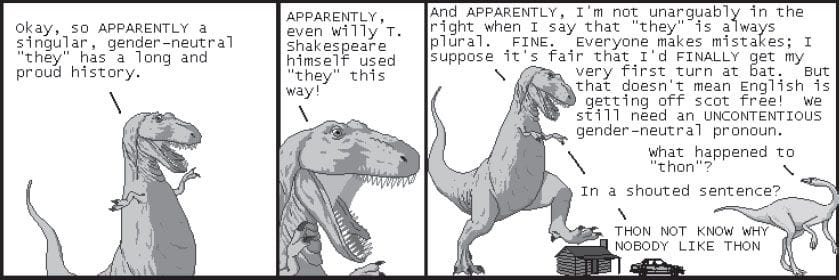
Assuming you aren’t willing to start a campaign for thon, does that mean you should go ahead and use singular they? It depends on the level of formality, the nature of the antecedent, and the available alternatives. Obviously singular they is less acceptable in formal than in informal writing. It is also more conspicuous when the antecedent is an indefinite noun phrase like a man, whose singular aroma makes the apparent plurality of they stand out. It’s not as problematic with a universally quantified antecedent like everyone, and barely noticeable with a negative quantifier like no or any.
The judgments of the Usage Panel are sensitive to this difference. Only a minority accepts A person at that level should not have to keep track of the hours they put in—though the size of that minority has doubled in the past decade, from 20 percent to almost 40 percent, one of many signs that we are in the midst of a historical change that’s returning singular they to the acceptability it enjoyed before a purist crackdown in the nineteenth century. A slim majority of the panel accepts If anyone calls, tell them I can’t come to the phone and Everyone returned to their seats. The main danger in using these forms is that a more-grammatical-than-thou reader may falsely accuse you of making an error. If they do, tell them that Jane Austen and I think it’s fine.
For many decades usage manuals have recommended two escape hatches for the singular pronoun trap. The easiest is to express the quantified description as a plural, which makes they a grammatically honest pronoun. If you think that you can improve on Jane Austen’s prose, for example, you could change Every body began to have their vexation to They all began to have their vexations. This is the solution that experienced writers use most often, and you would be surprised how many generic or universal sentences can be recast with plural subjects without anyone noticing: Every writer should shorten their sentences is easily transformed into All writers should shorten their sentences or just Writers should shorten their sentences.
The other escape hatch is to replace the pronoun with an indefinite or generic alternative and count on the reader’s common sense to fill in the referent: Every body began to have their vexation becomes Every body began to have a vexation, and Every dinosaur should look in his or her mirror becomes Every dinosaur should look in the mirror.
Neither solution is perfect. Sometimes a writer really does need to focus on a single individual, which makes a plural inappropriate. In Americans must never live under a cloud of suspicion just because of what they look like, the generic plural Americans can be interpreted to mean “the typical American” or “most Americans,” which undermines Obama’s declaration that freedom from discrimination must apply to each and every one without exception. With Shaw’s dialogue, plural subjects in Men never go to battle to be killed. But many of them do get killed would have undercut the point of the exchange, in which the listener is asked to ponder the foolhardiness of an individual enlistee, and the replacements would also have sabotaged Shaw’s juxtaposition of the low probability that any given individual will be killed with the high probability that some of them will be killed. Nor can a pronoun always be replaced by an indefinite or generic noun:
| During an emergency, every parent must pick up their child. | During an emergency, every parent must pick up a child. |
The replacement makes it seem as if a parent could choose a child at random to pick up, rather than being responsible for picking up his or her own child.
Because of these complexities, writers always have to consider the full inventory of devices that the English language makes available to convey generic information, each imperfect for a different reason: he, she, he or she, they, a plural antecedent, replacing the pronoun, and who knows, perhaps someday even using thon.
For some purists, these complexities provide an excuse to dismiss all concerns with gender inclusiveness and stick with the flawed option of he. Gelernter complains, “Why should I worry about feminist ideology while I write? … Writing is a tricky business that requires one’s whole concentration.” But the reaction is disingenuous. Every sentence requires a writer to grapple with tradeoffs between clarity, concision, tone, cadence, accuracy, and other values. Why should the value of not excluding women be the only one whose weight is set to zero?
DICTION
Even writers who are skeptical of traditional prescriptions on grammar tend to give more weight to prescriptions on word choice. Fewer superstitions have grown up around word meaning than around grammar, because lexicographers are pack rats who accumulate vast collections of examples and compose their definitions empirically rather than kibitzing in an armchair with half-baked theories about how English ought to work. As a result, the definitions in contemporary dictionaries are usually faithful to the consensus of literate readers. A writer who is unsure of the consensus for a word is well advised to look it up rather than embarrass himself and annoy his readers with a malaprop. (The word malaprop, short for malapropism, comes from Mrs. Malaprop, a character in Richard Sheridan’s 1775 play The Rivals, who misused words to comic effect, such as reprehend for apprehend and epitaph for epithet.)
Though less nonsense is disseminated about word meanings than about grammar, the nonsense factor is far from zero. With the backing of data from the AHD Usage Panel, historical analyses from several dictionaries, and a pinch of my own judgment, I will review a few fussbudget decrees you can safely ignore before turning to living distinctions you’d be wise to respect.
| Word | Only Sense Allowed by Purists | Sense Commonly Used | Comment |
| aggravate | make worse (aggravate the crisis) | annoy (aggravate the teacher) | The “annoy” sense has been in use since the 17th century and is accepted by 83% of the Usage Panel. |
| anticipate | deal with in advance (We anticipated the shortage by stocking up on toilet paper.) | expect (We anticipated a pleasant sabbatical year.) | The “expect” sense is accepted by 87% of the Usage Panel. |
| anxious | worried (Flying makes me anxious.) | eager (I’m anxious to leave.) | The Usage Panel splits 50-50, but the “eager” sense has long been in use and is included without comment in most dictionaries. |
| comprise | contain (The US comprises 50 states.) | compose, make up (The US is comprised of 50 states.) | The “compose” sense is often used and increasingly accepted, particularly in the passive. |
| convince | cause to believe (She convinced him that vaccines are harmless.) | cause to act (She convinced him to have his child vaccinated.) | Convince supposedly contrasts with persuade, which means “cause to act,” but few writers care. |
| crescendo | gradual increase (a long crescendo) | climax, peak (reach a crescendo) | The insistence on the “increase” sense is an etymological fallacy, based on the Italian source and the technical term in music. The “climax” sense is entrenched, and accepted by a slim majority of the Usage Panel. |
| critique | noun (a critique) | verb (to critique) | The verb is widely disliked but venerable, and usefully different from criticize in implying analysis rather than censure. |
| decimate | destroy a tenth | destroy most | An etymological fallacy, based on the Roman punishment of mutinous legions. |
| due to | adjective (The plane crash was due to a storm.) | preposition (The plane crashed due to a storm.) | Actually, both are prepositions, and both are fine.57 |
| Frankenstein | the fictional scientist | a monster | If you insist on We’ve created a Frankenstein’s monster! you probably also popped champagne on Jan. 1, 2001, wondering where all the other revelers were. (“You see, there was no Year 0, so the third millennium really begins in 2001 …”) Give it up. |
| graduate | transitive and usually passive (She was graduated from Harvard.) | intransitive (She graduated from Harvard.) | The “correct” sense in the passive is increasingly obscure, though it persists in the active Harvard graduated more lawyers this year. The Usage Panel embraces the intransitive, though it hates the flipped transitive She graduated Harvard. |
| healthy | possessing good health (Mabel is healthy.) | healthful, conducive to good health (Carrot juice is a healthy drink.) | Healthy meaning “conducive to health” has been more common than healthful for 500 years. |
| hopefully | verb phrase adverb: in a hopeful manner (Hopefully, he invited her upstairs to see his etchings.) | sentence adverb: it is to be hoped that (Hopefully, it will stop hailing.) | Many adverbs, such as candidly, frankly, and mercifully, modify both verb phrases and sentences. Hopefully is just newer, and became a purist cause célèbre in the 1960s. Irrational resistance lingers, but dictionaries and newspapers increasingly accept it. |
| intrigue | noun: a plot (She got involved in another intrigue.) | verb: to interest (This really intrigues me.) | This innocent verb is a target of two quack theories: verbs from nouns are bad; loan words from French are bad. |
| livid | black and blue, the color of a bruise | angry | Look it up. |
| loan | noun (a loan) | verb (to loan) | The verb goes back to 1200 CE, but after the 17th century was lost in England and preserved in the US; that was enough to taint it. |
| masterful | domineering (a masterful personality) | expert, masterly (a masterful performance) | One of Fowler’s harebrained schemes to tidy up the language. A few purists slavishly copied his rule into their stylebooks, but writers ignore him. |
| momentarily | for a moment (It rained momentarily.) | in a moment (I’ll be with you momentarily.) | The “in a moment” sense is more recent, and less common in Britain than in the US, but completely acceptable. The two meanings can be distinguished by the context. |
| nauseous | nauseating (a nauseous smell) | nauseated (The smell made me nauseous.) | Despite furious opposition, the “nauseated” sense has taken over. |
| presently | soon | now | The more transparent “now” sense has been in continuous use for 500 years, particularly in speech, and the word is rarely ambiguous in context. About half the Usage Panel reject it, but for no good reason. |
| quote | verb (to quote) | noun, a truncation of quotation (a quote) | A matter of style: the noun is acceptable in speech and informal writing, a bit less so in formal writing. |
| raise | nurture a farm animal or grow a crop (raise a lamb, raise corn) | rear a child, nurture a child (raise a child) | The childrearing sense dropped out of British English but remained in American, and is accepted by a resounding 93% of the Usage Panel. |
| transpire | become known (It transpired that he had been sleeping with his campaign manager.) | happen (A lot has transpired since we last spoke.) | The “become known” sense is fading; the “happen” sense has taken over, though it is perceived by many as pretentious. |
| while | at the same time (While Rome burned, Nero fiddled.) | whereas (While some rules make sense, others don’t.) | The “whereas” sense has been standard since 1749 and is as common as the “same time” sense. Usually it creates no ambiguity; if it does, rewrite the sentence. |
| whose | of a person (a man whose heart is in the right place) | of an entity (an idea whose time has come; trees whose trunks were coated with ice) | This handy pronoun can rescue many a phrase from awkwardness, e.g., trees the trunks of which were coated with ice. There’s no good reason to avoid it with nonhuman antecedents. |
And now the moment I’ve been waiting for: I get to be a purist! Here is a list of words which I am prepared to try to dissuade you from using in their nonstandard senses. (I’ll use the linguist’s convention of marking them with an asterisk.) Most of the nonstandard usages are malaprops traceable to a mishearing, a misunderstanding, or a kitschy attempt to sound sophisticated. A general rule for avoiding malaprops is to assume that the English language never tolerates two words with the same root and different affixes but the same meaning, like amused and bemused, fortunate and fortuitous, full and fulsome, simple and simplistic. If you know a word and then come across a similar one with a fancy prefix or suffix, resist the temptation to use it as a hoity-toity synonym. Your readers are likely to react as Inigo Montoya did in The Princess Bride to Vizzini’s repeated use of inconceivable to refer to events that just happened: “You keep using that word. I do not think it means what you think it means.”
| Word | Preferred Usage | Problematic Usage | Comment |
| adverse | detrimental (adverse effects) | averse, disinclined (*I’m not adverse to doing that.) | It should be I’m not averse to doing that. |
| appraise | ascertain the value (I appraised the jewels.) | apprise, inform (*I appraised him of the situation.) | It should be I apprised him of the situation. |
| as far as | As far as the money is concerned, we should apply for new funding. | *As far as the money, we should apply for new funding. | The is concerned (or goes) is redundant and wordy, but without it readers wait for the other shoe to drop. The error is encouraged by the lure of the similar As for, which needs no such continuation. |
| beg the question | assumes what it should be proving (When I asked the dealer why I should pay more for a German car, he said I would be getting “German quality,” but that just begs the question.) | raises the question (*The store has cut its hours and laid off staff, which begs the question of whether it will soon be closing.) | The “raise the question” sense is more transparent (particularly when the question is urgent, as if it were begging to be raised), and it is common enough that many dictionaries list it. But the “circular reasoning” sense is standard in the scholarly communities that originated the expression and has no good substitute, so using beg to mean “raise” will irritate such readers. |
| bemused | bewildered | amused | Dictionaries and the Usage Panel are clear on this. |
| cliché | noun (Shakespeare used a lot of clichés.) | adjective (*“To be or not to be” is so cliché.) | Don’t be fooled by the French –é, which often creates adjectives like passé and risqué; the adjective is clichéd, “being a cliché,” analogous to talented, “having talent.” |
| credible | believable (His sales pitch was not credible.) | credulous, gullible (*He was too credible when the salesman delivered his pitch.) | –ible and –able mean “able,” in this case “able to be believed, able to be credited.” |
| criteria | plural of criterion (These are important criteria.) | singular of criterion (*This is an important criteria.) | Nails on a chalkboard. |
| data | plural count noun (This datum supports the theory, but many of the other data refute it.) | mass noun (*This piece of data supports the theory, but much of the other data refutes it). | I like to use data as a plural of datum, but I’m in a fussy minority even among scientists. Data is rarely used as a plural today, just as candelabra and agenda long ago ceased to be plurals. But I still like it. |
| depreciate | decrease in value (My Volvo has depreciated a lot since I bought it). | deprecate, disparage (*She depreciated his efforts.) | The “disparage” sense is not a malaprop, and it’s accepted in dictionaries, but many writers like to reserve that sense for deprecate. |
| dichotomy | two mutually exclusive alternatives (the dichotomy between even and odd numbers) | difference, discrepancy (*There is a dichotomy between what we see and what is really there.) | A tacky attempt to sound fancy-shmancy. The tom means “cut,” as in atomic (originally “unsplittable”), anatomy, and tomography (x-ray cross sections). |
| disinterested | unbiased; without a vested interest (The dispute should be resolved by a disinterested judge.) | uninterested (*Why are you so disinterested when I tell you about my day?) | The “uninterested” sense is older, and has a continuous and respectable history. But since we have the word uninterested and lack an exact synonym for disinterested, readers will appreciate your maintaining the distinction. |
| enervate | sap, weaken (an enervating commute) | energize (*an enervating double espresso) | Literally “to remove the nerves” (originally “to remove the sinews”). |
| enormity | extreme evil | enormousness | The allegedly incorrect usage is both old and common, but many careful writers reserve enormity for evil. Some use enormity in the hybrid sense “deplorable enormousness,” writing of the enormity of population pressure in India, the task faced by teachers in slums, or the stockpile of nuclear weapons. |
| flaunt | show off (She flaunted her abs.) | flout (*She flaunted the rules.) | A malaprop based on the similar sound and spelling, together with the shared meaning “brazenly.” |
| flounder | flop around ineffectually (The indecisive chairman floundered.) | founder, sink to the bottom (*The headstrong chairman floundered.) | In practice flounder and founder are often interchangeable, being two ways of slowly failing. To keep them straight, remember that to flounder is what flounders do; to founder is related to other bottom-words like foundation and fundamental. |
| fortuitous | coincidental, unplanned (Running into my ex-husband at the party was purely fortuitous.) | fortunate (*It was fortuitous that I worked overtime because I ended up needing the money.) | Many writers, including a majority of the Usage Panel, approve the “fortunate” sense (particularly in the hybrid sense of good luck), and it is recognized in most dictionaries. But some readers still bristle. |
| fulsome | unctuous; excessively and insincerely complimentary (She didn’t believe his fulsome valentine for a second.) | full, copious (*a fulsome sound; *The contrite mayor offered a fulsome apology.) | The “copious” sense is historically respectable, but the Usage Panel hates it, and it could get you into trouble, because readers may assume you’re impugning something when you don’t mean to. |
| homogeneous | with the suffix -eous, pronounced “homogenius” | with the suffix -ous, pronounced like “homogenized” | homogenous is listed in dictionaries, but it’s a corruption which crept in after homogenized milk became popular. Similarly, heterogeneous is preferable to heterogenous. |
| hone | sharpen (hone the knife, hone her writing skills) | home in on, converge upon (*I think we’re honing in on a solution.) | AHD accepts to hone in on, but it is a malaprop of to home, “return home” (what homing pigeons do). The overlap in meaning (“gradually converge on a precise point or edge”) conspires with the similar sounds to encourage the malaprop. |
| hot button | an emotional, divisive controversy (She tried to stay away from the hot button of abortion.) | hot topic (*The hot button in the robotics industry is to get people and robots to work together.) | Slang and vogue words give rise to malaprops, too (see also New Age, politically correct, urban legend). The button metaphor pertains to eliciting an instant, reflexive response, as in He tried to press my buttons. |
| hung | suspended (hung the picture) | suspended from the neck until dead (*hung the prisoner) | Hung the prisoner is not incorrect, but the Usage Panel and other careful writers prefer hanged. |
| intern (verb) | detain, imprison (The rebels were interned in the palace basement for three weeks.) | inter, bury (*The good men do is oft interned with their bones.) | It’s interred with their bones. The meanings overlap, but listen for the terr (earth, as in “terrestrial”) in inter, and for the internal related to intern. |
| ironic | uncannily incongruent; seemingly designed to violate expectations (It was ironic that I forgot my textbook on human memory.) | inconvenient, unfortunate (*It was ironic that I forgot my textbook on organic chemistry.) | You keep using that word. I do not think it means what you think it means. |
| irregardless | There isn’t one. | regardless, irrespective | Purists have been ranting about this misnegated portmanteau for decades, but it’s not particularly common, and virtually all the Web hits are to claims that “irregardless is not a word.” The purists should declare victory and move on. |
| literally | in actual fact (I literally blushed.) | figuratively (*I literally exploded.) | The “figuratively” sense is a common hyperbole, and it is rarely confusing in context. But it drives careful readers crazy. Like other intensifiers it is usually superfluous, whereas the “actual fact” sense is indispensable and has no equivalent. And since the figurative use can evoke ludicrous imagery (e.g., The press has literally emasculated the president), it screams, “I don’t think about what my words mean.” |
| luxuriant | abundant, florid (luxuriant hair, a luxuriant imagination) | luxurious (*a luxuriant car) | The “luxurious” sense is not incorrect (all dictionaries list it), but as a showy synonym for a perfectly good word it’s in bad taste. |
| meretricious | tawdry; offensively insincere (a meretricious hotel lobby; a meretricious speech) | meritorious (*a meretricious public servant, *a meretricious benefactor) | The word originally referred to prostitutes. My advice: Never try to compliment something by calling it meretricious. See also fulsome, opportunism, simplistic. |
| mitigate | alleviate (Setting out traps will mitigate the ant problem.) | militate, provide reasons for (*The profusion of ants mitigated toward setting out traps.) | Some good writers have been caught using mitigate for militate, but it’s widely considered a malaprop. |
| New Age | spiritualistic, holistic (He treated his lumbago with New Age remedies, like chanting and burning incense.) | modern, futuristic (*This countertop is made from a New Age plastic.) | Just because the expression contains the word new, that does not mean it can refer to any new thing. |
| noisome | smelly | noisy | It’s from annoy, not from noise. |
| nonplussed | stunned, bewildered (The market crash left the experts nonplussed.) | bored, unimpressed (*His market pitch left the investors nonplussed.) | From the Latin non plus, “no more.” It means “nothing more can be done.” |
| opportunism | seizing or exploiting opportunities (His opportunism helped him get to the top, but it makes me sick.) | creating or promoting opportunities (*The Republicans advocated economic opportunism and fiscal restraint.) | The correct sense can be a compliment (“resourcefulness”) or an insult (“unscrupulousness”), more often the latter. As with fulsome, if you use it carelessly you may insult something you meant to praise. |
| parameter | a variable (Our prediction depends on certain parameters, like inflation and interest rates.) | a boundary condition, a limit (*We have to work within certain parameters, like our deadline and budget.) | The pseudo-technical “boundary” sense, a blend with perimeter, has become standard, and is accepted by most of the Usage Panel. But as with beg the question, the sloppy usage gets on the nerves of technically sophisticated readers who need the original sense. |
| phenomena | plural of phenomenon (These are interesting phenomena.) | singular of phenomenon (*This is an interesting phenomena.) | See criteria. |
| politically correct | dogmatically left-liberal (The theory that little boys fight because of the way they have been socialized is the politically correct one.) | fashionable, trendy (*The Loft District is the new politically correct place to live.) | See hot button, New Age, urban legend. The correct is sarcastic, lampooning the idea that only one kind of political opinion may be expressed. |
| practicable | easily put into practice (Learning French would be practical, because he often goes to France on business, but because of his busy schedule it was not practicable.) | practical (*Learning French would be practicable, because he often goes to France on business.) | The –able means “able,” as in ability. See also credible, unexceptionable. |
| proscribe | condemn, forbid (The policies proscribe amorous interactions between faculty and students.) | prescribe, recommend, direct (*The policies proscribe careful citation of all sources.) | A doctor writes a prescription, not a proscription, when he tells you what you should do. |
| protagonist | actor, active character (Vito Corleone was the protagonist in The Godfather.) | proponent (*Leo was a protagonist of nuclear power.) | The “proponent” sense is definitely a malaprop. |
| refute | prove to be false (She refuted the theory that the earth was flat.) | allege to be false, try to refute (*She refuted the theory that the earth was round.) | Refute is a factive or success verb, like know and remember, which presupposes the objective truth or falsity of the proposition. Many writers, including a slim majority of the Usage Panel, accept the non-factive “try to refute” sense, but the distinction is worth respecting. |
| reticent | shy, restrained (My son is too reticent to ask a girl out.) | reluctant (*When rain threatens, fans are reticent to buy tickets to the ballgame.) | The Usage Panel hates the “reluctant” sense. |
| shrunk, sprung, stunk, sunk | past participle (Honey, I’ve shrunk the kids.) | past tense (*Honey, I shrunk the kids.) | Admittedly, Honey, I shrank the kids might not have worked as the title of the Disney movie, and past-tense shrunk and similar forms are venerable and respectable. But it’s classier to distinguish pasts from participles (sank–has sunk, sprang–has sprung, stank–has stunk) and to avail oneself of other lovely irregular forms like shone, slew, strode–has stridden, and strove–has striven. |
| simplistic | Naïvely or overly simple (His proposal to end war by having children sing Kumbaya was simplistic.) | simple, pleasingly simple (*We bought Danish furniture because we liked its simplistic look.) | Though not uncommon in art and design journalism, using simplistic for simple sets many readers’ teeth on edge, and can insult something it means to praise. See also fulsome, opportunism. |
| staunch | loyal, sturdy (a staunch supporter) | stop a flow, stanch a flow (*staunch the bleeding) | Dictionaries say that both spellings are fine with both meanings, but it’s classier to keep them distinct. |
| tortuous | twisting (a tortuous road, tortuous reasoning) | torturous (*Watching Porky’s Part VII was a tortuous experience.) | Both come from the Latin word for “twist,” as in torque and torsion, because twisting limbs was a common form of torture. |
| unexceptionable | not worthy of objection (No one protested her getting the prize, because she was an unexceptionable choice.) | unexceptional, ordinary (*They protested her getting the prize, because she was an unexceptionable actress.) | Unexceptional means “not an exception.” Unexceptionable means “no one is able to take exception to it.” |
| untenable | indefensible, unsustainable (Flat-Earthism is an untenable theory; Caring for quadruplets while running IBM was an untenable situation.) | painful, unbearable (*an untenable tragedy; *untenable sadness) | The hybrid sense “so unbearable as to be unsustainable” is accepted by the Usage Panel, as in Isabel Wilkerson’s “when life became untenable.” |
| urban legend | an intriguing and widely circulated but false story (Alligators in the sewers is an urban legend.) | someone who is legendary in a city (*Fiorello LaGuardia became an urban legend.) | See also hot button, New Age, politically correct. The legend pertains to the original sense “a myth passed down for generations,” not the journalistic sense “a celebrity.” |
| verbal | in linguistic form (Verbal memories fade more quickly than visual ones.) | oral, spoken (*A verbal contract isn’t worth the paper it’s written on.) | The “spoken” sense has been standard for centuries and is by no means incorrect (the famous Goldwynism wouldn’t work without it), but sometimes it is confusing. |
The differences between two other families of similar-sounding words are so tortuous (and torturous) as to need a bit more explanation.
The words affect and effect come in both noun and verb versions. Though it’s easy to confuse them, it’s worth mastering the distinction, because the common errors in the third column will make you look like an amateur.
| Word | Correct Use and Spelling | Incorrect Use and Spelling |
| an effect | an influence: Strunk and White had a big effect on my writing style. | *Strunk and White had a big affect on my writing style. |
| to effect | to put into effect, to implement: I effected all the changes recommended by Strunk and White. | *I affected all the changes recommended by Strunk and White. |
| to affect (first sense) | to influence: Strunk and White affected my writing style. | *Strunk and White effected my writing style. |
| to affect (second sense) | to fake: He used big words to affect an air of sophistication. | *He used big words to effect an air of sophistication. |
But the most twisted family of look-alike and mean-alike words in the English lexicon is the one with lie and lay. Here are the gruesome details:
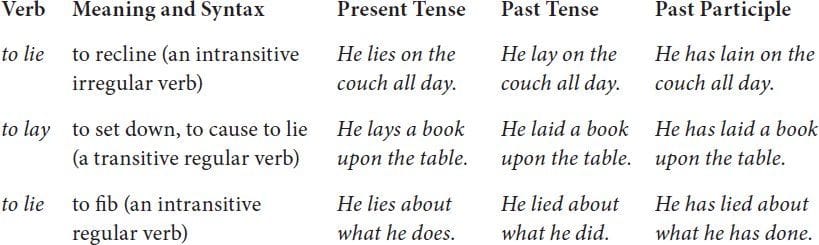
The imbroglio arises from the fact that we have two distinct verbs fighting over the form lay: it’s the past tense of lie, and it’s the plain form of lay, whose meaning—just to torment you further—is “cause to lie.” It’s no wonder that English speakers commonly say lay down or I’m going to lay on the couch, collapsing the transitive and intransitive versions of lie. Or are they collapsing the past and present tenses of lie? Both have same result:
| *to lay | to recline (an intransitive regular verb) | *He lays on the couch all day. | *He laid on the couch all day. | *He has laid on the couch all day. |
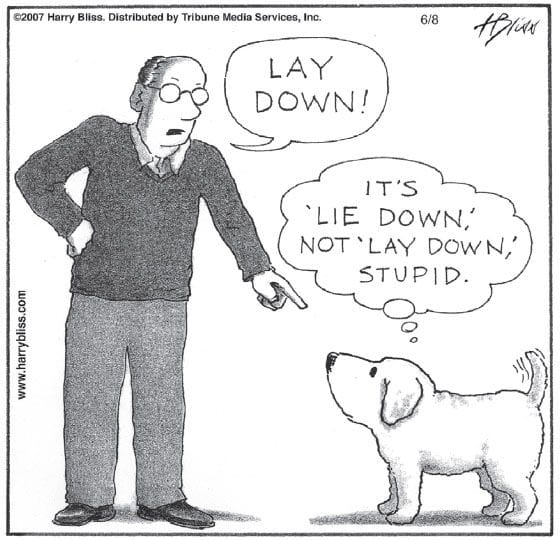
Don’t blame the usage on Bob Dylan’s “Lay, Lady, Lay” or Eric Clapton’s “Lay Down, Sally”; careful English writers have been using it since 1300, right up to William Safire’s “The dead hand of the present should not lay on the future” (no doubt triggering a flurry of mail for his UofAllPeople file). Intransitive lay is by no means incorrect, but to the ears of many, lie sounds better:
PUNCTUATION
The main job of punctuation is to eliminate the ambiguities and garden paths that would mislead a reader if print consisted only of vowels, consonants, and spaces.58 Punctuation restores some of the prosody (melody, pausing, and stress) that is missing from print, and it provides hints about the invisible syntactic tree that determines a sentence’s meaning. As the T-shirt observes, punctuation matters: Let’s eat, Grandma has a different meaning from Let’s eat Grandma.
The problem for the writer is that punctuation indicates prosody in some places, syntax in others, and neither of them consistently anywhere. After centuries of chaos, the rules of punctuation began to settle down only a bit more than a century ago, and even today the rules differ on the two sides of the Atlantic and from one publication to another. The rules, moreover, are subject to changes in fashion, including an ongoing trend to reduce all punctuation to the bare minimum. They fill scores of pages in reference manuals, and no one but a professional copy editor knows them all. Even the sticklers can’t agree on how to stickle. In 2003 the journalist Lynne Truss published the unlikely bestseller Eats, Shoots & Leaves: The Zero Tolerance Approach to Punctuation (whose title comes from the punch line of a joke about a panda who shot up a restaurant because he had read a mispunctuated description of his dietary habits). In her book Truss decries the punctuation errors she spotted in ads, signs, and newspapers. In a 2004 New Yorker review, the critic Louis Menand decries the punctuation errors he spotted in Truss’s book. In a Guardian article on the response to Truss, the English scholar John Mullan decries the punctuation flaws he spotted in Menand’s review.59
Still, a few common errors are so uncontroversial—the run-on sentence, the comma splice, the grocer’s apostrophe, the comma between subject and predicate, the possessive it’s—that they have become tantamount to the confession “I am illiterate,” and no writer should be caught making them. As I mentioned, the problem with these errors is not that they betray an absence of logical thinking but that they betray a history of inattention to the printed page. In the hope that an ability to distinguish the logical and illogical features of punctuation may help a reader master both, I’ll say a few words about the design of the system, highlighting the major bugs that have been locked into it.
commas and other connectors (colons, semicolons, and dashes). The first of the comma’s two major functions is to separate parenthetical comments about an event or a state—the time, place, manner, purpose, result, significance, writer’s opinion, and other by-the-way remarks—from the words that are necessary to pin down the event or state itself. We already met this function in the distinction between restrictive and nonrestrictive relative clauses. A restrictive relative clause, such as the one in Sticklers who don’t understand the conventions of punctuation shouldn’t criticize errors by others, is free of commas, and thereby singles out a subset of sticklers, namely those who don’t understand the conventions of punctuation. The same phrase set off by commas, Sticklers, who don’t understand the conventions of punctuation, shouldn’t criticize errors by others, slips in a snide comment on the competence of a typical stickler, but that jibe is irrelevant to the advice conveyed by the sentence, which is offered to sticklers across the board.
The traditional terms “restrictive” and “nonrestrictive” are misnomers, because the comma-less versions (called “integrated relative clauses” by the Cambridge Grammar) don’t always restrict the referents of the noun to some subset. What they do is specify information that is necessary to make the sentence true. In the sentence Barbara has two sons whom she can rely on and hence is not unduly worried, the underlined relative clause does not pare down the set of Barbara’s sons from the full brood to just the two she can rely on; she may only have two. It indicates that because those two sons are sons on whom Barbara can rely, therefore she has no need to worry.60
And that is a key to understanding where to put commas in other constructions. Commas set off a phrase that is not an integral constituent of the sentence, and which as a result is not essential to understanding its meaning. The sentence Susan visited her friend Teresa tells us that it’s important for us to know that Susan singled out Teresa as the person she intended to visit. In Susan visited her friend, Teresa, it’s only significant that Susan visited a friend (oh, and by the way, the friend’s name is Teresa). In the headline NATIONAL ZOO PANDA GIVES BIRTH TO 2ND, STILLBORN CUB, the comma between the two modifiers indicates that the panda gave birth to a second cub and (here’s another fact) the cub was stillborn. Without the comma, the stillborn would be embedded beneath the 2nd in the tree, and the meaning would be that this is the second time she has given birth to a stillborn cub. Strings of modifiers without commas progressively narrow down the referent of a noun, like nested circles in a Venn diagram, whereas strings of modifiers with commas just keep adding interesting facts about it, like overlapping circles. If the phrase had been 2nd, stillborn, male cub we would now know one more fact about the dead offspring, namely that it was male. If it had been 2nd stillborn male cub we would know that the previous stillborn cub was male, too.
This doesn’t sound all that hard. So why are there so many comma errors out there for the zero-tolerance squad to get incensed about? Why do comma errors account for more than a quarter of all language errors in student papers, occurring at a rate of about four errors per paper?61 The main reason is that a comma does not just signal a syntactic break (marking a phrase that is not integrated into a larger phrase) together with the corresponding semantic break (marking a meaning that is not essential to the meaning of the sentence). It also signals a prosodic break: a slight pause in pronunciation. Now, often these breaks line up: a supplementary phrase, the kind that calls for a comma, is typically preceded and followed by a pause. But often they do not line up, and that lays out a minefield for an inexperienced or inattentive writer.
When a supplementary phrase is short a speaker naturally skates right over it to the next phrase in the sentence, and the current rules of punctuation give writers the option of going with the sound and leaving out the commas—as I did just now, omitting the comma after short. The rationale is that too many commas too close together can give a sentence a herky-jerky feel. Also, since a sentence may have many levels of branching while English provides only the puny comma to separate them all on the page, a writer may choose to keep the comma in reserve to demarcate the major branches in the tree, rather than dicing the sentence into many small pieces that the reader must then reassemble. The reason I refrained from inserting a comma after When a supplementary phrase is short was that I wanted the comma between the end of that clause and the beginning of the next one to neatly cleave the sentence in two. The cleft would have been obscured if the first clause had also been riven by a comma. Here are some other sentences in which the comma may be omitted, at least in a “light” or “open” punctuation style, because the following phrase is short and clear enough not to require a pause before it:
Man plans and God laughs.
If you lived here you’d be home by now.
By the time I get to Phoenix she’ll be rising.
Einstein he’s not.
But it’s all right now; in fact it’s a gas!
Frankly my dear, I don’t give a damn.
That is the choice that Lynne Truss made in the dedication to Eats, Shoots & Leaves:
To the memory of the striking Bolshevik printers of St Petersburg who, in 1905, demanded to be paid the same rate for punctuation marks as for letters, and thereby directly precipitated the first Russian Revolution.
Menand poked fun at her, pointing out that the relative clause beginning with who was nonrestrictive (Truss meant to dedicate her book to all the striking printers, not to a subset who demanded payment for punctuation) and thus demanded a comma before it. Truss’s defenders pointed out that the alternative (To the striking Bolshevik printers of St Petersburg, who, in 1905, demanded …) would have been awkwardly thick with commas, forcing the reader to hopscotch through that part of the sentence a word or two at a time. One pointed out that Menand was universalizing the famously eccentric policy of his major outlet, The New Yorker, which sets off all supplementary phrases with commas, no matter how gratuitous in context or how juddering the pronunciation. Consider this sentence from a 2012 New Yorker article on electoral strategists for the Republican Party: 62
Before [Lee] Atwater died, of brain cancer, in 1991, he expressed regret over the “naked cruelty” he had shown to [Michael] Dukakis in making “Willie Horton his running mate.”
The commas around of brain cancer are there to make it clear that the cause of death is mentioned as a mere comment: it isn’t the case that Atwater died multiple times and that he expressed remorse only after his brain-cancer death, not after the other ones. This fussiness is too much even for some of The New Yorker’s own copy editors, one of whom kept a “comma-shaker” on her desk to remind her colleagues to sprinkle them more sparingly.63
Not only are commas partly regulated by prosody, but until recently that was their principal function. Writers used to place them wherever they thought a pause felt natural, regardless of the sentence’s syntax:
It is a truth universally acknowledged, that a single man in possession of a good fortune, must be in want of a wife.
A well-regulated militia, being necessary to the security of a free state, the right of the people to keep and bear arms, shall not be infringed.
Jane Austen and the framers of the American Constitution would get poor grades from composition teachers today, because commas are regulated less by prosody and more by syntax (this is the trend that The New Yorker has taken to an extreme). Austen’s sentence today would be stripped of both commas, and the Second Amendment would get to keep only the one after “free state.”
Though the comma which demarcates a supplementary phrase may be omitted when the pronunciation zips right through it, the converse is no longer true: a comma may not separate the elements of an integrated phrase (such as a subject and its predicate), no matter how badly its narrator may want to take a breath at that juncture. With the rules for comma placement being such a mishmash of syntax and prosody, it’s no wonder that the complaints of composition instructors about comma placement in their students’ writing fall into the same two categories as the complaints of people writing to Ann Landers about sex in their marriages: (1) too much, and (2) too little.64
In the “too much” category we have errors in which students place a comma in front of an integrated phrase, usually because they would pause at that point in pronouncing it:
[Between the subject and a predicate:] His brilliant mind and curiosity, have left.
[Between the verb and its complement:] He mentions, that not knowing how to bring someone back can be a deadly problem.
[Between a noun for an idea and a clause spelling out its content:] I believe the theory, that burning fossil fuels has caused global warming.
[Between a noun and an integrated relative clause:] The ethnocentric view, that many Americans have, leads to much conflict in the world.
[Between a subordinator and its clause:] There was a woman taking care of her husband because, an accident left him unable to work.
[Within a coordination of two phrases:] This conclusion also applies to the United States, and the rest of the world.
[Between a definite generic noun and the name identifying its referent (neither comma is correct here):] I went to see the movie, “Midnight in Paris” with my friend, Jessie.
And in the “too little” category, students forget to insert a comma to set off a supplementary word or phrase:
[Surrounding a sentence adverb:] In many ways however life in a small town is much more pleasant.
[Between a preposed adjunct and the main clause:] Using a scooping motion toss it in the air.
[Before a result adjunct:] The molecule has one double bond between carbons generating a monounsaturated fat.
[Before a contrast adjunct:] Their religion is all for equal rights yet they have no freedom.
[Before a supplementary relative clause:] There are monounsaturated fatty acids which lack two hydrogen atoms.
[Before a direct quotation:] She said “I don’t want to go.” [Compare the complementary error with an indirect quotation: She said that, she didn’t want to go.]
Sloppy writers also tend to forget that when a supplementary phrase is poked into the middle of a sentence, it needs to be set off with commas at both ends, like matching parentheses, not just at the beginning:
Tsui’s poem “A Chinese Banquet,” on the other hand partly focuses on Asian culture.
One of the women, Esra Naama stated her case.
Philip Roth, author of “Portnoy’s Complaint” and many other books is a perennial contender for the Nobel Prize.
My father, who gave new meaning to the expression “hard working” never took a vacation.
The other comma mistake is so common that composition teachers have invented many terms of abuse for it: the comma splice, comma error, comma fault, and comma blunder. It consists in using a comma to join two complete sentences, each of which could stand on its own:
There isn’t much variety, everything looks kind of the same.
I am going to try and outline the logic again briefly here, please let me know if this is still unclear.
Your lecture is scheduled for 5:00 pm on Tuesday, it is preceded by a meeting with our seminar hosts.
There is no trail, visitors must hike up the creek bed.
Unskilled writers are tempted to splice two sentences with a comma when the sentences are conceptually linked by one of the coherence relations discussed in chapter 5 and seem to want to snuggle up together in a single ensemble. But there are two reasons that comma splices drive careful readers crazy. (I won’t tolerate them in my students’ writing, not even in email.) They always create a garden path, distracting and annoying the reader. And they are easy to avoid, requiring no greater skill than the ability to identify a sentence.
There are several legitimate ways to splice two sentences, depending on the coherence relation that connects them. When two sentences are conceptually pretty much independent, the first should end with a period and the next should begin with a capital, just like they teach you in third grade. When the two are conceptually linked but the writer feels no need to pinpoint the coherence relation that holds between them, they can be joined with a semicolon; the semicolon is the all-purpose way to eliminate a comma splice. When the coherence relation is elaboration or exemplification (when one is tempted to say that is, in other words, which is to say, for example, here’s what I have in mind, or Voilà!), they may be linked with a colon: like this. When the second sentence intentionally interrupts the flow of the discussion, requiring the reader to wake up, think twice, or snap out of it, a writer can use a dash—dashes can enliven writing, as long as they are used sparingly. And when the writer pinpoints the coherence relation he has in mind with an explicit connective such as a coordinator (and, or, but, yet, so, nor) or a preposition (although, except, if, before, after, because, for), a comma is fine, because the phrase is a mere supplement (like the underlined clause, which I fastened to the preceding one with a comma). Just don’t confuse these connectives with sentence adverbs, such as however, nonetheless, consequently, or therefore, which are themselves supplements of the clause they precede. The clause with the adverb is a freestanding sentence; consequently, it cannot be joined to its predecessor with a comma. Here, then, are the possibilities (the asterisk indicates an illicit comma splice):
*Your lecture is scheduled for 5 PM, it is preceded by a meeting.
Your lecture is scheduled for 5 PM; it is preceded by a meeting.
Your lecture is scheduled for 5 PM—it is preceded by a meeting.
Your lecture is scheduled for 5 PM, but it is preceded by a meeting.
Your lecture is scheduled for 5 PM; however, it is preceded by a meeting.
*Your lecture is scheduled for 5 PM, however, it is preceded by a meeting.
The other bit of comma jargon that has spread beyond the world of copyediting is the serial comma or Oxford comma. It pertains to the second major function of the comma, which is to separate the items in a list. Everyone knows that when two items are joined with a conjunction, they cannot have a comma joining them, too: Simon and Garfunkel, not Simon, and Garfunkel. But when three or more items are joined, a comma must introduce every subsequent item except—and here comes the controversy—the last one: Crosby, Stills and Nash; Crosby, Stills, Nash and Young. The controversial question is whether you should also put a comma before the final item, resulting in Crosby, Stills, and Nash, or Crosby, Stills, Nash, and Young. This is the serial comma. On one side we have most British publishers (other than Oxford University Press), most American newspapers, and the rock group that calls itself Crosby, Stills and Nash. They argue that an item in a list should be introduced either with and or with a comma, not redundantly with both. On the other side we have Oxford University Press, most American book publishers, and the many wise guys who have discovered that omitting a serial comma can result in ambiguity:65
Among those interviewed were Merle Haggard’s two ex-wives, Kris Kristofferson and Robert Duvall.
This book is dedicated to my parents, Ayn Rand and God.
Highlights of Peter Ustinov’s global tour include encounters with Nelson Mandela, an 800-year-old demigod and a dildo collector.
The absence of a serial comma in a list of phrases can also create garden paths. He enjoyed his farm, conversations with his wife and his horse momentarily calls to mind the famous Mister Ed, and a reader who is unfamiliar with the popular music of the 1970s might well be tripped up by the sentence on the left, stumbling over the mythical duo Nash and Young and the run-on sequence Lake and Palmer and Seals and Crofts:
| Without the serial comma: | With the serial comma: |
| My favorite performers of the 1970s are Simon and Garfunkel, Crosby, Stills, Nash and Young, Emerson, Lake and Palmer and Seals and Crofts. | My favorite performers of the 1970s are Simon and Garfunkel, Crosby, Stills, Nash, and Young, Emerson, Lake, and Palmer, and Seals and Crofts. |
I say that unless a house style forbids it, you should use the serial comma. And if you’re enumerating lists of lists, then you can eliminate all ambiguity by availing yourself of one of the few punctuation tricks in English that explicitly signal tree structure, the use of a semicolon to demarcate lists of phrases containing commas:
My favorite performers of the 1970s are Simon and Garfunkel; Crosby, Stills, Nash, and Young; Emerson, Lake, and Palmer; and Seals and Crofts.
apostrophes. The serial comma is not the only punctuation sin that will hurt you in life:
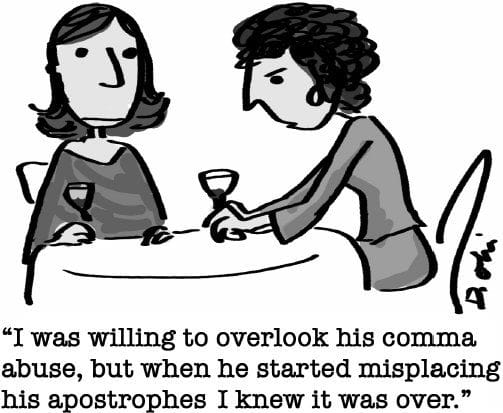
The disenchanted girlfriend, I surmise, is referring to three common errors with apostrophes. If I were her companion, I would advise her to consider which quality she values more in a soulmate, logic or literacy, because each of the errors is thoroughly systematic, albeit contrary to accepted usage.
The first is the grocer’s apostrophe, as in APPLE’S 99¢ EACH. The error is by no means restricted to grocers; the British press had a field day when a protesting student was spotted with the sign DOWN WITH FEE’S. The rule is straightforward: the plural s may not be connected to a noun using an apostrophe, but must be jammed right up against it without punctuation—apples, fees.
The error seduces grocers and students with three lures. One is that it is easy to confuse the plural s with the genitive ’s and the contraction ’s, both of which require an apostrophe: the apple’s color is impeccable, as is This apple’s sweet. Second, the grocers are, if anything, too conscious of grammatical structure: they seem to want to signal the difference between the phoneme s that is an intrinsic part of a word and the morpheme –s that is tacked on to mark the plural, as in the distinction between lens and pens (pen + –s), or species and genies. Marking a morpheme boundary is particularly tempting with words that end in vowels, because the correct, unpunctuated plural makes the word look like something else entirely, as in radios (which looks like adios) and avocados (which looks like asbestos). Perhaps if the grocers had their way and plurals were consistently marked with apostrophes (radio’s, avocado’s, potato’s, and so on), no one would ever mistakenly refer to a kudo (the word is kudos, a singular Greek noun meaning “praise”), and Dan Quayle would have been spared the embarrassment of publicly miscorrecting a schoolchild’s potato to potatoe. Most seductively of all, the rule banning apostrophes in plurals is not as straightforward as I said it was. With some nouns, an apostrophe really is (or at least was) legitimate. The apostrophe is mandatory with a letter of the alphabet (p’s and q’s) and common with words mentioned as words (There are too many however’s in this paragraph), unless they are clichés like dos and don’ts or no ifs, ands, or buts. Before the recent trend toward light punctuation, apostrophes were often used to pluralize years (the 1970’s), abbreviations (CPU’s), and symbols (@’s), and in some newspapers (such as the New York Times) they still are.66
The rules may not be logical, but if you want your literate lover not to leave you, don’t pluralize with an apostrophe. It’s also a good idea to know when to keep an apostrophe away from a pronoun. Dave Barry’s alter ego Mr. Language Person fielded the following question:
Q: Like millions of Americans, I cannot grasp the extremely subtle difference between the words “your” and “you’re.”
A: … The best way to tell them apart is to remember that “you’re” is a contraction, which is a type of word used during childbirth, as in: “Hang on, Marlene, here comes you’re baby!” Whereas “your” is, grammatically, a prosthetic infarction, which means a word that is used to score a debating point in an Internet chat room, as in: “Your a looser, you morron!”
The first part of Mr. Language Person’s answer is correct: an apostrophe must be used to mark the contraction of an auxiliary with a pronoun, as in you’re (you are), he’s (he is), and we’d (we would). And his first example (assuming you get the joke that you’re baby is mispunctuated) is also correct: an apostrophe is never used to mark the genitive (possessive) of a pronoun, no matter how logical it may seem to do so. Although we write the cat’s pajamas and Dylan’s dream, as soon as you replace the noun with a pronoun the apostrophe goes out the window: one must write its pajamas, not it’s pajamas; your baby, not you’re baby; their car, not they’re car; Those hats are hers, ours, and theirs, not Those hats are her’s, our’s, and their’s. Deep in the mists of time, someone decided that an apostrophe doesn’t belong in a possessive pronoun, and you’ll just have to live with it.
The last of the great apostrophe errors is explained in this cartoon, in which the boy shows that an unconventional family does not necessarily lead to unconventional punctuation:
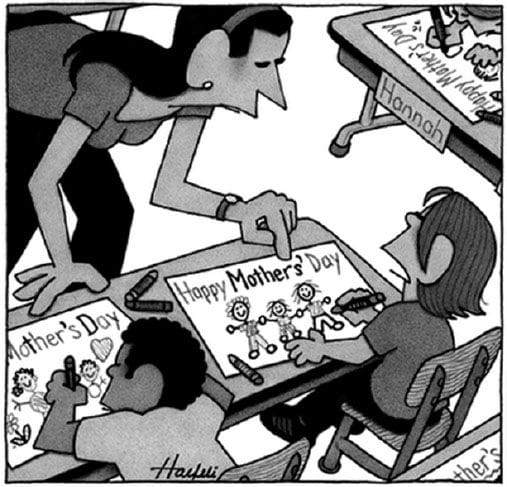
“I have two mommies. I know where the apostrophe goes.”
The possessive of a singular is spelled ’s: He is his mother’s son. The possessive of a regular plural is spelled s’: He is his parents’ son, or, with a same-sex couple, He is his mothers’ son. As for names ending in s like Charles and Jones, go with grammatical logic and treat them as the singulars they are: Charles’s son, not Charles’ son. Some manuals stipulate an exception for Moses and Jesus, but grammarians should make no law respecting an establishment of religion, and the exception in fact applies to other ancient names ending in s (Achilles’ heel, Sophocles’ play).67 It also applies to modern names which already end with a ses sound, whose genitives contain the tongue-twister seses (Kansas’, Texas’).
quotation marks. Another insult to punctuational punctiliousness is the use of quotation marks for emphasis, commonly seen in signs like WE SELL “ICE”, CELL PHONES MAY “NOT” BE USED IN THIS AREA, and the disconcerting “FRESH” SEAFOOD PLATTER and even more disconcerting EMPLOYEES MUST “WASH HANDS”. The error is common enough to have inspired the cartoon on the following page.
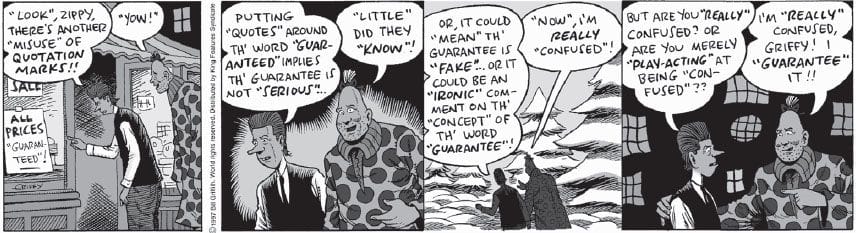
Why do so many signmakers commit the error? What they are doing is what we all used to do in the Paleolithic days of word processing, when terminals and printers lacked italics and underlining (and what many of us still do when composing email in plain text format), which is to emphasize a word by bracketing it with symbols, like *this* or _this_ or <this>. But not like “this”. As Griffy explains in the cartoon, quotation marks already have a standard function: they signal that the author is not using words to convey their usual meaning but merely mentioning them as words. If you use quotation marks for emphasis, readers will think you’re unschooled or worse.
No discussion of the illogic of punctuation would be complete without the infamous case of the ordering of a quotation mark with respect to a comma or period. The rule in American publications (the British are more sensible about this) is that when quoted material appears at the end of a phrase or sentence, the closing quotation mark goes outside the comma or period, “like this,” rather than inside, “like this”. The practice is patently illogical: the quotation marks enclose a part of the phrase or sentence, and the comma or period signals the end of that entire phrase or sentence, so putting the comma or period inside the quotation marks is like Superman’s famous wardrobe malfunction of wearing his underwear outside his pants. But long ago some American printer decided that the page looks prettier without all that unsightly white space above and to the left of a naked period or comma, and we have been living with the consequences ever since.
The American punctuation rule sticks in the craw of every computer scientist, logician, and linguist, because any ordering of typographical delimiters that fails to reflect the logical nesting of the content makes a shambles of their work. On top of its galling irrationality, the American rule prevents a writer from expressing certain thoughts. In his semi-serious 1984 essay “Punctuation and Human Freedom,” Geoffrey Pullum discusses the commonly misquoted first two lines of Shakespeare’s King Richard III: “Now is the winter of our discontent / Made glorious summer by this sun of York.”68 Many people misremember it as “Now is the winter of our discontent”, full stop. Now suppose one wanted to comment on the error by writing:
Shakespeare’s King Richard III contains the line “Now is the winter of our discontent”.
This is a true sentence. But an American copy editor would change it to:
Shakespeare’s King Richard III contains the line “Now is the winter of our discontent.”
But this is a false sentence, or at least there’s no way for the writer to make it unambiguously true or false. Pullum called for a campaign of civil disobedience, and with the subsequent rise of the Internet his wish has come true. Many logic-conscious and computer-savvy writers have taken advantage of the freedom from copy editors they enjoy on the Web and have explicitly disavowed the American system, most notably on Wikipedia, which has endorsed the alternative called Logical Punctuation.69 Punctuation nerds may have noticed that I myself recently defied the American rule in four places (underlined):
The final insult to punctuational punctiliousness is the use of quotation marks for emphasis, commonly seen in signs like WE SELL “ICE”, CELL PHONES MAY “NOT” BE USED IN THIS AREA, and the disconcerting “FRESH” SEAFOOD PLATTER and even more disconcerting EMPLOYEES MUST “WASH HANDS”.
But not like “this”.
Many people misremember it as “Now is the winter of our discontent”, full stop.
These acts of civil disobedience were necessary to make it clear where the punctuation marks went in the examples I was citing. You should do the same if you ever need to discuss quotations or punctuation, if you write for Wikipedia or another tech-friendly platform, or if you have a temperament that is both logical and rebellious. The movement may someday change typographical practice in the same way that the feminist movement in the 1970s replaced Miss and Mrs. with Ms. But until that day comes, if you write for an edited American publication, be prepared to live with the illogic of putting a period or comma inside quotation marks.
I hope to have convinced you that dealing with matters of usage is not like playing chess, proving theorems, or solving textbook problems in physics, where the rules are clear and flouting them is an error. It is more like research, journalism, criticism, and other exercises of discernment. In considering questions of usage, a writer must critically evaluate claims of correctness, discount the dubious ones, and make choices which inevitably trade off conflicting values.
Anyone who reviews the history of prescriptive grammar can’t help but be struck by the misplaced emotion the topic evokes. At least since Henry Higgins decried “the cold-blooded murder of the English tongue,” the self-proclaimed defenders of high standards have been outdoing each other with tasteless invective.70 David Foster Wallace expressed “despair” at the “Evil” inherent in “voguish linguistic methane.” David Gelernter refers to advocates of singular they as “language rapists,” while John Simon has likened the people who use words in ways he disapproves of to slave traders, child molesters, and the guards at Nazi death camps. The hyperbole often shades into misanthropy, as when Lynne Truss suggests that people who misuse apostrophes “deserve to be struck by lightning, hacked up on the spot and buried in an unmarked grave.” Robert Hartwell Fiske, after calling humongous a “hideous, ugly word,” adds, “Though it’s not fair to say that people who use the word are hideous and ugly as well, at some point we come to be—or at the least are known by—what we say, what we write.”
The irony, of course, is that all too often it is the targets of the vituperation who have history and usage on their side, and the vilifiers who are full of baloney. Geoffrey Pullum, whose Language Log analyzes claims about the use and misuse of language, has noted the tendency among faultfinders “to move straight to high dudgeon, skipping right over the stage where you check the reference books to make sure you have something to be in high dudgeon about. … People just don’t look in reference books when it comes to language; they seem to think their status as writers combined with their emotion of anger gives them all the standing they need.”71
Though correct usage is well worth pursuing, we have to keep it in perspective. Not even the most irksome errors are portents of the death of the language, to say nothing of civilization, as the webcomic XKCD reminds us:
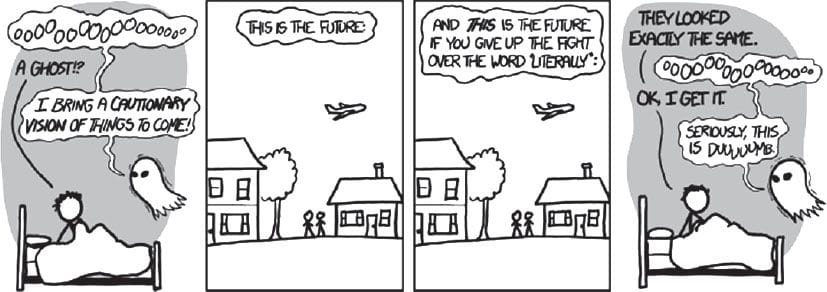
Yes, writers today sometimes make unfortunate choices. But so did the writers of yesterday and the day before, while many of the kids today, the target of so much purist bile, write gorgeous prose, comment incisively on usage, and even develop their own forms of purism (such as the Typo Eradication Advancement League, which stealthily corrects grocers’ signs with correction fluid and felt markers).72
And for all the vitriol brought out by matters of correct usage, they are the smallest part of good writing. They pale in importance behind coherence, classic style, and overcoming the curse of knowledge, to say nothing of standards of intellectual conscientiousness. If you really want to improve the quality of your writing, or if you want to thunder about sins in the writing of others, the principles you should worry about the most are not the ones that govern fused participles and possessive antecedents but the ones that govern critical thinking and factual diligence. Here are a few which are commonly flouted—not least in purist rants—and which are worth bearing in mind every time you put pen to paper or fingers to keyboard.
First, look things up. Humans are cursed with the deadly combination of a highly fallible memory and an overconfidence in how much they know.73 Our social networks, traditional and electronic, multiply the errors, so that much of our conventional wisdom consists of friend-of-a-friend legends and factoids that are too good to be true. As Mark Twain said, “The trouble with the world is not that people know too little, but that they know so many things that aren’t so.” Actually, he didn’t say that—I looked it up.74 But whoever said it (probably Josh Billings) made an important point. We are blessed to live in an age in which no subject has gone unresearched by scholars, scientists, and journalists. The fruits of their research are available within seconds to anyone with a laptop or smartphone, and within minutes to anyone who can get to a library. Why not take advantage of these blessings and try to restrict the things you know (or at least the things you write) to things that are true?
Second, be sure your arguments are sound. If you are making a factual claim, it should be verifiable in an edited source—one that has been vetted by disinterested gatekeepers such as editors, fact-checkers, or peer reviewers. If you’re making an argument, it should proceed from premises that reasonable people already agree upon to your newer or more contentious assertion using valid if-then steps. If you’re making a moral argument—a claim about what people ought to do—you should show how doing it would satisfy a principle or increase a good that reasonable people already accept.
Third, don’t confuse an anecdote or a personal experience with the state of the world. Just because something happened to you, or you read about it in the paper or on the Internet this morning, it doesn’t mean it is a trend. In a world of seven billion people, just about anything will happen to someone somewhere, and it’s the highly unusual events that will be selected for the news or passed along to friends. An event is a significant phenomenon only if it happens some appreciable number of times relative to the opportunities for it to occur, and it is a trend only if that proportion has been shown to change over time.
Fourth, beware of false dichotomies. Though it’s fun to reduce a complex issue to a war between two slogans, two camps, or two schools of thought, it is rarely a path to understanding. Few good ideas can be insightfully captured in a single word ending with -ism, and most of our ideas are so crude that we can make more progress by analyzing and refining them than by pitting them against each other in a winner-take-all contest.
Finally, arguments should be based on reasons, not people. Saying that someone you disagree with is motivated by money, fame, politics, or laziness, or slinging around insults like simplistic, naïve, or vulgar, does not prove that the things the person is saying are false. Nor is the point of disagreement or criticism to show that you are smarter or nobler than your target. Psychologists have shown that in any dispute both sides are convinced that they themselves are reasonable and upright and that their opposite numbers are mulish and dishonest.75 They can’t all be right, at least not all the time. Keep in mind a bit of wisdom from the linguist Ann Farmer: “It isn’t about being right. It’s about getting it right.”
All of these principles lead us back to why we should care about style in the first place. There is no dichotomy between describing how people use language and prescribing how they might use it more effectively. We can share our advice on how to write well without treating the people in need of it with contempt. We can try to remedy shortcomings in writing without bemoaning the degeneration of the language. And we can remind ourselves of the reasons to strive for good style: to enhance the spread of ideas, to exemplify attention to detail, and to add to the beauty of the world.