Chapter 6
Telling Right from Wrong
HOW TO MAKE SENSE OF THE RULES OF CORRECT GRAMMAR, WORD CHOICE, AND PUNCTUATION
Many people have strong opinions on the quality of language today. They write books and articles deploring it, fire off letters to the editor, and call in to radio talk shows with their criticisms and complaints. I have found that few of these objections single out clarity or grace or coherence. Their concern is correct usage—rules of proper English such as these:
- The word less may not be used for countable items, as in the sign over the supermarket express lane which restricts customers to TEN ITEMS OR LESS; the sign should read TEN ITEMS OR FEWER.
- A modifier may not contain a dangling participle, such as Lying in bed, everything seemed so different, where the implicit subject of the participle lying (I) is different from the subject of the main clause (everything).
- The verb aggravate does not mean “annoy”; it means “make worse.”
The purists who call out these errors see them as symptomatic of a decline in the quality of communication and reasoning in our culture today. As one columnist put it, “I’m concerned about a country that’s not quite sure what it’s saying and doesn’t seem to care.”
It’s not hard to see how these worries arose. There is a kind of writer who makes issues of usage impossible to ignore. These writers are incurious about the logic and history of the English language and the ways in which it has been used by its exemplary stylists. They have a tin ear for its nuances of meaning and emphasis. Too lazy to crack open a dictionary, they are led by gut feeling and intuition rather than attention to careful scholarship. For these writers, language is not a vehicle for clarity and grace but a way to signal their membership in a social clique.
Who are these writers? You might think I’m referring to Twittering teenagers or Facebooking freshmen. But the writers I have in mind are the purists—also known as sticklers, pedants, peevers, snobs, snoots, nitpickers, traditionalists, language police, usage nannies, grammar Nazis, and the Gotcha! Gang. In their zeal to purify usage and safeguard the language, they have made it difficult to think clearly about felicity in expression and have muddied the task of explaining the art of writing.
The goal of this chapter is to allow you to reason your way to avoiding the major errors of grammar, word choice, and punctuation. In announcing this goal shortly after making fun of the language police, I might seem to be contradicting myself. If this is your reaction, you are a victim of the confusion sown by the sticklers. The idea that there are exactly two approaches to usage—all the traditional rules must be followed, or else anything goes—is the sticklers’ founding myth. The first step in mastering usage is to understand why the myth is wrong.
The myth goes like this:
Once upon a time, people cared about using language properly. They consulted dictionaries to look up correct information about word meanings and grammatical constructions. The makers of these dictionaries were Prescriptivists: they prescribed correct usage. Prescriptivists uphold standards of excellence and a respect for the best of our civilization, and are a bulwark against relativism, vulgar populism, and the dumbing down of literate culture.
In the 1960s an opposing school emerged, inspired by academic linguistics and theories of progressive education. The ringleaders of this school are Descriptivists: they describe how language actually is used rather than prescribing how it ought to be used. Descriptivists believe that the rules of correct usage are nothing more than the secret handshake of the ruling class, designed to keep the masses in their place. Language is an organic product of human creativity, say the Descriptivists, and people should be allowed to write however they please.
The Descriptivists are hypocrites: they adhere to standards of correct usage in their own writing but discourage the teaching and dissemination of those standards to others, thereby denying the possibility of social advancement to the less privileged.
The Descriptivists had their way with the publication of Webster’s Third New International Dictionary in 1961, which accepted such errors as ain’t and irregardless. This created a backlash that led to Prescriptivist dictionaries such as The American Heritage Dictionary of the English Language. Ever since then, Prescriptivists and Descriptivists have been doing battle over whether writers should care about correctness.
What’s wrong with this fairy tale? Pretty much everything. Let’s begin with the very idea of objective correctness in language.
What does it mean to say that it is incorrect to end a sentence with a preposition, or to use decimate to mean “destroy most of” rather than “destroy a tenth of”? After all, these are not logical truths that one could prove like theorems, nor are they scientific discoveries one could make in the lab. And they are certainly not the stipulations of some governing body, like the rules of Major League Baseball. Many people assume that there is such a governing body, namely the makers of dictionaries, but as chair of the Usage Panel of the famously prescriptive American Heritage Dictionary (AHD), I am here to tell you that this assumption is false. When I asked the editor of the dictionary how he and his colleagues decide what goes into it, he replied, “We pay attention to the way people use language.”
That’s right: when it comes to correct English, there’s no one in charge; the lunatics are running the asylum. The editors of a dictionary read a lot, keeping their eyes open for new words and senses that are used by many writers in many contexts, and the editors add or change the definitions accordingly. Purists are often offended when they learn that this is how dictionaries are written. In his famous 1962 smackdown of Webster’s Third, the literary critic Dwight Macdonald declared that even if nine-tenths of English speakers were to use a word incorrectly (say, nauseous meaning “nauseated” rather than “nauseating”), the remaining tenth would be correct (he did not say by what criterion or on whose authority), and the dictionaries should back them up.1 But no lexicographer could carry out Macdonald’s mandate. A dictionary that instructed its users to write in a way that guaranteed they would be misunderstood would be as useless as the Hungarian–English phrasebook in the Monty Python sketch which translated “Can you direct me to the train station?” as Please fondle my buttocks.
At the same time, there is something that is objectively true about usage. We can all agree that George W. Bush spoke incorrectly when he asked, “Is our children learning?”—and when he used inebriating to mean “exhilarating,” referred to the citizens of Greece as “Grecians,” and lamented policies that “vulcanize” (rather than Balkanize) society. Even Bush, in a self-deprecating speech, agreed that these were errors.2
So how can we reconcile the conviction that certain usages are wrong with the absence of any authority that ever decided what was right? The key is to recognize that the rules of usage are tacit conventions. A convention is an agreement among the members of a community to abide by a single way of doing things. There need not be any inherent advantage to which choice is made, but there is an advantage to everyone making the same choice. Familiar examples include standardized weights and measures, electrical voltages and cables, computer file formats, and paper currency.
The conventions of written prose represent a similar standardization. Countless idioms, word senses, and grammatical constructions have been coined and circulated by the universe of English speakers. Linguists capture their regularities in “descriptive rules”—that is, rules that describe how people speak and understand. Here are a few of them:
- The subject of a tensed verb must be in nominative case, such as I, he, she, and they.
- The first-person singular form of the verb be is am.
- The verb vulcanize means “to strengthen a material such as rubber by combining it with sulfur and then applying heat and pressure.”
Many of these rules have become entrenched in a vast community of English speakers, who respect the rules without ever having to think about them. That’s why we laugh at Cookie Monster, LOLcats, and George W. Bush.
A subset of these conventions are less widespread and natural, but they have become accepted by a smaller virtual community of literate speakers for use in public forums such as government, journalism, literature, business, and academia. These conventions are “prescriptive rules”—rules that prescribe how one ought to speak and write in these forums. Unlike the descriptive rules, many of the prescriptive rules have to be stated explicitly, because they are not second nature to most writers: the rules may not apply in the spoken vernacular, or they may be difficult to implement in complicated sentences which tax the writer’s memory (chapter 4). Examples include the rules that govern punctuation, complex forms of agreement, and fine semantic distinctions between uncommon words like militate and mitigate and credible and credulous.
What this means is that there is no such thing as a “language war” between Prescriptivists and Descriptivists. The alleged controversy is as bogus as other catchy dichotomies such as nature versus nurture and America: Love It or Leave It. It is true that descriptive and prescriptive rules are different kinds of things and that descriptive and prescriptive grammarians are engaged in different kinds of activities. But it’s not true that if one kind of grammarian is right then the other kind of grammarian is wrong.
Once again I can write from authority. I am, among other things, a descriptive linguist: a card-carrying member of the Linguistic Society of America who has written many articles and books on how people use their mother tongue, including words and constructions that are frowned upon by the purists. But the book you are holding is avowedly prescriptivist: it consists of several hundred pages in which I am bossing you around. While I am fascinated by the linguistic exuberance of the vox populi, I’d be the first to argue that having prescriptive rules is desirable, indeed indispensable, in many arenas of writing. They can lubricate comprehension, reduce misunderstanding, provide a stable platform for the development of style and grace, and signal that a writer has exercised care in crafting a passage.
Once you understand that prescriptive rules are the conventions of a specialized form of the language, most of the iptivist controversies evaporate. One of them surrounds the linguist’s defense of nonstandard forms like ain’t, brang, and can’t get no (the so-called double negative) against the common accusation that they are products of laziness or illogic (an accusation that easily mixes with racism or class prejudice). History tells us that the reason that standard English prefers the alternatives isn’t, brought, and can’t get any is not that the two versions were ever weighed on their merits and the standard forms discovered to be superior. No, they are just frozen historical accidents: the “correct” forms are those that happened to be used in the dialect spoken in the region around London when written English first became standardized several centuries ago. If history had unfolded differently, today’s correct forms could have been incorrect, and vice versa. The London dialect became the standard of education, government, and business, and it was also the dialect of better-educated and more affluent speakers throughout the Anglosphere. Double negatives, ain’t, and other nonstandard forms soon became stigmatized by their association with the less prestigious dialects of English used by its poorer and less educated speakers.
But the claim that there is nothing inherently wrong with ain’t (which is true) should not be confused with the claim that ain’t is one of the conventions of standard written English (which is obviously false). This distinction is lost on the purists, who worry that if we point out that people who say ain’t or He be working or ax a question are not lazy or careless, then we have no grounds for advising students and writers to avoid them in their prose. So here is an analogy. In the United Kingdom, everyone drives on the left, and there is nothing inherently wrong with that convention; it is in no way sinister, gauche, or socialist. Nonetheless, we have an excellent reason to encourage a person in the United States to drive on the right. There is a joke about a commuter who’s on his way to work when he gets a call on his mobile phone from his wife. “Be careful, honey,” she says. “They just said on the radio that there’s a maniac driving on the wrong side of the freeway.” “One maniac?” he replies; “There are thousands of them!”
And not even the supposedly descriptivist dictionaries leave their users in doubt as to what the standard forms are. The endlessly repeated claim that Webster’s Third treated ain’t as correct English is a myth.3 It originated in a press release from the publisher’s marketing department which announced “Ain’t gets official recognition at last.” The dictionary, quite reasonably, contained an entry in which people could learn about the word, including, of course, the fact that many speakers disapprove of it. Journalists misinterpreted the press release as saying that the dictionary listed ain’t without comment.
Another firestorm can be extinguished by recalling that the conventions of usage are tacit. The rules of standard English are not legislated by a tribunal of lexicographers but emerge as an implicit consensus within a virtual community of writers, readers, and editors. That consensus can change over the years in a process as unplanned and uncontrollable as the vagaries of fashion. No official ever decided that respectable men and women were permitted to doff their hats and gloves in the 1960s or to get pierced and tattooed in the 1990s. Nor could any authority with powers short of Mao Zedong have stopped them. In a similar manner, centuries of respectable writers have gradually shifted the collective consensus of what is right and wrong while shrugging off now-forgotten edicts by self-appointed guardians of the language. The nineteenth-century prescriptivist Richard White had no luck banning standpoint and washtub, nor did his contemporary William Cullen Bryant succeed in outlawing commence, compete, lengthy, and leniency. And we all know how successful Strunk and White were in forbidding to personalize, to contact, and six people. Lexicographers have always understood this. In resigning themselves to the role of chronicling ever-changing usage, they are acknowledging the wisdom of Thomas Carlyle’s famous reply to Margaret Fuller’s statement “I accept the universe”: “Gad! She’d better.”
Although lexicographers have neither the desire nor the power to prevent linguistic conventions from changing, this does not mean, as purists fear, that they cannot state the conventions in force at a given time. That is the rationale behind the American Heritage Dictionary’s Usage Panel: two hundred authors, journalists, editors, scholars, and other public figures whose writing shows that they choose their words with care. Every year they fill out questionnaires on pronunciation, meaning, and usage, and the dictionary reports the results in usage notes attached to entries for problematic words. The Usage Panel is intended to be a sample of the virtual community for whom careful writers write. When it comes to best practices in usage, there is no higher authority.
The powerlessness of dictionaries to enforce the prescriptivists’ dream of preventing linguistic change does not mean that the dictionaries are doomed to preside over a race to the bottom. Macdonald titled his 1962 review of Webster’s Third “The String Untuned,” an allusion to the calamitous violation of the natural order that Ulysses foresaw in Shakespeare’s Troilus and Cressida: “The bounded waters should lift their bosoms higher than the shores and make a sop of all this solid globe. Strength should be lord of imbecility and the rude son should strike his father dead.” As an example of the cataclysm that would result from Webster’s untuning of the string, Macdonald worried that the dictionaries of 1988 would list without comment the solecisms mischievious, inviduous, and nuclear pronounced as “nucular.” Here we are more than a quarter-century after the prophesied date and more than a half-century after the prediction, and we can check to see what happened. A peek at the entries for these words in any dictionary will show that Macdonald was wrong about the inevitable degeneration of a language that is not policed by lexicographers. And though I can’t prove it, I suspect that even if the dictionaries had approved mischievious, inviduous, and “nucular,” the bounded waters would not have lifted their bosoms higher than the shores, nor would rude sons have struck their fathers dead.
And now we come to the most bogus controversy of all. The fact that many prescriptive rules are worth keeping does not mean that every pet peeve, bit of grammatical folklore, or dimly remembered lesson from Miss Thistlebottom’s classroom is worth keeping. As we shall see, many prescriptive rules originated for screwball reasons, impede clear and graceful prose, and have been flouted by the best writers for centuries. Phony rules, which proliferate like urban legends and are just as hard to eradicate, are responsible for vast amounts of ham-fisted copyediting and smarty-pants one-upmanship. Yet when language scholars try to debunk the spurious rules, the dichotomizing mindset imagines that they are trying to abolish all standards of good writing. It is as if anyone who proposed repealing a stupid law, like the one forbidding interracial marriage, must be a black-cloaked, bomb-clutching anarchist.
Experts on usage (not to be confused with the purists, who are often ignoramuses) call these phony rules fetishes, folklore, hobgoblins, superstitions, shibboleths, or (my favorite) bubbe meises, Yiddish for “grandmothers’ tales.” (Each word has two syllables; the u is pronounced like the vowel sound in “book,” the ei like that of “mice.”)
Linguistic bubbe meises arise from a number of sources. Some of them originated in the first English writing guides published in the seventeenth and eighteenth centuries, and have been handed down in an oral tradition ever since.4 In those days Latin was considered the ideal language for the expression of thought. Guides to English grammar were written as pedagogical steppingstones to mastery of Latin grammar, and they tried to shoehorn English constructions into the categories designed for Latin. Many perfectly good English constructions were stigmatized because they had no counterparts in the language of Lucretius and Plutarch.
Other hobgoblins were the brainchildren of self-proclaimed experts who cooked up idiosyncratic theories of how language ought to behave, usually with a puritanical undercurrent in which people’s natural inclinations must be a form of dissoluteness. According to one of these theories, Greek and Latin forms must never be combined, so automobile should have been either autokinetikon or ipsomobile, and bigamy, electrocution, homosexual, and sociology were abominations (the words, that is). According to another theory, words may never be derived by back-formation, that is, by extracting a piece of a complex word and using it on its own, as in the recent verbs commentate, coronate, incent, and surveil, and the slightly older ones intuit and enthuse. Unfortunately, this theory would also retroactively outlaw choreograph, diagnose, resurrect, edit, sculpt, sleepwalk, and hundreds of other verbs that have become completely unexceptionable.
Many purists maintain that the only correct sense of a word is the original one. That’s why they insist, for example, that transpire can only mean “become known,” not “take place” (since it initially meant “release vapor,” from the Latin spirare, “breathe”), and that decimate can only mean “killing one in ten” (since it originally described the execution of every tenth soldier in a mutinous Roman legion). The misconception is so common that it has been given a name: the etymological fallacy. It can be debunked with a glance at any page of a historical reference book, such as the Oxford English Dictionary, which will show that very few words retain their original senses. Deprecate used to mean “ward off by prayer,” meticulous once meant “timid,” and silly went from “blessed” to “pious” to “innocent” to “pitiable” to “feeble” to today’s “foolish.” And as Kory Stamper, an editor at Merriam-Webster, has pointed out, if you insist that decimate be used only with its original meaning, “kill one in ten,” shouldn’t you also insist that December be used with its original meaning, “the tenth month in the calendar”?
The last refuge of the stickler is the claim that proper usages are more logical than the alternatives. As we shall see, the claim gets it backwards. Many of the commonest usage errors are the result of writers thinking logically when they should be mindlessly conforming to convention. Writers who spell lose as loose (which would make it follow the pattern in choose), who punctuate the possessive of it as it’s (just as we punctuate the possessive of Pat as Pat’s), or who use enormity to mean “the quality of being enormous” (just as we use hilarity to mean the quality of being hilarious) are not being illogical. They are being too logical, while betraying their lack of familiarity with the conventions of the printed page. This may be grounds for suspicion by the reader and a prod to self-improvement for the writer, but it is not a failure of consistency or logic.
And this brings us to the reasons to obey some prescriptive rules (the ones accepted by good writers, as opposed to the phony ones that good writers have always ignored). One is to provide grounds for confidence that the writer has a history of reading edited English and has given it his full attention. Another is to enforce grammatical consistency: to implement rules, such as agreement, that everyone respects but that may be hard to keep track of when the sentence gets complicated (see chapter 4). The use of consistent grammar reassures a reader that the writer has exercised care in constructing his prose, which in turn increases her confidence that he has exercised care in the research and thinking behind the prose. It is also an act of courtesy, because consistent trees are easier to parse and harder to misunderstand.
Still another reason to care about usage is to ratify a certain attitude to language. Careful writers and discerning readers delight in the profusion of words in the English lexicon, no two of which are exact synonyms. Many words convey subtle shades of meaning, provide glimpses into the history of the language, conform to elegant principles of assembly, or enliven prose with distinctive imagery, sound, and rhythm. Careful writers pick up the nuances of words by focusing on their makeup and their contexts over the course of tens of thousands of hours of reading. Their readers’ reward consists of partaking in—and, if they themselves write, helping to preserve—this rich patrimony. When a not-so-careful writer tries to gussy up his prose with an upmarket word that he mistakenly thinks is a synonym of a common one, like simplistic for simple or fulsome for full, his readers are likely to conclude the worst: that he has paid little attention to what he has read, is affecting an air of sophistication on the cheap, and is polluting a common resource.
To be sure, the language, to say nothing of all this solid globe, will survive such lapses. Many preferred senses stand their ground over long stretches of time despite constant battering by careless writers. There is no lexicographical version of Gresham’s Law in which the bad meaning of a word always drives out the good one. The preferred sense of disinterested as “impartial,” for example, has coexisted for centuries with its frowned-upon sense as “bored.” This should not be all that surprising, because many words embrace happily coexisting senses, such as literate, which means both “able to read” and “familiar with literature,” and religious, which means both “pertaining to religion” and “obsessively thorough.” The senses are usually sorted out by the context, so both survive. A language has plenty of room for multiple meanings, including the ones that good writers hope to preserve.
Still, writers will do themselves a favor, and increase the amount of pleasure in the world, if they use a word in the senses that are accepted by literate readers. This raises the question of how a careful writer can distinguish a legitimate rule of usage from a grandmother’s tale. The answer is unbelievably simple: look it up. Consult a modern usage guide or a dictionary with usage notes, such as Merriam-Webster Unabridged, American Heritage Dictionary, Encarta World English Dictionary, or Random House Dictionary (the one behind www.dictionary.com). Many people, particularly sticklers, are under the impression that every bubbe meise ever loosed on the world by a self-proclaimed purist will be backed up by the major dictionaries and manuals. In fact, these reference works, with their careful attention to history, literature, and actual usage, are the most adamant debunkers of grammatical nonsense. (This is less true of style sheets drawn up by newspapers and professional societies, and of manuals written by amateurs such as critics and journalists, which tend to mindlessly reproduce the folklore of previous guides.)5
Take the quintessential bogus rule, the prohibition of split infinitives, according to which Captain Kirk should not have said to boldly go where no man has gone before, but rather to go boldly or boldly to go. Here’s what you will find if you look up “split infinitive” in the major guides:
American Heritage Dictionary: “The only rationale for condemning the construction is based on a false analogy with Latin. … In general, the Usage Panel accepts the split infinitive.”
Merriam-Webster Unabridged online dictionary: “Even though there has never been a rational basis for objecting to the split infinitive, the subject has become a fixture of folk belief about grammar. … Modern commentators … usually say it’s all right to split an infinitive in the interest of clarity. Since clarity is the usual reason for splitting, this advice means merely that you can split them whenever you need to.”
Encarta World English Dictionary: “There is no grammatical basis for rejecting split infinitives.”
Random House Dictionary: “Nothing in the history of the infinitive in English … supports the so-called rule, and in many sentences … the only natural place for the modifying adverb is between to and the verb.”
Theodore Bernstein, The Careful Writer: “There is nothing wrong with splitting an infinitive … except that eighteenth- and nineteenth-century grammarians, for one reason or another, frowned on it.”
Joseph Williams, Style: Toward Clarity and Grace: “The split infinitive is now so common among the very best writers that when we make an effort to avoid splitting it, we invite notice, whether we intend to or not.”
Roy Copperud, American Usage and Style: The Consensus: “Many writers believe they will not go to heaven if they split the infinitive. … After the folly of [the Latin-based] system of grammar was noted, English was analyzed on its own terms, and the rule against splitting infinitives went out the window. … The consensus of seven critics is that infinitives may be split when splitting makes the sentence read more smoothly and does not cause awkwardness.”
So split if you need to (as I did in the first line on the preceding page); the experts have your back.
What follows is a judicious guide to a hundred of the most common issues of grammar, diction (word choice), and punctuation. These are the ones that repeatedly turn up in style guides, pet-peeve lists, newspaper language columns, irate letters to the editor, and inventories of common errors in student papers. I will use the following criteria to distinguish the legitimate concerns of a careful writer from the folklore and superstitions: Does the prescriptive rule merely extend the logic of an intuitive grammatical phenomenon to more complicated cases, like enforcing agreement in a sentence with a bushy tree? Do careful writers who inadvertently flout the rule agree, when the breach is pointed out, that something has gone wrong? Has the rule been respected by the best writers in the past? Is it respected by careful writers in the present? Is there a consensus among discerning writers that it conveys an interesting semantic distinction? And are violations of the rule obvious products of mishearing, careless reading, or a chintzy attempt to sound highfalutin?
A rule should be blown off, in contrast, if the answer to any of the following questions is yes. Is the rule based on some crackpot theory, such as that English should emulate Latin, or that the original meaning of a word is the only correct one? Is it instantly refuted by the facts of English, such as the decree that nouns may not be converted into verbs? Did it originate with the pet peeve of a self-anointed maven? Was it routinely flouted by the great writers of the past? Is it rejected by the careful writers of the present? Is it based on a misdiagnosis of a legitimate problem, such as declaring that a construction which is sometimes ambiguous is always ungrammatical? Do attempts to fix a sentence so that it obeys the rule only make it clumsier and less clear?
Finally, does the putative rule confuse grammar with formality? Every writer commands a range of styles that are appropriate to different times and places. A formal style that is appropriate for the inscription on a genocide memorial will differ from a casual style that is appropriate for an email to a close friend. Using an informal style when a formal style is called for results in prose that seems breezy, chatty, casual, flippant. Using a formal style when an informal style is called for results in prose that seems stuffy, pompous, affected, haughty. Both kinds of mismatch are errors. Many prescriptive guides are oblivious to this distinction, and mistake informal style for incorrect grammar.
My advice will often shock purists and occasionally puzzle readers who have always been under the impression that this word meaning or that grammatical usage is an error. But the advice is thoroughly conventional. It combines data from the ballots given to the Usage Panel of the American Heritage Dictionary, the usage notes of several dictionaries and style guides, the erudite historical analyses in Merriam-Webster’s Dictionary of English Usage, the meta-analysis in Roy Copperud’s American Usage and Style: The Consensus, and the view from modern linguistics represented in The Cambridge Grammar of the English Language and the blog Language Log.6 When the experts disagree, or when the examples are all over the map, I will offer my own best judgment.
I divide the hundred usage issues into points of grammar, the expression of quantity and quality, word choice, and punctuation.
GRAMMAR
adjectives and adverbs. Every now and again a language grump complains that the distinction between adverbs and adjectives is disappearing from English. In fact, the distinction is alive and well, but it is governed by two subtleties that go beyond the vague memory that adverbs are words that modify verbs and end in –ly.7
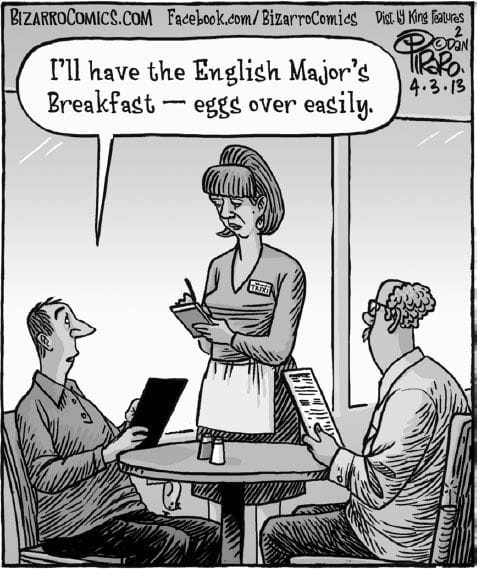
The first subtlety is a fact about adverbs: many of them (the ones called flat adverbs) are identical to their related adjectives. You can drive fast (adverb) or drive a fast car (adjective); hit the ball hard or hit a hard ball. The list of flat adverbs differs across dialects: real pretty (as opposed to really pretty) and The house was shaken up bad (as opposed to badly) are common in nonstandard dialects of English and have made inroads into casual and folksy speech in the standard dialect. This crossover is what gave rise to the vague impression that adverbs are endangered. But the historical trend is in the opposite direction: adverbs and adjectives are more often distinguished today than they were in the past. Standard English used to have many flat adverbs that have since been separated from their adjectival twins, such as monstrous fine (Jonathan Swift), violent hot (Daniel Defoe), and exceeding good memory (Benjamin Franklin). When today’s purists reflect on the ones that remain, like those in Drive safe, Go slow, She sure fooled me, He spelled my name wrong, and The moon is shining bright, they may hallucinate a grammatical error and promulgate prissy alternatives such as She surely fooled me and the one in this Bizarro cartoon:
The second subtlety is a fact about adjectives: they don’t just modify nouns, but can appear as complements to verbs, as in This seems excellent, We found it boring, and I feel tired. They can also show up as an adjunct to a verb phrase or clause, as in She died young and They showed up drunk. Recall from chapter 4 that grammatical categories like adjective are not the same thing as grammatical functions like modifier and complement. People who confuse the two may think that the adjectives in these sentences “modify the verb” and hence ought to be replaced by adverbs. The result is a hypercorrection like I feel terribly (which really should be I feel terrible). The related expression I feel badly may have started out in previous generations as a hypercorrected version of I feel bad. Badly has now become an adjective in its own right, meaning “sorrowful” or “regretful.” Thankfully, James Brown was never tempted to hypercorrect “I Got You (I Feel Good)” to “I Got You (I Feel Well).”
A failure to appreciate the multiple functions of adjectives also gave rise to the false accusation that Apple made a grammatical error in its slogan Think Different. The company was right not to revise it to Think Differently: the verb think can take an adjectival complement which refers to the nature of the thoughts being entertained. That is why Texans think big (not largely) and why in the musical Funny Face the advertising slogan that set off a lavish production number was Think Pink, not Think Pinkly.8
To be sure, surveys of typical errors in student papers show that inexperienced writers really do mix up adjectives and adverbs. The phrase The kids he careless fathered is just careless, and in The doctor’s wife acts irresponsible and selfish the writer stretched the ability of act to take an adjectival complement (as in act calm) further than most readers are willing to go.9
ain’t. No one needs to be reminded that ain’t is frowned upon. The prohibition has been drilled into children for so long that they have made it into a jump-rope rhyme:
Don’t say ain’t or your mother will faint.
Your father will fall in a bucket of paint.
Your sister will cry; your brother will die.
Your dog will call the FBI.
I like this poetic warning of what will happen if you violate a prescriptive rule better than Dwight Macdonald’s prophecy that the bounded waters will lift their bosoms higher than the shores and make a sop of all this solid globe. But both warnings are overstatements. Despite the taint of ain’t from its origin in regional and lower-class English, and more than a century of vilification by schoolteachers, today the word is going strong. It’s not that ain’t is used as a standard contraction for negated forms of be, have, and do; no writer is that oblivious. But it does have some widely established places. One is in the lyrics of popular songs, where it is a crisp and euphonious substitute for the strident and bisyllabic isn’t, hasn’t, and doesn’t, as in “It Ain’t Necessarily So,” “Ain’t She Sweet,” and “It Don’t Mean a Thing (If It Ain’t Got That Swing).” Another is in expressions that are meant to capture homespun truths, like If it ain’t broke don’t fix it, That ain’t chopped liver, and It ain’t over till it’s over. This use of ain’t may be found even in relatively formal settings to emphasize that some fact is so obvious as to be beyond further debate—as if to say, “Anyone with a lick of sense can see that.” Hilary Putnam, perhaps the most influential analytic philosopher of the second half of the twentieth century, published a famous article called “The Meaning of Meaning” in a learned academic volume. At one point he summed up his argument with “Cut the pie any way you like, ‘meanings’ just ain’t in the head!” As far as I know, his mother did not lose consciousness.
and, because, but, or, so, also. Many children are taught that it is ungrammatical to begin a sentence with a conjunction (what I have been calling a coordinator). Because they sometimes write in fragments. And are shaky about when to use periods. And when to capitalize. Teachers need a simple way to teach them how to break sentences, so they tell them that sentences beginning with and and other conjunctions are ungrammatical.
Whatever the pedagogical merits may be of feeding children misinformation, it is inappropriate for adults. There is nothing wrong with beginning a sentence with a coordinator. As we saw in chapter 5, and, but, and so are among the commonest coherence markers, and they may be used to begin a sentence whenever the clauses being connected are too long or complicated to fit comfortably into a single megasentence. I’ve begun about a hundred sentences with and or but in the book so far, such as “And we all know how successful Strunk and White were in forbidding to personalize, to contact, and six people,” which capped off a series of sentences about purists who failed to change the language.
The coordinator because can also happily sit at the beginning of a sentence. Most commonly it ends up there when it introduces an explanation that has been preposed in front of a main clause, as in Because you’re mine, I walk the line. But it can also kick off a single clause when the clause serves as the answer to a why-question. The question can be explicit, as in Why can’t I have a pony? Because I said so. It can also be implicit in a series of related assertions that calls for a single explanation, which the author then provides, as in Aleksandr Solzhenitsyn’s reflection on the twentieth-century’s genocidal tyrants:
Macbeth’s self-justifications were feeble—and his conscience devoured him. Yes, even Iago was a little lamb too. The imagination and the spiritual strength of Shakespeare’s evildoers stopped short at a dozen corpses. Because they had no ideology.
between you and I. This commonly heard phrase is often held out as an excruciating grammatical blunder. I spelled out the reason in chapter 4 when discussing the example Give Al Gore and I a chance to bring America back. Rigorous tree-thinking demands that a complicated phrase behave in the same way as a simpler phrase in the same position. The object of a preposition like between must be in the accusative case: we say between us or between them, not between we or between they. Therefore, according to this way of thinking, the pronouns in a coordination must also be accusative: between you and me. The phrase between you and I appears to be a hypercorrection, which arose when speakers who were corrected for Me and Amanda are going to the mall took away the crude moral that you should always say X and I, never me and X or X and me.
But the conviction that between you and I is an error needs a second look, together with the explanation that the phrase is a hypercorrection. When enough careful writers and speakers fail to do something that a theory of syntax says they should, it could mean that it’s the theory that’s wrong, not the writers.
A coordination phrase is a strange entity, and the logic of trees that applies elsewhere in English syntax does not apply to it. Most phrases have a head: a single word inside the phrase that determines its properties. The phrase the bridge to the islands has the head bridge, which is a singular noun, so we call the phrase a noun phrase, interpret it as referring to a kind of bridge, and treat the phrase as singular—that’s why everyone agrees that one should say The bridge to the islands is crowded, not are crowded. Not so for a coordination, which is headless: it cannot be equated with any of its components. In the coordination the bridge and the causeway, the first noun phrase, the bridge, is singular, and the second noun phrase, the causeway, is also singular, but the coordination as a whole is plural: The bridge and the causeway are crowded, not is crowded.
Perhaps the same is true of case: the case that applies to a whole coordination phrase is not necessarily the same as the case that applies to its parts. When we strive to apply tree-thinking as we write, we may furrow our brows and consciously force the parts to harmonize with the whole. But because coordination phrases are headless, the harmony is not a requirement of our intuitive grammar, and few of us can consistently pull it off. Thus even an assiduous speaker might say Give Al Gore and I a chance or between you and I. The Cambridge Grammar suggests that in contemporary English many speakers have settled on a rule that allows a nominative pronoun like I or he after the coordinator and. And even more of them—the ones who say Me and Amanda are going to the mall—allow an accusative pronoun before and. It is a natural preference, because the accusative is the default case in English, occurring in a motley range of contexts (such as the bare exclamation Me!?), pretty much anywhere it is not preempted by the more selective nominative or genitive.
You might think that the standard prescriptive recommendation, with its ironclad application of tree analysis, is more logical and elegant, and that we should all just try harder to implement it and thereby make our language more consistent. But when it comes to coordination, this is an unrealizable dream. Not only does the grammatical number of a coordination systematically differ from the number of the nouns inside it, but sometimes the number and person of a coordination cannot be determined from the tree at all. Which alternative in each of these pairs of sentences is correct?10
| Either Elissa or the twins are sure to be there. | Either Elissa or the twins is sure to be there. |
| Either the twins or Elissa is sure to be there. | Either the twins or Elissa are sure to be there. |
| You mustn’t go unless either I or your father comes home with you. | You mustn’t go unless either I or your father come home with you. |
| Either your father or I am going to have to come with you. | Either your father or I is going to have to come with you. |
No amount of tree-thinking will help you here. Even the style manuals throw up their hands and suggest that writers just look at the linear order of words in the string and make the verb agree with the noun phrase closest to it, like the versions in the left column. Coordination phrases simply don’t follow the logic of ordinary headed phrases. Writers are well advised to avoid between you and I, since it makes many readers bristle, but it is not a heinous error.
can versus may. This cartoon explains a traditional rule about two common modal auxiliaries:
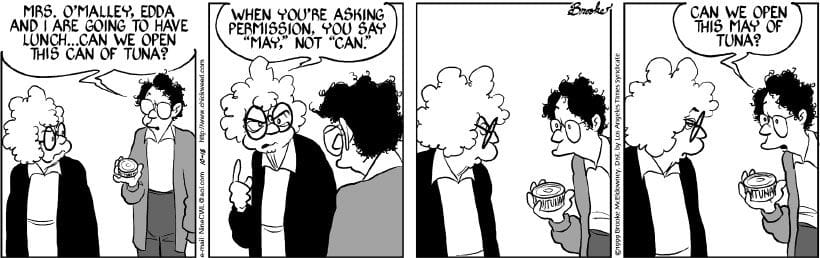
9 Chickweed Lane © brooke mceldowney. Used by permission of Universal Uclick for Ufs. All rights reserved.
At least Mrs. O’Malley didn’t give the standard grown-up’s answer to a child’s request with can: “You can, but the question is, may you?” A colleague of mine recalls that whenever she said, “Daddy, can I ask you a question?” the response was “You just did, but you may ask me another.”
As the puzzlement of the young man in the cartoon suggests, the traditional distinction between the meaning of can (capability or possibility) and the meaning of may (permissibility) is tenuous at best. Even many sticklers don’t have the courage of their convictions, such as the maven who insisted on the distinction in one entry in his usage guide but slipped up in another entry and ruled that a certain verb “can only be followed by for.”11 (Gotcha! He should have written may.) Conversely, may is commonly and innocuously used for possibility rather than permission, as in It may rain this afternoon.
In formal style we see a slight preference for using may for permission. But as Mrs. O’Malley suggested, it is only when one is asking (or granting) permission that may is preferable, not when one is merely talking about it. The sentence Students can submit their papers anytime Friday might be said by one student to another, but Students may submit their papers anytime Friday is more likely to be an announcement of the policy by the professor. Since most prose neither grants nor requests permission, the distinction is usually moot, and the two words may (or can) be used more or less interchangeably.
dangling modifiers. Do you see a problem with the sentences that follow?
Checking into the hotel, it was nice to see a few of my old classmates in the lobby.
Turning the corner, the view was quite different.
Born and raised in city apartments, it was always a marvel to me.
In order to contain the epidemic, the area was sealed off.
Considering the hour, it is surprising that he arrived at all.
Looking at the subject dispassionately, what evidence is there for this theory?
In order to start the motor, it is essential that the retroflex cam connecting rod be disengaged.
To summarize, unemployment remains the state’s major economic and social problem.
According to an old rule about “dangling modifiers,” these sentences are ungrammatical. (Sometimes the rule is stated as applying to “dangling participles,” namely the gerund form of a verb ending with –ing or the passive form typically ending in –ed or –en, but the examples include infinitival modifiers as well.) The rule decrees that the implied subject of the modifier (the one doing the checking, turning, and so on) must be identical to the overt subject of the main clause (it, the view, and so on). Most copy editors would recast the main clause, supplying it with a subject (underlined) to which the modifier can be properly fastened:
Checking into the hotel, I was pleased to see a few of my old classmates in the lobby.
Turning the corner, I saw that the view was quite different.
Born and raised in city apartments, I always found it a marvel.
In order to contain the epidemic, authorities sealed off the area.
Considering the hour, we should be surprised that he arrived at all.
Looking at the subject dispassionately, what evidence do we find for this theory?
In order to start the motor, one should ensure that the retroflex cam connecting rod is disengaged.
To summarize, we see that unemployment remains the state’s major economic and social problem.
Newspaper columns on usage are filled with apologies for “errors” like these, spotted by ombudsmen or managing editors who have trained themselves to flag them. Danglers are extremely common, not just in deadline-pressured journalism but in the works of distinguished authors. Considering how often these forms turn up in edited prose and how readily they are accepted even by careful readers, two conclusions are possible: either dangling modifiers are a particularly insidious grammatical error for which writers must develop sensitive radar, or they are not grammatical errors at all. (Did you notice the dangler in the sentence before last?)
The second conclusion is the right one: some dangling modifiers should be avoided, but they are not grammatical errors. The problem with dangling modifiers is that their subjects are inherently ambiguous and sometimes a sentence will inadvertently attract a reader to the wrong choice. Many style guides reproduce (or contrive) dangling modifiers with unintentionally comical interpretations, such as these ones from Richard Lederer’s Anguished English:
Having killed a man and served four years in prison, I feel that Tom Joad is ripe to get into trouble.
Plunging 1,000 feet into the gorge, we saw Yosemite Falls.
As a baboon who grew up wild in the jungle, I realized that Wiki had special nutritional needs.
Locked in a vault for 50 years, the owner of the jewels has decided to sell them.
When a small boy, a girl is of little interest.
It’s easy—and wrong—to diagnose the problem as a violation of a grammatical rule called subject control. Most verbs that take subjectless complements, such as try in Alice tried to calm down, are governed by an ironclad rule that forces the overt subject to be identical to the missing subject. That is, we have to interpret Alice tried to calm down as “Alice tried to get Alice to calm down,” rather than “Alice tried to get someone to calm down” or “Alice tried to get everyone to calm down.” But with modifiers there is no such rule. The missing subject of a modifier is identified with the protagonist whose point of view we are assuming as we read the sentence, which is often, but need not always be, the grammatical subject of the main clause. The problem is not one of ungrammaticality but of ambiguity, as in the examples we saw in chapter 4. The jewelry owner who was locked in a vault for fifty years is like the panel on sex with four professors and the recommendation of the candidate with no qualifications.
Some so-called danglers are perfectly acceptable. Many participles have turned into prepositions, such as according, allowing, barring, concerning, considering, excepting, excluding, failing, following, given, granted, including, owing, regarding, and respecting, and they don’t need subjects at all. Inserting we find or we see into the main clause to avoid a dangler can make the sentence stuffy and self-conscious. More generally, a modifier can dangle when its implied subject is the writer and the reader, as in To summarize and In order to start the motor in the examples above. And when the subject of the main clause is the dummy element it or there, the reader glides right over it, and it poses no danger of attracting a dangler.
The decision of whether to recast a sentence to align its subject with the subject of a modifier is a matter of judgment, not grammar. A thoughtlessly placed dangler can confuse the reader or slow her down, and occasionally it can lure her into a ludicrous interpretation. Also, even if a dangler is in no danger of being misinterpreted, enough readers have trained themselves to spot danglers that a writer who leaves it incurs the risk of being judged as slovenly. So in formal styles it’s not a bad idea to keep an eye open for them and to correct the obtrusive ones.
fused participles (possessives with gerunds). Do you have a problem with the sentence She approved of Sheila taking the job? Do you insist that it should be She approved of Sheila’s taking the job, in which the gerund (taking) has a subject (Sheila’s) that is marked with genitive case? Perhaps you think that the first version, the one with the unmarked subject, is an increasingly common symptom of grammatical laziness. If so, you are a victim of the spurious rule about so-called fused participles. (The term was coined by Fowler to suggest that the participle taking has been illicitly fused with the noun Sheila into the mongrel Sheila-taking: the theory made little sense, but the term stuck.) In fact, gerunds with unmarked subjects were the historically earlier form, have long been used by the language’s best writers, and are perfectly idiomatic. Unfusing a participle can make a sentence clumsy or pretentious:12
Any alleged evils of capitalism are simply the result of people’s being free to choose.
The police had no record of my car’s having been towed.
I don’t like the delays caused by my computer’s being underpowered.
The ladies will pardon my mouth’s being full.
And often it cannot be done at all:
I was annoyed by the people behind me in line’s being served first.
You can’t visit them without Ethel’s pulling out pictures of her grandchildren.
What she objects to is men’s making more money than women for the same work.
Imagine a child with an ear infection who cannot get penicillin’s losing his hearing.
In these cases, dropping the ’s results in a perfectly acceptable sentence: I was annoyed by the people behind me in line being served first. A substantial majority of the AHD Usage Panel accept the so-called fused participle, not just in these complicated sentences but in simple ones like I can understand him not wanting to go. For sentences that have been repeated verbatim in questionnaires over the decades, the rate of acceptance has increased over time.
How should a writer choose? Any semantic difference between the alternatives is elusive, and the choice mainly hinges on style: the genitive subject (I approve of Sheila’s taking the job) is appropriate in more formal writing, the unmarked subject (I approve of Sheila taking the job) in informal writing and speech. The nature of the grammatical subject matters, too. The clumsy examples above show that long and complicated subjects are best left unmarked, whereas simpler ones like pronouns work well in the genitive, as in I appreciate your coming over to help. Some writers sense a subtle distinction in the focus of attention. When the focus is on the entire event, packaged into a conceptual whole, the genitive subject seems better: if the fact that Sheila is taking the job had been mentioned previously, and we were all discussing whether this was a good thing or a bad thing (not just for Sheila but for the company, her friends, and her family), I might say I approve of Sheila’s taking the job. But if the focus is on the subject and her possible courses of action, say, if I was a friend of Sheila’s and had been advising her whether to stay in school or accept the offer, I might say I approve of Sheila taking the job.
if-then. Something is slightly off in these sentences, but what?
If I didn’t have my seat belt on, I’d be dead.
If he didn’t come to America, our team never would have won the championship.
If only she would have listened to me, this would never have happened.
Many conditional constructions (those with an if and a then) seem bewilderingly picky about which tenses, moods, and auxiliaries may go into them, particularly had and would. Fortunately, there is a formula for writing graceful conditionals, and it becomes clear once you recognize two distinctions.
The first is that English has two kinds of conditional constructions:13
If you leave now, you will get there on time. [an open conditional]
If you left now, you would get there on time. [a remote conditional]
The first is called an open conditional, from the expression “an open possibility.” It refers to a situation that the writer is uncertain about, and it invites the reader to draw inferences or make predictions about that situation. Here are a couple of other examples:
If he is here, he’ll be in the kitchen.
If it rains tomorrow, the picnic will be canceled.
With these conditionals, anything goes: you can use pretty much any tense in the if and then clauses, depending only on when the relevant events take place or are discovered.
The second kind is called a remote conditional, from the expression “a remote possibility.” It refers to a counterfactual, highly improbable, blue-sky, or make-believe world, one that the writer thinks is unlikely to be true but whose implications are worth exploring:
If I were a rich man, I wouldn’t have to work hard.
If pigs had wings, they would fly.
Remote conditionals are the finicky ones, though their demands, as we shall see, are not as arbitrary as they at first seem. The formula is that the if-clause must have a past-tense verb, and the then-clause must contain would or a similar auxiliary such as could, should, or might. If we take a typical double-would conditional (left side) and put the if-clause into the past tense, it instantly sounds classier:
| If only she would have listened to me, this would never have happened. | If only she had listened to me, this would never have happened. |
The problem with the left-hand version is that would have does not belong in the if-clause, only in the then-clause. The job of the conditional would is to explain what ought to happen in the make-believe world; it does not set up that world, a task that is reserved for the if-clause and its past-tense verb. By the way, this is true for counterfactuals in general, not just for ones that are found in if-then constructions. Doesn’t the right-hand version in this pair sound better?
| I wish you would have told me about this sooner. | I wish you had told me about this sooner. |
Now here’s the rationale behind the formula. When I said that the if-clause must be in the past tense, I did not mean that it refers to a past time. “Past tense” is a grammatical term referring to one of the forms an English verb can take, namely the verb plus –ed, or, in the case of irregular verbs, some variant such as make-made, sell-sold, or bring-brought. “Past time,” in contrast, is a semantic concept referring to an event that took place before the moment of speaking or writing. In English, a past-tense form is typically used to refer to past time, but it can also be used with a second meaning, factual remoteness. That’s the meaning it’s expressing in the if-clause. Consider the sentence If you left tomorrow, you’d save a lot of money. The verb left couldn’t possibly refer to an event in the past: the sentence says “tomorrow.” But the past-tense form is fine, because it refers to a hypothetical (factually remote) event.
(By the way, with 99.98 percent of the common verbs in English, the same verb form, past tense, is used to convey both past time and factual remoteness. But one verb has a special form to express remoteness: be, which distinguishes If I was from If I were. We’ll deal with it in the discussion of the subjunctive.)
What about the second half of the conditional, the then-clause, which calls for the auxiliaries would, could, should, or might? It turns out they are just like the verbs in the if-clause: they are in the past tense, with a factual-remoteness meaning. The d’s and the t at the ends of these auxiliaries are a giveaway: would is just the irregular past-tense form of will, could the past-tense form of can, should the past-tense form of shall, and might the past-tense form of may. We can see this in the contrast between open conditionals in the present tense and their remote conditionals in the past tense:
| If you leave now, you can get there on time. | If you left now, you could get there on time. |
| If you leave now, you will get there on time. | If you left now, you would get there on time. |
| If you leave now, you may get there on time. | If you left now, you might get there on time. |
| If you leave now, you shall get there on time. | If you left now, you should get there on time. |
So the rule for remote conditionals turns out to be simpler than it looks: the if-clause contains a verb which sets up a hypothetical world; the then-clause explores what will happen in that world, using a modal auxiliary. Both clauses use the past tense to express the meaning “factual remoteness.”
There is one more piece to the puzzle of how to write classy conditionals. Why do they so often contain the verb form had, as in If I hadn’t had my seat belt on, I’d be dead, which sounds better than If I didn’t have my seat belt on, I’d be dead? The key is that had turns up when the if-clause refers to an event whose time of occurrence really is the past. Recall that the if-clause in a remote conditional demands the past tense but has nothing to do with past time. Now when a writer really does want to refer to a past-time event in a remote conditional, he needs the past tense of a past-tense form. The past-of-the-past is called the pluperfect, and it is formed with the auxiliary had, as in I had already eaten. So whenever the time of the make-believe world of the if-clause is prior to the time of writing, the clause needs to be in the pluperfect: If you had left earlier, you would have been on time.
Though the rules are perfectly logical, the conditions are hard to keep track of. Together with forgetting to use had in a past-time if-clause, writers sometimes overcompensate by using too many of them, as in If that hadn’t have happened, he would not be the musician he is today—a hypercorrection sometimes called the plupluperfect. One instance of have is enough: it should be If that hadn’t happened.
like, as, such as. Long ago, in the Mad Men era when cigarettes were advertised on radio and television, every brand had a slogan. “I’d walk a mile for a Camel.” “Lucky Strike means fine tobacco.” “Come to where the flavor is. Come to Marlboro Country.” And most infamously, “Winston tastes good, like a cigarette should.”
The infamy did not come from the fact that the company was using a catchy jingle to get people addicted to carcinogens. It came from the fact that the jingle allegedly contained a grammatical error. Like is a preposition, said the accusers, and may take only a noun phrase object, as in crazy like a fox or like a bat out of hell. It is not a conjunction (what I have been calling a coordinator) and so may not be followed by a clause. The New Yorker sneered at the error, Ogden Nash wrote a poem about it, Walter Cronkite refused to say it on the air, and Strunk and White declared it illiterate. The slogan, they agreed, should have been “Winston tastes good, as a cigarette should.” The advertising agency and the tobacco company were delighted by the unpaid publicity and were only too happy to confess to the error in the coda, “What do you want, good grammar or good taste?”
Like many usage controversies, the brouhaha over like a cigarette should is a product of grammatical ineptitude and historical ignorance. To start with, the fact that like is a preposition, which typically takes a noun phrase complement, does not mean that it may not take a clausal complement as well. As we saw in chapter 4, many prepositions, such as after and before, take either one, so the question of whether like is a conjunction is a red herring. Even if it is a preposition, it could very well precede a clause.
More important, the ad’s use of like with a clause was not a recent corruption. The combination has been in use for six hundred years throughout the English-speaking world, though with greater frequency in the nineteenth century and in the United States. It has been used in literary works by dozens of great writers (including Shakespeare, Dickens, Twain, Wells, and Faulkner) and has flown beneath the radar of the purists themselves, who have inadvertently used it in their own style guides. This does not show that purists are only human and sometimes make errors; it shows that the alleged error is not an error. The R. J. Reynolds Tobacco Company was confessing to the wrong crime; its slogan was perfectly grammatical. Writers are free to use either like or as, mindful only that as is a bit more formal, and that the Winston-tastes-good controversy became such a bloody shirt in the grammar wars that readers may mistakenly think the writer has made an error.
A related superstition, ruthlessly enforced by many copy editors, is that like may not be used to introduce examples, as in Many technical terms have become familiar to laypeople, like “cloning” and “DNA.” They would correct it to such as “cloning” and “DNA.” According to this guideline, like may be used only for resemblance to an exemplar, as in I’ll find someone like you and Poems are made by fools like me. Few writers consistently follow this bogus rule, including the mavens who insist on it (one of whom, for example, wrote, “Avoid clipped forms like bike, prof, doc”). Such as is more formal than like, but both are legitimate.
possessive antecedents. Ready for another example of pointless purist dudgeon? Then consider this question from a 2002 College Board exam, which asked students to identify the grammatical error, if there was one, in the following sentence:
Toni Morrison’s genius enables her to create novels that arise from and express the injustices African Americans have endured.
The official answer was that the sentence did not contain an error. A high school teacher complained that it did, because the possessive phrase Toni Morrison’s cannot serve as the antecedent of the pronoun her. The College Board caved in to his pressure and retroactively gave credit to all the students who had identified her as incorrect. On cue, pundits moaned about declining standards.14
But the rule against possessive (more accurately, genitive) antecedents is a figment of the purists’ misunderstanding. Far from being an established principle of grammar, the rule seems to have been conjured out of thin air by a usage maven in the 1960s and has been uncomprehendingly copied by others ever since. Genitive antecedents have been considered unexceptionable throughout the history of English, and may be found in Shakespeare, the King James Bible (“And Joseph’s master took him, and put him into the prison”), Dickens, and Thackeray, together with Strunk and White (“The writer’s colleagues … have greatly helped him in the preparation of his manuscript”) and one of the irate pundits himself (“It may be Bush’s utter lack of self-doubt that his detractors hate most about him”).
Why would anyone think that this perfectly natural construction is ungrammatical? The rationale stated by one rule-giver was that “there is in fact no person named for the him to refer to.” Say what? Is there a neurologically intact reader anywhere who can’t figure out whom the pronoun refers to in Bob’s mother loved him or Stacy’s dog bit her?
The other rationale is that Toni Morrison’s is an adjective, and pronouns must refer back to nouns. But Toni Morrison’s is not an adjective, like red or beautiful; it’s a noun phrase in genitive case. (How do we know? Because you can’t use genitives in clear adjectival contexts like That child seems Lisa’s or Hand me the red and John’s sweater.) The confusion comes from the vague impression that the phrase is a “modifier.” But the impression not only confuses a grammatical category (adjective) with a grammatical function (modifier) but also gets the function wrong. Toni Morrison’s isn’t functioning as a modifier, which shades the meaning of genius, but as a determiner, which pins down its referent, in the same way that an article like the or this would do. (How do we know? Because a count noun cannot stand on its own—you can’t say Daughter cooked dinner—and a modifier doesn’t help; Beautiful daughter cooked dinner is still bad. But add either an article, as in A daughter cooked dinner, or a genitive, as in Jenny’s daughter cooked dinner, and the sentence is complete. This shows that genitives have the same function as articles, namely determiner.)
As with any pronoun, a writer can confuse his readers if he fails to make the antecedent clear, such as in Sophie’s mother thinks she’s fat, where we don’t know whether it’s Sophie or her mother who is thought to be fat. But that has nothing to do with the antecedent being in the genitive case; it’s just as much of a problem in Sophie and her mother think she’s fat.
Though it’s only fair that the students who thought they spotted an error got credit for their answer (since they may have been miseducated by purists), the ire of language lovers ought to be directed at the stylistic clumsiness of the godawful sentence about Toni Morrison, not at a fictitious error in it.
preposition at the end of a sentence. Winston Churchill did not, as legend has it, reply to an editor who had corrected his prose with “This is pedantry up with which I will not put.”15 Nor is that witticism (originally from a 1942 Wall Street Journal article) a particularly good example of the construction that linguists call preposition stranding, as in Who did you talk to? or That’s the bridge I walked across. The particle up is an intransitive preposition and does not require an object, so even the most pedantic of pedants would have no objection to a phrase like This is pedantry with which I will not put up.
Though the attribution and the example are spurious, the mockery is appropriate. As with split infinitives, the prohibition against clause-final prepositions is considered a superstition even by the language mavens, and it persists only among know-it-alls who have never opened a dictionary or style manual to check. There is nothing, repeat nothing, wrong with Who are you looking at? or The better to see you with or We are such stuff as dreams are made on or It’s you she’s thinking of. The pseudo-rule was invented by John Dryden based on a silly analogy with Latin (where the equivalent to a preposition is attached to the noun and cannot be separated from it) in an effort to show that Ben Jonson was an inferior poet. As the linguist Mark Liberman remarked, “It’s a shame that Jonson had been dead for 35 years at the time, since he would otherwise have challenged Dryden to a duel, and saved subsequent generations a lot of grief.”16
The alternative to stranding a preposition at the end of a clause is allowing it to accompany a wh-word to the front, a rule that the linguist J. R. (Haj) Ross dubbed pied-piping, because it reminded him of the way that the Pied Piper lured the rats out of the village of Hamelin. The standard question rule in English converts You are seeing what? into What are you seeing? and hence You are looking at what? into What are you looking at? The pied-piping rule allows the what to pull the at with it to the front of the sentence, yielding At what are you looking? The same rule creates relative clauses that begin with a preposition and a wh-word such as the better with which to see you or It’s you of whom she’s thinking.
Sometimes it really is better to pied-pipe a preposition to the beginning of a clause than to strand it at the end. Most obviously, pied-piping sounds better in a formal style. Abraham Lincoln knew what he was doing at the graves of the fallen soldiers at Gettysburg when he vowed “increased devotion to that cause for which they gave the last full measure of devotion,” rather than “increased devotion to that cause which they gave the last full measure of devotion for.” Pied-piping is also a good choice when a stranded preposition would get lost in a hubbub of little grammatical words, such as One of the beliefs which we can be highly confident in is that other people are conscious. The sentence is easier to parse when the role of the preposition is settled before we get to that busy crossroads: One of the beliefs in which we can be highly confident is that other people are conscious.
A good piece of advice on when to pied-pipe and when to strand comes from Theodore Bernstein, who invokes the principle emphasized in chapter 4: select the construction that allows you to end a sentence with a phrase that is heavy or informative or both. The problem with stranding a preposition is that it can end the sentence with a word that is too lightweight to serve as its focal point, making the sentence sound like “the last sputter of an engine going dead.” As an example Bernstein cites He felt it offered the best opportunity to do fundamental research in chemistry, which was what he had taken his Doctor of Philosophy degree in. By the same principle, a preposition should be stranded at the end of a sentence when it contributes a crucial bit of information, as in music to read by, something to guard against, and that’s what this tool is for, or when it pins down the meaning of an idiom, as in It’s nothing to sneeze at, He doesn’t know what he’s talking about, or She’s a woman who can be counted on.
predicative nominative. When you come home after a day at the office, do you call out to your spouse, “Hi, honey, it’s I”? If you do, you are the victim of a schoolmarm rule that insists that a pronoun serving as the complement of be must be in nominative case (I, he, she, we, they) rather than accusative case (me, him, her, us, them). According to this rule, Psalms (120:5), Isaiah (6:5), Jeremiah (4:31), and Ophelia should have cried out, “Woe is I,” and the cartoon possum Pogo should have reworded his famous declaration as “We have met the enemy, and he is we.”
The rule is a product of the usual three confusions: English with Latin, informal style with incorrect grammar, and syntax with semantics. Though the referent of the noun phrase after be is the same as that of the subject (enemy = we), the case of the noun phrase is determined by its position after the verb, which can always be accusative. (The accusative case is the default in English, and it can be used anywhere except in the subject of a tensed verb; thus we have hit me, give me a hand, with me, Who, me?, What, me get a tattoo?, and Molly will be giving the first lecture, me the second.) Accusative predicates have been used for centuries by many respected writers (including Pepys, Steele, Hemingway, and Woolf), and the choice between It is he and It is him is strictly one of formal versus informal style.
sequence of tenses and other perspective shifts. A common error in student writing is to shift the tense from a main clause to a subordinate one even when they refer to the same time period. 17
| She started panicking and got stressed out because she doesn’t have enough money. | She started panicking and got stressed out because she didn’t have enough money. |
| The new law requires the public school system to abandon any programs that involved bilingual students. | The new law requires the public school system to abandon any programs that involve bilingual students. |
The incorrect versions on the left make the reader feel like she is being yanked back and forth along the time line between the moment at which the sentence was written (present) and the time of the situation being described (past). They belong to a family of “inappropriate shifts” in which the writer fails to stay put at a single vantage point but vanishes from one and pops up at another. The reader can get vertigo when the writer flip-flops within a sentence between persons (first, second, and third), voices (active and passive), or types of discourse (a direct quotation of the speaker’s exact words, usually set off with quotation marks, versus an indirect report of the gist, usually set off with that):
| Love brings out the joy in people’s hearts and puts a glow in your eyes. | Love brings out the joy in people’s hearts and puts a glow in their eyes. |
| People express themselves more offensively when their comments are delivered through the Internet rather than personally. | People express themselves more offensively when they deliver their comments through the Internet rather than personally. |
| The instructor told us, “Please read the next two stories before the next class” and that she might give us a quiz on them. | The instructor told us that we should read the next two stories before the next class and that she might give us a quiz on them. |
Sticking to a consistent vantage point is the first step in getting the tenses in a complex story to come out right, but there’s more to it than that. A writer also has to harmonize the tenses according to a scheme called sequence of tenses, tense agreement, or backshift. Most readers sense that there is something askew in the sentences on the left:
| But at some point following the shootout and car chase, the younger brother fled on foot, according to State Police, who said Friday night they don’t believe he has access to a car. | But at some point following the shootout and car chase, the younger brother fled on foot, according to State Police, who said Friday night they didn’t believe he had access to a car. |
| Mark Williams-Thomas, a former detective who amassed much of the evidence against Mr. Savile last year, said that he is continuing to help the police in coaxing people who might have been victimized years ago to come forward.18 | Mark Williams-Thomas, a former detective who amassed much of the evidence against Mr. Savile last year, said that he was continuing to help the police in coaxing people who might have been victimized years ago to come forward. |
| Security officials said that only some of the gunmen are from the Muslim Brotherhood. | Security officials said that only some of the gunmen were from the Muslim Brotherhood. |
In indirect discourse in the past tense (a staple of news reporting), the tense of a verb often sounds better when it, too, is in the past tense, even though the event was in the present from the vantage point of the person speaking.19 This is clear enough in simple sentences. One would say I mentioned that I was thirsty, not I mentioned that I am thirsty, even though what I actually mentioned at the time was “I am thirsty.” Though backshifting usually occurs when someone said something in the past, it also occurs when a proposition was generally believed in the past, as in This meant that Amy was taking on too many responsibilities.
At first glance, the conditions that govern sequences of tenses seem daunting. Bernstein’s The Careful Writer, an informal style manual, takes five pages to explain fourteen rules, exceptions, and exceptions to the exceptions. Surely not even the most careful writer has learned them one by one. It’s better to understand a few principles that govern time, tense, and discourse than to try to memorize a list of regulations that are tailored to the sequence-of-tense phenomenon itself.
The first is to remember that past tense is not the same thing as past time. Recall from the discussion of if-then constructions that the past tense is used not just for events that took place in the past but for events that are remote possibilities (as in If you left tomorrow, you’d save a lot of money). We now see that the past tense has a third meaning in English: a backshifted event in a sequence of tenses. (Though the meaning of backshifting may seem to be just past time, there are subtle semantic differences between the two.)20
The second principle is that backshifting is not mandatory, which means that violating the sequence-of-tense rules and keeping the reported content in the present tense is not always an error. Grammarians distinguish the “attracted” or backshifted sequence, in which the tense of the embedded verb is metaphorically attracted to the tense of the verb of saying, from the “vivid,” “natural,” or “breakthrough” sequence, in which the embedded verb metaphorically breaks out of the story line of its clause and is located in the real time of the writer and reader. The vivid, nonbackshifted sequence feels more natural when the state being spoken about is not just true at the time that the speaker was speaking but true for all time, or at least indubitably true at the time that the writer is writing and the reader is reading. It would be odd to say The teacher told the class that water froze at 32 degrees Fahrenheit, which seems to suggest that perhaps it no longer does; one should violate the backshifting rule here and say The teacher told the class that water freezes at 32 degrees Fahrenheit. This leaves plenty of leeway for judgment, depending on whether the writer wishes to emphasize the continuing truth of some idea that was bruited in the past. The backshifted Simone de Beauvoir noted that women faced discrimination is neutral as to whether such discrimination is a persistent feature of our society. Simone de Beauvoir noted that women face discrimination takes the more feminist position that it is.
A third principle is that indirect discourse is not always introduced with an expression like he said that or she thought that; sometimes it is implicit in the context. Journalists get tired of repeating he said, and novelists sometimes skip it by using a technique called free indirect style, in which the narration of the author incorporates the interior monologue of a protagonist:
According to the Prime Minister, there was no cause for alarm. As long as the country kept its defense up and its alliances intact, all would be well.
Renee was getting more and more anxious. What could have happened to him? Had he leapt from the tower of Fine Hall? Was his body being pulled out of Lake Carnegie?
A writer can do the opposite, too, and interrupt his narration of an indirect discourse with an aside directed to the reader, which breaks out of the backshifted tense and into the present:
Mayor Menino said the Turnpike Authority, which is responsible for the maintenance of the tunnel, had set up a committee to investigate the accident.
The final key to using sequences of tenses should be familiar from our discussion of if and then. The past-tense forms of can, will, and may are could, would, and might, and these are the forms to use in backshifting:
| Amy can play the bassoon. | Amy said that she could play the bassoon. |
| Paul will leave on Tuesday. | Paul said that he would leave on Tuesday. |
| The Liberals may try to form a coalition government. | Sonia said that the Liberals might try to form a coalition government. |
And the past tense of a past tense (the pluperfect) uses the auxiliary had, so when the backshifted verb refers to a past time, had is summoned into action:
| He wrote it himself. | He said that he had written it himself. |
It’s not obligatory, though; writers often simplify things by using the simple past tense in both places (He said that he wrote it himself), which (for complicated reasons) is technically consistent with the semantics of backshifting.
shall and will. According to another old rule, when speaking about an event in the future one must use shall in the first person (I shall, we shall) but will in the second and third person (you will, he will, she will, they will). But when expressing determination or permission, it’s the other way around. Thus Lillian Hellman, when she defied the House Un-American Activities Committee in 1952, properly declared I will not cut my conscience to fit this year’s fashions. Had her comrades been speaking on her behalf, they would have said She shall not cut her conscience to fit this year’s fashions.
The rule is suspiciously complicated for something as basic to everyday expression as future time, and it turns out not to be a rule at all. The authors of Merriam-Webster’s Dictionary of English Usage, having surveyed the uses of the two forms over six hundred years, conclude, “The traditional rules about shall and will do not appear to have described real usage of these words precisely at any time, although there is no question that they do describe the usage of some people some of the time and that they are more applicable in England than elsewhere.”
Even with some Englishmen some of the time, it can be hard to distinguish future time in the first person from determination in the first person because of the metaphysical peculiarity of future time: no one knows what the future will bring, but we can choose to try to affect it.21 When Churchill said, “We shall fight on the beaches, we shall fight on the landing grounds, … we shall never surrender,” was he fiercely proclaiming the determination of the British people, or was he calmly prophesying a future that was certain because of the determination of the British people?
With everyone else—the Scots, Irish, Americans, and Canadians (other than those with traditional English schooling)—the rule about shall and will never applied. In his manual Plain Words, Ernest Gowers wrote, “The story is a very old one of the drowning Scot who was misunderstood by English onlookers and left to his fate because he cried, ‘I will drown and nobody shall save me!’” Outside England (and for a growing number of speakers there as well), shall sounds prissy as an expression of future tense: no one says I shall pick up the toilet paper at Walmart this afternoon. And when shall is used at all, particularly in the first person, it tends to defy the rule and convey non-future senses such as permission (Shall we dance?) and determination (as in General Douglas MacArthur’s famous declaration “I shall return” and the civil rights anthem “We Shall Overcome”). As Copperud wrote, “Shall, then, seems well on the way to extinction, much like the hapless Scot.”
split infinitives. Most mythical usage rules are merely harmless. The prohibition of split infinitives (as in Are you sure you want to permanently delete all the items and subfolders in the “Deleted Items” folder?) and the even more sweeping prohibition of “split verbs” (as in I will always love you and I would never have guessed) is downright pernicious. Good writers who have been brainwashed into unsplitting their infinitives can come out with monstrosities such as these:
Hobbes concluded that the only way out of the mess is for everyone permanently to surrender to an authoritarian ruler.
David Rockefeller, a member of the Harvard College Class of 1936 and longtime University benefactor, has pledged $100 million to increase dramatically learning opportunities for Harvard undergraduates through international experiences and participation in the arts.22
The split-verb superstition can even lead to a crisis of governance. During the 2009 presidential inauguration, Chief Justice John Roberts, a famous stickler for grammar, could not bring himself to have Barack Obama “solemnly swear that I will faithfully execute the office of president of the United States.” Abandoning his strict constructionism, Roberts unilaterally amended the Constitution and had Obama “solemnly swear that I will execute the office of president to the United States faithfully.” The garbled oath raised fears about whether the transfer of power had been legitimate, and so they repeated the oath verbatim, split verb and all, in a private meeting later that afternoon.
The very terms “split infinitive” and “split verb” are based on a thick-witted analogy to Latin, in which it is impossible to split a verb because it consists of a single word, such as amare, “to love.” But in English, the so-called infinitive to write consists of two words, not one: the subordinator to and the plain form of the verb write, which can also appear without to in constructions such as She helped him pack and You must be brave.23 Similarly, the allegedly unsplittable verb will execute is not a verb at all but two verbs, the auxiliary verb will and the main verb execute.
There is not the slightest reason to interdict an adverb from the position before the main verb, and great writers in English have placed it there for centuries.24 Indeed, the spot in front of the main verb is often the most natural resting place for an adverb. Sometimes it is the only resting place, particularly when the modifier is a negation or quantifier such as not or more than. (Recall from chapter 5 that the placement of not affects its logical scope and thus the meaning of the sentence.) In each of the examples below, unsplitting the infinitive either changes the sense or leads to garble:
| The policy of the Army at that time was to not send women into combat roles.25 | The policy of the Army at that time was not to send women into combat roles. |
| I’m moving to France to not get fat [caption of a New Yorker cartoon].26 | I’m moving to France not to get fat. |
| Profits are expected to more than double next year.27 | Profits are expected more than to double next year. |
More generally, the preverbal position is the only one in which the adverb unambiguously modifies the verb. In a sentence in which the author may have taken pains to unsplit an infinitive, such as The board voted immediately to approve the casino, the reader has to wonder whether it was the vote that was immediate, or the approval. With the infinitive left unsplit—The board voted to immediately approve the casino—it can only be the approval.
This does not mean that infinitives should always be split. When the adverbial modifier is long and heavy, or when it contains the most important information in a sentence, it should be moved to the end, just like any other heavy or newsworthy phrase:
| Flynn wanted to more definitively identify the source of the rising IQ scores. | Flynn wanted to identify the source of the rising IQ scores more definitively. |
| Scholars today are confronted with the problem of how to non-arbitrarily interpret the Qur’an. | Scholars today are confronted with the problem of how to interpret the Qur’an non-arbitrarily. |
Indeed, it’s a good habit to at least consider moving an adverb to the end of the verb phrase. If the adverb conveys important information, it belongs there; if it doesn’t (such as really, just, actually, and other hedges), it might be a verbal fluffball that is best omitted altogether. And since there are benighted sticklers out there who will mistakenly accuse you of making an error when you split an infinitive, you might as well not ask for trouble if it makes no difference to the sentence anyway.
Finally, in many cases a quantifier naturally floats leftward away from the verb, unsplitting the infinitive, as in the examples on the right:
| It seems monstrous to even suggest the possibility. | It seems monstrous even to suggest the possibility. |
| Is it better to never have been born? | Is it better never to have been born? |
| Statesmen are not called upon to only settle easy questions. | Statesmen are not called upon only to settle easy questions.28 |
| I find it hard to specify when to not split an infinitive. | I find it hard to specify when not to split an infinitive. |
The unsplit versions sound more elegant to me, though I can’t be sure that my ears haven’t been contaminated by a habit of cravenly unsplitting infinitives to avoid spitballs from the Gotcha! Gang.
subjunctive mood and irrealis were. For several hundred years commentators on the English language have been predicting, lamenting, or celebrating the imminent extinction of the subjunctive mood. But here we are in the twenty-first century and it refuses to die, at least in writing. To appreciate this, one has to get straight what the subjunctive is, because most people, including traditional grammarians, are confused about it.
There is no distinctive subjunctive form in English; the construction just uses the unmarked form of the verb, such as live, come, and be. This makes subjunctives hard to spot: they are noticeable only when the verb has a third-person singular subject (in which case it ordinarily takes the suffix –s, as in lives and comes) or when the verb is to be (which ordinarily shape-shifts to am, is, or are). Subjunctives can be sighted in a few clichés that have come down to us from a time in which the form was more common in English:
So be it; Be that as it may; Far be it from me; If need be.
Long live our noble queen.
Heaven forbid.
Suffice it to say.
Come what may.
But otherwise the subjunctive is found only in subordinate clauses, generally with mandative verbs and adjectives, which indicate that something is demanded or required:29
I insist that she be kept in the loop.
It’s essential that he see a draft of the speech before it is given.
We must cooperate in order that the system operate efficiently.
Subjunctives also turn up with certain prepositions and subordinators that specify hypothetical situations:
Bridget was racked with anxiety lest her plagiarism become known.
He dared not light a candle for fear that it be spotted by some prowling savage.
Dwight decided he would post every review on his Web site, whether it be good or bad.
Some of the examples are a bit formal and can be replaced by the indicative, such as It’s essential that he sees a draft and whether it is good or bad. But many subjunctives can be found in everyday writing and speech, such as I would stress that people just be aware of the danger, showing that reports of the death of the subjunctive are greatly exaggerated.
Traditional grammarians get tripped up by the verb be because they have to squeeze two different forms, be and were (as in If I were free), into a single slot called “subjunctive.” Sometimes they call be the “present subjunctive” and were the “past subjunctive,” but in reality there’s no difference in tense between them. Rather, the two belong to different moods: whether he be rich or poor is subjunctive; If I were a rich man is irrealis (“not real”). The irrealis mood is found in many languages, where it expresses situations that are not known to have happened, including hypotheticals, imperatives, and questions. In English it exists only in the form were, where it conveys factual remoteness: an irrealis proposition is not just hypothetical (the speaker does not know whether it is true or false) but counterfactual (the speaker believes it’s false). Tevye the Milkman was emphatically not a rich man, nor were Tim Hardin, Bobby Darin, Johnny Cash, or Robert Plant (all of whom sang “If I Were a Carpenter”) in any doubt as to whether they were carpenters. Counterfactual, by the way, need not mean outlandish—one can say If she were half an inch taller, that dress would be perfect—it just means “known to be not the case.”
So what’s the difference between the past-tense was, in those contexts in which it has the meaning of factual remoteness, and the irrealis were, which also has the meaning of factual remoteness? The obvious difference is the level of formality: irrealis I wish I were younger is fancier than past-tense I wish I was younger. Also, in careful writing, were conveys a somewhat stronger sense of remoteness than was does, implying that the scenario is contrary to fact: If he were in love with her, he’d propose accuses him of not being in love; If he was in love with her, he’d propose leaves the door open a crack, and the present-tense open conditional If he is in love with her, he’ll propose doesn’t commit the writer either way.
Some writers, dimly sensing that were is posher, hypercorrect themselves and use it with open possibilities, such as He looked at me as if he suspected I were cheating on him and If he were surprised, he didn’t show it.30 In both cases, was is appropriate.
than and as. Is anything wrong with the sentences on the left?
| Rose is smarter than him. | Rose is smarter than he. |
| George went to the same school as me. | George went to the same school as I. |
Many students are taught that they are ungrammatical, because than and as are conjunctions (which precede clauses), not prepositions (which precede noun phrases). The material that follows them must be a clause, albeit an elliptical clause, from which the predicate has been amputated: the full versions are Rose is smarter than he is and George went to the same school as I did. Since the noun phrases coming after than and as are the subjects of the truncated clauses, they must be in nominative case: he and I.
But if you squirm at the thought of using the “correct” versions on the right because they sound insufferably fussy, you have grammar and history on your side. Like the words before and like, which we examined earlier, the words than and as are not conjunctions in the first place but prepositions that take a clause as a complement.31 The only question is whether they may also take a noun phrase as a complement. Several centuries of great writers—Milton, Shakespeare, Pope, Swift, Johnson, Austen, Thurber, Faulkner, Baldwin—have voted with their pens, and the answer is yes. The difference is just one of style: than I is more suited to formal writing, than me to writing that is closer to speech.
Though the pedants are mistaken in insisting that than and as may only be conjunctions, the tree-thinking that motivates their judgment is sound. First, if you do opt for a formal style, don’t go overboard and write things like It affected them more than I. The chopped-off material after than is it affected me, not it affected I, so even the snootiest of the snoots would call for me in this sentence. Second, the two elements being compared should be grammatically and semantically parallel, a requirement that’s easy to flub when the first is complex. The condition of the first house we visited was better than the second can pass unnoticed in speech but can be grating on the page, because it compares apples (the condition) with oranges (the house). A careful reader will be happier with was better than that of the second; the cost of the additional empty words is outweighed by the pleasure of parallel syntax and semantics (a condition in each case). Finally, the casual version (than me, as her, and so on) can be ambiguous: Biff likes the professor more than me can mean that he likes the professor more than he likes me or that he likes the professor more than I do. In these cases, using a nominative subject is technically clear but a bit stuffy—Biff likes the professor more than I—and the best solution is to saw off less of the sentence, leaving Biff likes the professor more than I do.
The debate on the correct syntactic category of than also feeds the tempest over whether you can say different than the rest, where than, once again, is a preposition with a noun phrase object, or you must say different from the rest, using the uncontroversial preposition from. Though different than NP is disliked by a slim majority of the AHD Usage Panel, it has long been common in carefully written prose. H. L. Mencken reported that a futile attempt to ban it in the 1920s elicited the following comment from the editors of the New York Sun: “The excellent tribe of grammarians, the precisians who strive to be correct and correctors, have as much power to prohibit a single word or phrase as a gray squirrel has to put out Orion with a flicker of its tail.”32
that and which. Many spurious rules start out as helpful hints intended to rescue indecisive writers from paralysis when faced with a choice provided by the richness of English. These guides for the perplexed also make the lives of copy editors easier, so they may get incorporated into style sheets. Before you know it, a rule of thumb morphs into a rule of grammar, and a perfectly innocuous (albeit second-choice) construction is demonized as incorrect. Nowhere is this transition better documented than with the phony but ubiquitous rule on when to use which and when to use that.33
According to the traditional rule, the choice depends on which of two kinds of relative clause the word is introducing. A nonrestrictive relative clause is set off by commas, dashes, or parentheses, and expresses a comment from the peanut gallery, as in The pair of shoes, which cost five thousand dollars, was hideous. A restrictive relative clause is essential to the meaning of the sentence, often because it pinpoints the referent of the noun from among a set of alternatives. If we were narrating a documentary about Imelda Marcos’s vast shoe collection and wanted to single out one of the pairs by how much she paid for it and then say something about that pair alone, we would write The pair of shoes that cost five thousand dollars was hideous. The choice between that and which, according to the rule, is simple: nonrestrictive relative clauses take which; restrictive relative clauses take that.
One part of the rule is correct: it’s odd to use that with a nonrestrictive relative clause, as in The pair of shoes, that cost a thousand dollars, was hideous. So odd, in fact, that few people write that way, rule or no rule.
The other part of the rule is utterly incorrect. There is nothing wrong with using which to introduce a restrictive relative clause, as in The pair of shoes which cost five thousand dollars was hideous. Indeed, with some restrictive relatives, which is the only option, such as That which doesn’t kill you makes you stronger and The book in which I scribbled my notes is worthless. Even when which isn’t mandatory, great writers have been using it for centuries, as in Shakespeare’s “Render therefore unto Caesar the things which are Caesar’s” and Franklin Roosevelt’s “a day which will live in infamy.” The linguist Geoffrey Pullum searched through a sample of classic novels by authors such as Dickens, Conrad, Melville, and Brontë and found that on average readers will bump into a restrictive relative clause with which by the time they are 3 percent of the way into it.34 Turning to edited prose in twenty-first-century English, he found that which was used in about a fifth of the restrictive relative clauses in American newspapers and in more than half of those in British newspapers. Even the grammar nannies can’t help themselves. In The Elements of Style E. B. White recommended “which-hunting,” but in his classic essay “Death of a Pig” he wrote, “The premature expiration of a pig is, I soon discovered, a departure which the community marks solemnly on its calendar.”
The spurious rule against restrictive which sprang from a daydream by Henry Fowler in Modern English Usage in 1926: “If writers would agree to regard that as the defining relative pronoun, & which as the non-defining, there would be much gain both in lucidity & in ease. Some there are who follow this principle now; but it would be idle to pretend that it is the practice either of most or of the best writers.” The lexicographer Bergen Evans punctured the reverie with an observation that should be embossed on little cards and handed out to language pedants: “What is not the practice of most, or of the best, is not part of our common language.”35
So what’s a writer to do? The real decision is not whether to use that or which but whether to use a restrictive or a nonrestrictive relative clause. If a phrase which expresses a comment about a noun can be omitted without substantially changing the meaning, and if it would be pronounced after a slight pause and with its own intonation contour, then be sure to set it off with commas (or dashes or parentheses): The Cambridge restaurant, which had failed to clean its grease trap, was infested with roaches. Having done so, you don’t have to worry about whether to use that or which, because if you’re tempted to use that it means either that you are more than two hundred years old or that your ear for the English language is so mistuned that the choice of that and which is the least of your worries.
If, on the other hand, a phrase provides information about a noun that is crucial to the point of the sentence (as in Every Cambridge restaurant which failed to clean its grease trap was infested with roaches, where omitting the underlined phrase would radically alter the meaning), and if it is pronounced within the same intonation contour as the noun, then don’t set it off with punctuation. As for the choice you now face between which and that: if you hate making decisions, you generally won’t go wrong if you use that. You’ll be a good boy or girl in the eyes of copy editors, and will have avoided a sibilant, which many readers find ugly. Some guidelines recommend a switch to which when the relative clause is separated from the noun it modifies, as in An application to renew a license which had previously been rejected must be resubmitted within thirty days, where the underlined clause modifies the faraway noun application, not the next-door noun license. Otherwise you could tilt toward that depending on the degree of restrictiveness, that is, the degree to which the meaning of the sentence critically depends on the relative clause. When the modified noun is quantified with every, only, all, some, or few, the relative changes everything: Every iPad that has been dropped in the bathtub stops working is very different from Every iPad stops working, and with those noun phrases that tends to sound a bit better. Or you could trust your ear, or flip a coin. Level of style won’t help you here: unlike the alternatives set apart by other pseudo-rules in the oral tradition, neither which nor that is more formal than the other.
verbing and other neologisms. Many language lovers recoil from neologisms in which a noun is repurposed as a verb:
Dilbert © 2001 scott Adams. Used by permission of Universal Uclick. All rights reserved.
Other denominal verbs which have shattered the worlds of anal-retentives include author, conference, contact, critique, demagogue, dialogue, funnel, gift, guilt, impact, input, journal, leverage, mentor, message, parent, premiere, and process (in the sense of “think over”).
But the retentives are misdiagnosing their anomie if they blame it on the English rule that converts nouns into verbs without an identifying affix such as –ize, –ify, en–, or be–. (Come to think of it, they hate many of those, too, like incentivize, finalize, personalize, prioritize, and empower.) Probably a fifth of English verbs started out life as nouns or adjectives, and you can find them in pretty much any paragraph of English prose.36 A glance at the most emailed stories in today’s New York Times turns up arriviste verbs such as biopsy, channel, freebase, gear, headline, home, level, mask, moonlight, outfit, panic, post, ramp, scapegoat, screen, sequence, showroom, sight, skyrocket, stack up, and tan, together with verbs derived from nouns or adjectives by affixation such as cannibalize, dramatize, ensnarl, envision, finalize, generalize, jeopardize, maximize, and upend.
The English language welcomes converts to the verb category and has done so for a thousand years. Many novel verbs that set purists’ teeth on edge become unexceptionable to their grown children. It’s hard to get worked up, for example, over the now-indispensable verbs contact, finalize, funnel, host, personalize, and prioritize. Even many of the denominal verbs that gained traction in the past couple of decades have earned a permanent place in the lexicon because they convey a meaning more transparently and succinctly than any alternative, including incentivize, leverage, mentor, monetize, guilt (as in She guilted me into buying a bridesmaid’s dress), and demagogue (as in Weiner tried to demagogue the mainly African-American crowd by playing the victim).
What really gets on the nerves of Ms. Retentive and her ilk is not verbing per se but neologisms from certain walks of life. Many people are irritated by buzzwords from the cubicle farm, such as drill down, grow the company, new paradigm, proactive, and synergies. They also bristle at psychobabble from the encounter group and therapy couch, such as conflicted, dysfunctional, empower, facilitate, quality time, recover, role model, survivor, journal as a verb, issues in the sense of “concerns,” process in the sense of “think over,” and share in the sense of “speak.”
Recently converted verbs and other neologisms should be treated as matters of taste, not grammatical correctness. You don’t have to accept all of them, particularly instant clichés like no-brainer, game-changer, and think outside the box, or trendy terms which tart up a banal meaning with an aura of technical sophistication, like interface, synergy, paradigm, parameter, and metrics.
But many neologisms earn a place in the language by making it easy to express concepts that would otherwise require tedious circumlocutions. The fifth edition of the American Heritage Dictionary, published in 2011, added ten thousand words and senses to the edition published a decade before. Many of them express invaluable new concepts, including adverse selection, chaos (in the sense of the theory of nonlinear dynamics), comorbid, drama queen, false memory, parallel universe, perfect storm, probability cloud, reverse-engineering, short sell, sock puppet, and swiftboating. In a very real sense such neologisms make it easier to think. The philosopher James Flynn, who discovered that IQ scores rose by three points a decade throughout the twentieth century, attributes part of the rise to the trickling down of technical ideas from academia and technology into the everyday thinking of laypeople.37 The transfer was expedited by the dissemination of shorthand terms for abstract concepts such as causation, circular argument, control group, cost-benefit analysis, correlation, empirical, false positive, percentage, placebo, post hoc, proportional, statistical, tradeoff, and variability. It is foolish, and fortunately impossible, to choke off the influx of new words and freeze English vocabulary in its current state, thereby preventing its speakers from acquiring the tools to share new ideas efficiently.
Neologisms also replenish the lexical richness of a language, compensating for the unavoidable loss of words and erosion of senses. Much of the joy of writing comes from shopping from the hundreds of thousands of words that English makes available, and it’s good to remember that each of them was a neologism in its day. The new entries in AHD 5 are a showcase for the linguistic exuberance and recent cultural history of the Anglosphere:
Abrahamic, air rage, amuse-bouche, backward-compatible, brain freeze, butterfly effect, carbon footprint, camel toe, community policing, crowdsourcing, Disneyfication, dispensationalism, dream catcher, earbud, emo, encephalization, farklempt, fashionista, fast-twitch, Goldilocks zone, grayscale, Grinch, hall of mirrors, hat hair, heterochrony, infographics, interoperable, Islamofascism, jelly sandal, jiggy, judicial activism, ka-ching, kegger, kerfuffle, leet, liminal, lipstick lesbian, manboob, McMansion, metabolic syndrome, nanobot, neuroethics, nonperforming, off the grid, Onesie, overdiagnosis, parkour, patriline, phish, quantum entanglement, queer theory, quilling, race-bait, recursive, rope-a-dope, scattergram, semifreddo, sexting, tag-team, time-suck, tranche, ubuntu, unfunny, universal Turing machine, vacuum energy, velociraptor, vocal percussion, waterboard, webmistress, wetware, Xanax, xenoestrogen, x-ray fish, yadda yadda yadda, yellow dog, yutz, Zelig, zettabyte, zipline
If I were allowed to take just one book to the proverbial desert island, it might be a dictionary.
who and whom. When Groucho Marx was once asked a long and orotund question, he replied, “Whom knows?” A 1928 short story by George Ade contains the line “‘Whom are you?’ he said, for he had been to night school.” In 2000 the comic strip Mother Goose and Grimm showed an owl in a tree calling “Whom” and a raccoon on the ground replying “Show-off!” A cartoon entitled “Grammar Dalek” shows one of the robots shouting, “I think you mean Doctor Whom!” And an old Rocky and Bullwinkle cartoon contains the following dialogue between the Pottsylvanian spies Boris Badenov and Natasha Fatale:
NATASHA: Ve need a safecracker!
BORIS: Ve already got a safecracker!
NATASHA: Ve do? Whom?
BORIS: Meem, dat’s whom!
The popularity of whom humor tells us two things about the distinction between who and whom.38 First, whom has long been perceived as formal verging on pompous. Second, the rules for its proper use are obscure to many speakers, tempting them to drop whom into their speech whenever they want to sound posh.
As we saw in chapter 4, the distinction between who and whom ought to be straightforward. If you mentally rewind the transformational rule that moves the wh-word to the front of a sentence, the distinction between who and whom is identical to the distinction between he and him or between she and her, which no one finds difficult. The declarative sentence She tickled him can be turned into the question Who tickled him? in which the wh-word replaces the subject and appears in nominative case, who. Or it can be turned into the question Whom did she tickle? in which the wh-word replaces the object and hence appears in accusative case, whom.
But the cognitive difficulty of mentally undoing the movement rule, combined with the historical disappearance of case-marking from English (except for the personal pronouns and the genitive ’s), has long made it hard for English speakers to keep track of the distinction. Shakespeare and his contemporaries frequently used who where the rules would call for whom and vice versa, and even after a century of nagging by prescriptive grammarians the who-whom distinction remains tenuous in speech and informal writing. Only the stuffiest prig would use whom to begin a short question or relative clause:
Whom are you going to believe, me or your own eyes?
It’s not what you know; it’s whom you know.
Do you know whom you’re talking to?
And when people do try to write with whom, they often get it wrong:
In 1983, Auerbach named former Celtics player K.C. Jones coach of the Celtics, whom starting in 1984 coached the Celtics to four straight appearances in the NBA Finals.
Whomever installed the shutters originally did not consider proper build out, and the curtains were too close to your window and door frames.
The exploration of syntactic trees in chapter 4 turned up an especially common fumble of whom. When the deep-structure position of the wh-word is the subject of a clause (demanding who), but it occurs adjacent to a verb which takes the clause as its complement (whispering whom), writers lose sight of the tree and allow their eyes to be caught by the adjacent verb, resulting in The French actor plays a man whom she suspects __ is her husband (pages 101 and 102). These sequences have been so common for so long, and arouse so little reaction even in many careful writers, that some linguists have argued that they are no longer errors at all. In the dialect of these writers, they argue, the rules for whom call for it to be used when it links to the position following a verb, even if it is the subject of a clause.39
Like the subjunctive mood, the pronoun whom is widely thought to be circling the drain. Indeed, tabulations of its frequency in printed text confirm that it has been sinking for almost two centuries. The declining fortunes of whom may represent not a grammatical change in English but a cultural change in Anglophones, namely the informalization of writing, which makes it increasingly resemble speech. But it’s always risky to extrapolate a downward slope all the way to zero, and since the 1980s the curve seems to be leveling off.40 Though whom is pompous in short questions and relative clauses, it is a natural choice in certain other circumstances, even in informal speech and writing. We still use whom in double questions like Who’s dating whom?, in fixed expressions like To whom it may concern and With whom do you wish to speak?, and in sentences in which a writer has decided not to strand a preposition at the end of a clause but to pied-pipe it to the front. A scan of my email turns up hundreds of hits for whom (even after I discarded the ones with the boilerplate “The information in this email is intended only for the person to whom it is addressed”). Here are a few unmistakably informal sentences in which whom is so natural as to be unnoticeable:
I realize it’s short notice, but are you around on Monday? Al Kim from Boulder (grad student friend of Jesse’s and someone with whom I’ve worked a lot as well) will be in town.
Not sure if you remember me; I’m the fellow from Casasanto’s lab with whom you had a hair showdown while at Hunter.
Hi Steven. We have some master’s degree applicants for whom I need to know whether they passed prosem with a B+ or better. Are those grades available?
Reminder: I am the guy who sent you the Amy Winehouse CD. And the one for whom you wrote “kiss the cunt of a cow” at your book signing.41
The best advice to writers is to calibrate their use of whom to the complexity of the construction and the degree of formality they desire. In casual prose, whom can be reserved for the object of a preposition and other positions in which who would be conspicuously wrong; all other uses will sound pompous. In formal prose, a writer should mentally move the wh-word back to its original position in the tree and choose who or whom accordingly. But even in formal prose, an author may want a voice that is lean and direct rather than ornate and flowery, and in that case who has a place in simple constructions. If William Safire, who wrote the New York Times’ “On Language” column and coined the term language maven in reference to himself, could write, “Let tomorrow’s people decide who they want to be president,” so can you.42
QUANTITY, QUALITY, AND DEGREE
The rules of usage we just examined were centered on grammatical form, such as distinctions among grammatical categories and the marking of tense and mood. But other prescriptive rules—those that govern the expression of quality, quantity, and degree—are alleged to be closer to the truths of logic and mathematics than to the conventions of grammar. To flout these rules, the purists claim, is no mere peccadillo but an assault on reason itself.
Claims of this kind are always fishy. Though language certainly provides writers with the means to express fine logical distinctions, none of the distinctions is mechanically conveyed by a single word or construction. All words have multiple meanings which must be sorted out by the context, and each of those meanings is far subtler than the ones invoked by purists. Let’s examine some of the sophistry behind claims that issues of usage can be settled by logical or mathematical consistency.
absolute and graded qualities (very unique). They say you can’t be a little bit married or a little bit pregnant, and purists believe that the same is true for certain other adjectives. One of the commonest insults to the sensibility of the purist is the expression very unique and other phrases in which an “absolute” or “incomparable” adjective is modified by an adverb of degree such as more, less, somewhat, quite, relatively, or almost. Uniqueness, the purists say, is like marriage and pregnancy: something is either unique (one of a kind) or not unique, so referring to degrees of uniqueness is meaningless. Nor can one sensibly modify absolute, certain, complete, equal, eternal, perfect, or the same. One may not write, for instance, that one statement is more certain than another, or that an inventory is now more complete, or that an apartment is relatively perfect.
A glance at the facts of usage immediately sets off Klaxon horns. Great writers have been modifying absolute adjectives for centuries, including the framers of the American Constitution, who sought a more perfect union. Many of the examples pass unnoticed by careful writers and are approved by large majorities of the AHD Usage Panel, including nothing could be more certain, there could be no more perfect spot, and a more equal allocation of resources. Though the phrase very unique is universally despised, other modifications of unique are unobjectionable. Martin Luther King wrote, “I am in the rather unique position of being the son, the grandson, and the great grandson of preachers.” The New York Times science section recently had an article which said, “The creature is so unique in its style and appearance that the biologists who discovered it have given it not just its own species name … but have declared that it is an entirely new phylum.”
Even very unique might have a place. Last night while I was walking by a cabaret in Provincetown, I was handed a glossy postcard inviting passersby to the show. The card showed a well-toned man wearing a silver lamé dinner jacket with matching bow tie, pasties, codpiece, and nothing else, surrounded by a bevy of voluptuous big-haired showgirls of both genders, and at his feet an androgynous waif with a pencil mustache in a turquoise sequined sailor suit. The copy read: “The Atomic BOMBSHELLS. A Drag-tastic BURLESQUE Extravaganza! Featuring Boyleseque superstar JETT ADORE! Hosted by Seattle’s Premiere Fancy Lady BEN DELACREME.” The hostess who handed me the card promised that it would be a “very unique show.” Who would argue?
Here is the flaw in the purists’ logic. Uniqueness is not like pregnancy and marriage; it must be defined relative to some scale of measurement. I am told that all snowflakes are unique, and so they may be under a microscope, but frankly, they all look the same to me. Conversely, each of the proverbial two peas in a pod is unique if you squint hard enough through a magnifying glass. Does this mean that nothing is unique, or does it mean that everything is unique? The answer is neither: the concept “unique” is meaningful only after you specify which qualities are of interest to you and which degree of resolution or grain size you’re applying.
Occasionally we can state the quality explicitly and the scale is discrete, as in Hawaii is unique among states in being surrounded by water, or The number 30 may be factored into the unique set of primes 2, 3, and 5. Purists would like to reserve the word unique for those circumstances, in which adverbs of comparison are indeed incongruous. But often our eye is caught by many qualities, some of them continuous, and the item we are considering may either be close to others on the scale or be miles away. Calling something quite unique or very unique implies that the item differs from the others in an unusual number of qualities, that it differs from them to an unusual degree, or both. In other words, pick any scale or cutoff you want, and the item will still be unique. This “distinctive” sense has coexisted with the “having no like or equal” sense for as long as the word unique has been in common use. The other supposedly absolute adjectives also depend on the granularity of the comparison scale, and thus may be qualified by how coarse or fine a scale is being used in that comparison.
This doesn’t mean that you should go ahead and use very unique, even if you are handing out postcards for The Atomic Bombshells. As we saw in chapter 2, very is a soggy modifier in the best of circumstances, and the combination with unique grates on enough readers that it’s wise to avoid it. (If you must qualify the word, really unique and truly unique, which convey degree of confidence rather than degree of distinctness, will meet with fewer objections.) But comparisons of supposedly absolute adjectives are not illogical, and often they are unavoidable.
singulars and plurals (none is versus none are). The neat dichotomy in English grammar between singular and plural leaves many situations out in the cold. The problem is that there is a mismatch between the simplistic theory of number baked into our grammar and the true nature of number in all its mathematical and logical glory. Suppose I name a bunch of things and ask you to sort them into two piles, one pile for quantities equal to 1 and the other pile for quantities greater than 1. Here’s how our dialogue might go. Ready?
| “A cup.” | Easy! 1. |
| “The potted plants.” | Easy! More than 1. |
| “A cup and a spoon.” | Still easy! 1 + 1 = 2, which is more than 1. |
| “A pair of gloves.” | Well, that depends … I see two objects, but they count as one item on my sales receipt, and when I decide whether I can use the express checkout lane. |
| “The dining room set.” | Gee, that also depends. It’s one set, but four chairs and a table. |
| “The gravel under the flowerpot.” | Hey, am I supposed to count every pebble, or can I consider it just a saucerful of gravel? |
| “Nothing.” | Hmmm … Neither, I guess. What am I supposed to do now? |
| “The desk or the chair.” | Huh? |
| “Each object in the room.” | Wait—do you want me to stand back and consider all those things at once (that would be greater than 1) or zoom in and examine them one at a time (that would be 1 each time)? |
These are the brainteasers that English writers must solve when they shoehorn expressions with none, every, and other quantifiers into the singular-plural dichotomy.
Purists insist that none means “no one” and therefore must be singular: None of them was home, not None of them were home. This is false; you can look it up. None has always been either singular or plural, depending on whether the writer is pondering the entire group at once or each member individually. The singular (None of the students was doing well) feels a bit more specific and emphatic than the plural (None of the students were doing well), and is often stylistically preferable for that reason. But when an additional quantifier forces us to carve out a subset of the group and say something about that subset, the plural is irresistible: Almost none of them are honest (not is); None but his closest friends believe his alibi (not believes). Any can also swing both ways: Are any of the children coming? Any of the tools is fine. And so it is with no, depending on the number of the noun it quantifies: No man is an island; No men are islands.
In contrast to these three terms, which specify pure not-ness and lack an inherent number, some quantifiers do single out one individual at a time. Neither means “not one of the two,” and it is singular: Neither book was any good, not Neither book were any good. The same is true of either, even when it picks one item from a pair: Either of the candidates is experienced enough to run the country, not are. Likewise, the one in anyone and everyone, the body in somebody and everybody, and the thing in nothing shout that they are referring to one thing at a time (even though the words rope in the entire universe of individuals), and that makes each of them singular: Anyone is welcome to try; Everyone eats at my house; Everybody is a star; Nothing is easy.
When two singular nouns are coordinated with and, the phrase is usually plural, as if the language is acknowledging that one plus one equals two: A fool and his money are soon parted; Frankie and Johnny were lovers. But when the duo is mentally packaged as a single entity, it can be singular: One and one and one is three; Macaroni and cheese is a good dinner for kids. This is part of a larger phenomenon called notional agreement, in which the grammatical number of a noun phrase can depend on whether the writer conceives of its referent as singular or plural, rather than on whether it is grammatically marked as singular or plural. A writer can mentally package a conjoined phrase into a single unit (Bobbing and weaving is an effective tactic). Or he can do the opposite: peer into a singular collective noun and see the plurality of individual members composing it (as in The panel were informed of the new rules). This is far more common in British English; Americans do a double take when they read The government are listening at last, The Guardian are giving you the chance to win books, and Microsoft are considering the offer.
What happens with other words that join nouns together, like with, plus, and or? With is a preposition, so the phrase a man with his son is not a coordination at all but an ordinary phrase with the head a man, modified by with his son. It inherits the singular number of its head, so we say A man with his son is coming up the walk. The word plus began as a preposition, and again we say All that food plus the weight of the backpack is a lot to carry. But plus is increasingly being used as a coordinator as well, and it’s natural to say The hotel room charge plus the surcharge add up to a lot of money.
And then we have to figure out what to do with or (an issue we met on page 207). A disjunction of two singular nouns is singular: Either beer or wine is served. A disjunction of two plurals is plural: Either nuts or pretzels are served. With a disjunction of a singular and a plural, traditional grammar books say that number agreement goes with the noun closest to the verb: Either a burrito or nachos are served; Either nachos or a burrito is served. But that policy leaves many writers queasy (the Usage Panel divides up the middle on it), and it may be best to spare readers from stretching their grammatical intuitions and recast the sentence, such as They serve either nachos or a burrito.
Certain nouns specify a measure and then indicate what they’re measuring using an of-phrase, such as a lot of peanuts, a pair of socks, and a majority of the voters. These Zelig-like nouns can be singular or plural depending on the number of the of-phrase: A lot of work was done; A lot of errors were made. (It’s possible that their trees differ, with a lot being the head of the phrase in the first version but a determiner of the head errors in the second.) When the of-phrase is absent, the writer mentally supplies it, and the phantom phrase determines the number: A lot [of people] were coming; A lot [of money] was spent. Other chameleonic quantifiers include couple, majority, more than one, pair, percentage, plenty, remainder, rest, and subset.
And then there is the puzzling construction one of those who. Recently I endorsed a book by Douglas Hofstadter and Emmanuel Sander with a blurb that began, “I am one of those cognitive scientists who believes that analogy is a key to explaining human intelligence.” Hofstadter thanked me but sheepishly asked if I would mind correcting who believes to who believe. I even more sheepishly agreed, because Hofstadter (as his readers might expect) was engaging in impeccable tree-thinking. The relative clause beginning with who is attached to the plural cognitive scientists, not the singular one: there is a set of cognitive scientists (plural) who value analogy, and I belong to that set. So it must take the plural verb believe.
Though I couldn’t defend my original wording, it still sounded fine to my ears, so I did a bit of research on the construction. It turns out I am not alone. For more than a thousand years the siren song of singular one has overridden the syntactic demand of the plural those, and writer after writer has gone with the singular. This includes the über-purist James Kilpatrick, who to his chagrin repeatedly found himself using it even after having been corrected by the UofAllPeople Club. (He wrote, for example, “In Washington, we encounter ‘to prioritize’ all the time; it is one of those things that makes Washington unbearable.”) Often the technically correct version sounds off-kilter. More than 40 percent of the Usage Panel rejected The sports car turned out to be one of the most successful products that were ever manufactured in this country. Sometimes the dilemma can be sidestepped by artful rewording (in this example, deleting that were), but not always. In Tina is one of the few students who turns to the jittery guidance counselor, Emma, for help with her feelings, a switch to turn would require a parallel switch of her feelings to their feelings, which makes it seem as if each girl sought counseling for all the girls’ feelings, not her own.
The Cambridge Grammar suggests that the construction is a hybrid of two trees that mingle in the reader’s mind: one in which the relative clause is attached to the downstairs noun (cognitive scientists who believe), and it determines the meaning, and one in which it is attached to the upstairs noun (one … who believes), and it determines the number agreement. Usage guides today suggest that either the singular or plural is acceptable in this construction, depending on whether one or those looms larger in the writer’s mind.43
duals and plurals (between/among and other distinctions between two and more than two). Many languages distinguish three quantities in their number system: singular (one), dual (two), and plural (many). Hebrew, for example, distinguishes yom, “day,” yomayim, “two days,” and yamim, “days.” English doesn’t have dual number marking, but it does recognize twoness in words like pair and couple, and, with varying degrees of controversy, in other quantifying words.
between and among. Many students are taught that between must be used with just two items (since tween is related to two and twain) and among with more than two: between you and me but among the three of us. This is only half right. It’s certainly true that among may not be used with a twosome: among you and me is impossible. But it’s not true that between is reserved for two: no one would say I’ve got sand among my toes, I never snack among meals, or Let’s keep this among you, me, and the lamppost. Nonetheless some writers have dutifully followed this pseudo-rule to the bitter end and have concocted fussy expressions like sexual intercourse among two men and a woman, a book that falls among many stools, and The author alternates among mod slang, clichés, and quotes from literary giants. The real principle is that between is used for a relationship of an individual to any number of other individuals, as long as they are being considered two at a time, whereas among is used for a relationship of an individual to an amorphous mass or collectivity. Thistles grew between the roses suggests an orderly row in a formal garden, and Thistles grew among the roses more of an entwined profusion.
each other and one another. A traditional rule of the same ilk assigns each other to twosomes and one another to groups larger than two. If you don’t trust your ear you will never get into trouble if you follow the rule, and that’s what a majority of the Usage Panel claims to do. But the common practice is to use them interchangeably—the teammates hugged each other, the teammates hugged one another—and the major dictionaries and usage guides say that’s fine.
alternatives. There is a claim in Prescriptistan that alternative refers only to two possibilities, never more than two. It’s a bubbe meise; forget it.
either and any. The twosome restriction is on firmer ground with either, at least when it is used as a noun or a determiner. The phrases Either of the three movies and Either boy of the three are decidedly odd, and either should be replaced with any. But when either is used in an either-or construction, threesomes are more acceptable, if not always graceful: Either Tom, Dick, or Harry can do the job; Either lead, follow, or get out of the way.
–er and –est; more and most. Adjectives can be inflected for degree, giving us comparatives (harder, better, faster, stronger) and superlatives (hardest, best, fastest, strongest). Tradition says that you should reserve the comparative for two things and use the superlative for more than two: you should refer to the faster of the two runners, rather than the fastest, but it’s all right to refer to the fastest of three runners. The same is true for polysyllabic adjectives that shun –er and –est in favor of more and most: the more intelligent of the two; the most intelligent of the three. But it’s not a hard-and-fast rule: we say May the best team win, not the better team, and Put your best foot forward, not your better foot. Once again the traditional rule is stated too crudely. It’s not the sheer number of items that determines the choice but the manner in which they are being compared. A comparative adjective is appropriate when the two items are being directly contrasted, one against the other; a superlative can work when an item is superior not just to the alternative in view at the time but to a larger implicit comparison group. If Usain Bolt and I happened to be competing for a spot on an Olympic Dream Team, it would be misleading to say that they picked the faster of the two men for the team; they picked the fastest man.
things and stuff (count nouns, mass nouns and ten items or less). Finally, let’s turn to the pebbles and gravel, which represent the two ways that English speakers can conceptualize aggregates: as discrete things, which are expressed as plural count nouns, and as continuous substances, which are expressed as mass nouns. Some quantifiers are choosy as to which they apply to. We can talk about many pebbles but not much pebbles, much gravel but not many gravel. Some quantifiers are not choosy: We can talk about more pebbles or more gravel.44
Now, you might think that if more can be used with both count and mass nouns, so can less. But it doesn’t work that way: you may have less gravel, but most writers agree that you can only have fewer pebbles, not less pebbles. This is a reasonable distinction, but purists have extended it with a vengeance. The sign over supermarket express checkout lanes, TEN ITEMS OR LESS, is a grammatical error, they say, and as a result of their carping whole-food and other upscale supermarkets have replaced the signs with TEN ITEMS OR FEWER. The director of the Bicycle Transportation Alliance has apologized for his organization’s popular T-shirt that reads ONE LESS CAR, conceding that it should read ONE FEWER CAR. By this logic, liquor stores should refuse to sell beer to customers who are fewer than twenty-one years old, law-abiding motorists should drive at fewer than seventy miles an hour, and the poverty line should be defined by those who make fewer than eleven thousand five hundred dollars a year. And once you master this distinction, well, that’s one fewer thing for you to worry about.45
If this is all starting to sound weird to you, you’re not alone. The caption of this cartoon reminds us that while sloppy grammar can be a turnoff, so can the kind of pedantry that takes a grammatical distinction too far:
© luke surl 2008
What’s going on? As many linguists have pointed out, the purists have botched the less-fewer distinction. It is certainly true that less is clumsy when applied to the plurals of count nouns for discrete items: fewer pebbles really does sound better than less pebbles. But it’s not true that less is forbidden to apply to count nouns across the board. Less is perfectly natural with a singular count noun, as in one less car and one less thing to worry about. It’s also natural when the entity being quantified is a continuous extent and the count noun refers to units of measurement. After all, six inches, six months, six miles, and a bill for six dollars don’t actually correspond to six hunks of matter; the units, like the 1–11 scale on Nigel Tufnel’s favorite amplifier in This Is Spinal Tap, are arbitrary. In these cases less is natural and fewer is a hypercorrection. And less is idiomatic in certain expressions in which a quantity is being compared to a standard, including He made no less than fifteen mistakes and Describe yourself in fifty words or less. Nor are these idioms recent corruptions: for much of the history of the English language, less could be used with both count and mass nouns, just as more is today.
Like many dubious rules of usage, the less-fewer distinction has a smidgen of validity as a pointer of style. In cases where less and fewer are both available to a writer, such as Less/fewer than twenty of the students voted, the word fewer is the better choice in classic style because it enhances vividness and concreteness. But that does not mean that less is a grammatical error.
The same kind of judgment applies to the choice between over and more than. When the plural refers to countable objects, it’s a good idea to use more than. He owns more than a hundred pairs of boots is more classic-stylish than He owns over a hundred pairs of boots, because it encourages us to imagine the pairs individually rather than lumping them together as an amorphous collection. But when the plural defines a point on a scale of measurement, as in These rocks are over five million years old, it’s perverse to insist that it can only be more than five million years old, because no one is counting the years one by one. In neither of these cases, usage guides agree, is over a grammatical error.
I can’t resist the temptation to sum up this review with a short story by the writer Lawrence Bush (reproduced with his kind permission), which alludes to many of the points of usage we have examined (see how many you can spot) while speaking to the claim that the traditional rules reduce misunderstanding:46
I had only just arrived at the club when I bumped into Roger. After we had exchanged a few pleasantries, he lowered his voice and asked, “What do you think of Martha and I as a potential twosome?”
“That,” I replied, “would be a mistake. Martha and me is more like it.”
“You’re interested in Martha?”
“I’m interested in clear communication.”
“Fair enough,” he agreed. “May the best man win.” Then he sighed. “Here I thought we had a clear path to becoming a very unique couple.”
“You couldn’t be a very unique couple, Roger.”
“Oh? And why is that?”
“Martha couldn’t be a little pregnant, could she?”
“Say what? You think that Martha and me …”
“Martha and I.”
“Oh.” Roger blushed and set down his drink. “Gee, I didn’t know.”
“Of course you didn’t,” I assured him. “Most people don’t.”
“I feel very badly about this.”
“You shouldn’t say that: I feel bad …”
“Please, don’t,” Roger said. “If anyone’s at fault here, it’s me.”
masculine and feminine (nonsexist language and singular they). In a 2013 press release President Barack Obama praised a Supreme Court decision striking down a discriminatory law with the sentence “No American should ever live under a cloud of suspicion just because of what they look like.”47 In doing so he touched one of the hottest usage buttons of the past forty years: the use of the plural pronouns they, them, their, and themselves with a grammatically singular antecedent like no American. Why didn’t the president write because of what he looks like, or because of what he or she looks like?
Many purists claim that singular they is a LOLcat-worthy grammatical howler which is tolerated only as a sop to the women’s movement. According to this theory, the pronoun he is a perfectly serviceable gender-neutral pronoun; as grammar students used to be taught, “The masculine embraces the feminine, even in grammar.” But feminist sensibilities could not abide even the illusory sexism of using a masculine form to represent both genders, and so they engaged in a campaign of linguistic engineering that started with a mandate to use the clumsy he or she and slipped down a slope that ended in singular they. The computer scientist David Gelernter explains: “Unsatisfied with having rammed their 80-ton 16-wheeler into the nimble sports-car of English style, [feminist authorities] proceeded to shoot the legs out from under grammar—which collapsed in a heap after agreement between subject and pronoun was declared to be optional.”48 (He should have written “antecedent and pronoun”—the issue has nothing to do with subjects.)
The webcomic artist Ryan North addresses the same usage problem with a lighter touch and no hostility toward feminism. One of his creations, T-Rex, is more skeptical than Gelernter about how nimble English really is, and confronts the language in the second person, asking it to admit one of the gender-neutral pronouns that have been proposed over the years, such as hir, zhe, or thon:
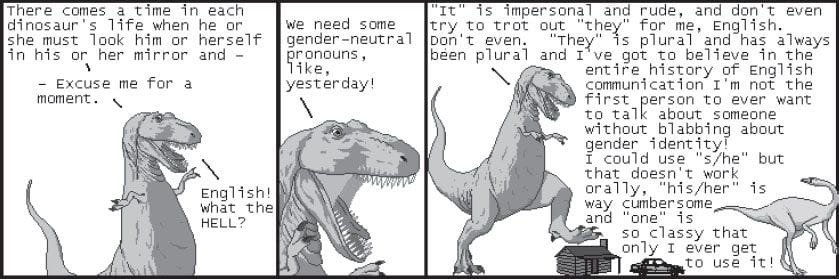
But in a subsequent panel in this strip, the talking dinosaur equivocates, first worrying that “invented pronouns always sound strange,” and then reversing himself and wondering whether he should learn to like There comes a time when thon must look thonself in the mirror.
Let’s try to sort this out. To begin with, T-Rex is right and the purists are wrong: English has no gender-neutral pronoun. At least in grammar, the masculine does not embrace the feminine. Experiments have shown that when people read the word he they are likely to assume that the writer intended to refer to a male.49 But the experiments hardly needed to be run, because it’s a brute fact of English grammar that he is a masculine and not a common-gender pronoun. If you don’t believe it, just read these sentences:50
Is it your brother or your sister who can hold his breath for four minutes?
The average American needs the small routines of getting ready for work. As he shaves or pulls on his pantyhose, he is easing himself by small stages into the demands of the day.
She and Louis had a game—who could find the ugliest photograph of himself.
I support the liberty of every father or mother to educate his children as he desires.
Do you still think that he is gender-neutral? It’s hard to disagree with T-Rex’s accusation that there is a bug in the English language. It would seem that a writer who wants to embrace both sexes in a quantified sentence must either make an error in number by writing No American should be under a cloud of suspicion because of what they look like or make an error in gender by writing No American should be under a cloud of suspicion because of what he looks like. And as the dinosaur explained, other solutions—it, one, he or she, s/he, his/her, novel pronouns like thon—have problems as well.
One theoretical possibility is no longer an actual possibility: blow off concerns with gender inclusiveness, use masculine terms, and let the reader read between the lines and infer that women are included, too. No major publication today will allow this “sexist usage,” nor should they. Quite aside from the moral principle that half of humanity should not be excluded from generic statements about the species, we now know that the major objections to nonsexist language that were first voiced forty years ago have been refuted. Not only have the grace and expressiveness of the English language survived the substitution of gender-neutral terms for masculine ones (humanity for man, firefighter for fireman, chair for chairman, and so on), but the generation of readers that has grown up with the new norms has turned the traditionalists’ startle reaction on its head. Today it is sexist usage that stops readers in their tracks and distracts them from the writer’s message.51 It’s hard, for example, not to cringe when reading this sentence from a famous 1967 article by a Nobel laureate: “In the good society a man should be free … of other men’s limitations on his beliefs and actions.”52
This brings us back to the solution of singular they. The first thing to realize about the usage is that it is not a recent contrivance forced on writers by militant 1970s feminists. Gelernter pines for “Shakespeare’s most perfect phrases” and Jane Austen’s “pure simple English,” but this turns out to be a pratfall of slapstick proportions, because both writers were exuberant users of—you guessed it—singular they. Shakespeare used it at least four times, and in a paper entitled “Everyone Loves Their Jane Austen,” the scholar Henry Churchyard counts eighty-seven instances in her works, of which thirty-seven were in her own voice rather than her characters’ (for example, “Every body began to have their vexation,” from Mansfield Park).53 Chaucer, the King James Bible, Swift, Byron, Thackeray, Wharton, Shaw, and Auden also used the form, as did Robert Burchfield, editor of the Supplement to the Oxford English Dictionary and the most recent edition of Fowler’s Modern English Usage.
A second thing to understand about singular they is that even though it offers a handy solution to the need for a gender-free pronoun, that is not its only or even its primary appeal. Many writers use it even when the gender is unambiguously male or female. George Bernard Shaw, for example, wrote the lines “No man goes to battle to be killed.” “But they do get killed.” Since the dialogue was about men, Shaw had no need to pander to feminism, but he used singular they anyway, because the supposedly correct form with he would have turned the exchange into hash: “No man goes to battle to be killed.” “But he does get killed.” (The same is true for a sentence I used two paragraphs ago: No major publication today will allow this “sexist usage,” nor should they. The alternative nor should it would make it sound as if I had a particular publication in mind and raise the question “Nor should which?”) A contemporary example with an unambiguous female referent comes from a spoken interview with Sean Ono Lennon in which he specified the kind of person he was seeking as a romantic partner: “Any girl who is interested must simply be born female and between the ages of 18 and 45. They must have an IQ above 130 and they must be honest.”54 Once again he did not need they as a gender-neutral pronoun; he had already stipulated the congenital and current sex of his desired mate (nowadays perhaps you have to specify both). But since he was speaking not of an individual female but of the entire pool, they felt right to him. In each of these cases they takes part in a kind of notional agreement. No man and any girl are grammatically singular but psychologically plural: they pertain to classes with many individuals. The mismatch is similar to the one we saw in examples like None are coming and Are any of them coming?
Indeed, “singular they” is a misnomer. In these constructions, they is not being used as a singular pronoun being wrenched into agreement with a singular antecedent like each dinosaur, everyone, no American, the average American, or any girl. Remember when we tried to sort descriptions of objects into piles for “one” and “more than one”? We discovered that the very idea of the numerosity of a quantified expression like nothing or each object is obscure. Does no American refer to one American or to many Americans? Whom knows? 0 ≠ 1, but then 0 ≯ 1 either. This indeterminism forces us to realize that the word they in the sentences we have been considering does not have the usual semantics of a pronoun and an antecedent, as it does in The musicians are here and they expect to be fed. Rather, the pronoun they is functioning as a bound variable: a symbol that keeps track of an individual across multiple descriptions of that individual. So-called singular they really means “x” in an expression like “For all x, if x is an American, then x should not be under a cloud of suspicion because of x’s appearance,” or “For all x, if Sean Ono Lennon considers marrying x, then x is born female & x has an IQ above 130 & x is honest.”55
So singular they has history and logic behind it. Experiments that measure readers’ comprehension times to the thousandth of a second have shown that singular they causes little or no delay, but generic he slows them down a lot.56\ Even T-Rex, in a subsequent Dinosaur Comics strip, conceded that his purism was mistaken: